
New US security agreement requires Greenland to remain in NATO if it becomes independent
The deal preserves the 1951 framework while expanding Washington’s military access to the Arctic island
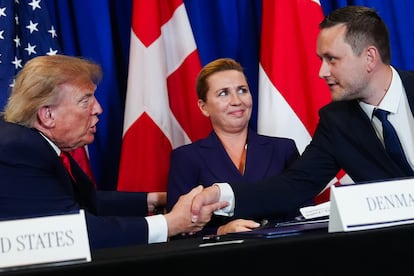
Seventy-five years after the 1951 defense agreement, the new security pact commits Greenland to remaining in NATO even if it one day gains independence from Denmark. The agreement, signed on September 22 by the United States, Denmark and Greenland, has no end date and requires any future Greenlandic state to remain within the Atlantic Alliance. It also allows U.S. vessels to operate underwater and, unless all three parties agree otherwise, bars military bases belonging to non-NATO countries as well as sensitive investments from countries that are neither NATO members nor partners, or members of the European Union.
The agreement follows the crisis triggered by U.S. President Donald Trump at the start of his second term. During his first presidency, in 2019, Trump floated the idea of purchasing the island. On December 23, 2024, before returning to the White House, he described ownership and control of Greenland as an “absolute necessity” and later refused to rule out the use of force to achieve it. After months of tension, the three governments agreed on January 14, at a meeting in the White House, to establish a high-level working group for negotiations. Trump, Danish Prime Minister Mette Frederiksen and Greenlandic Prime Minister Jens-Frederik Nielsen signed the agreement on the sidelines of the U.N. General Assembly.
Aside from those changes, much of the existing framework remains the same. The new text does not replace the agreement from the 1950s, which governs the U.S. military presence on the island, but rather amends and expands it. Washington will be free to move between its bases by land, sea and air, but it will not be able to decide unilaterally where and how to establish new ones.
Under the 1951 agreement, the United States maintained 17 installations and 10,000 personnel on the island during the Cold War. Today, it retains only the former Thule base at Pituffik, staffed by around 150 troops. “Old wine in a new bottle,” is how Jacob Funk Kirkegaard, a researcher at the Peterson Institute for International Economics in Washington, summed it up in a recent analysis.
What does change is the duration: the agreement is open-ended and can be amended only by mutual consent. Marc Jacobsen, a professor at the Royal Danish Defence College, says by telephone that this is “a significant difference,” although the agreement remains “closely tied to the existence of NATO.” What it does not clarify, he notes, is what would happen if the North Atlantic Treaty were ever to cease to apply. The 1951 agreement also had no end date, but it was explicitly linked to the continued validity of that treaty.
The clause on independence has no precedent. If Greenland were to become independent, Denmark and Greenland would be required to ensure that the new state remains within NATO, applying for membership if necessary, and assumes Denmark’s rights and obligations under the alliance.
Experts, however, disagree on the extent of its implications. Kirkegaard argues that it limits the options available to a future Greenlandic state and, paradoxically, strengthens its ties to Copenhagen. Sharon Hudson-Dean, a researcher at the Center for European Policy Analysis (CEPA) in Washington and deputy assistant secretary of state for Europe and Eurasia from 2024 to 2025, sees it instead as an arrangement that benefits both Washington and Nuuk. As she explained in an email to EL PAÍS, Trump obtains what he has sought for the past seven years: anchoring the island’s defense within NATO, an alliance that the United States “effectively leads.” Greenland, meanwhile, gains explicit recognition of its right to self-determination.
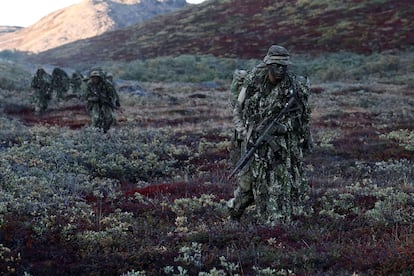
Military access is expanded. As under the 1951 agreement, the United States will be able to move between its defense areas, and its aircraft will be permitted to fly over and land anywhere on the island. The key innovation is underwater access. U.S. vessels will be allowed to operate in Greenland’s territorial waters “without restriction except as mutually agreed upon by the parties,” according to the agreement. Under the 1951 framework, such freedom was subject to rules imposed by the Danish authorities. The new provision no longer mentions those restrictions, although it requires respect for Greenlandic ways of life, including hunting and fishing.
For Hudson‑Dean, the agreement “changes the default situation.” The scope of that freedom of movement will be reviewed regularly by the Permanent Committee, the body through which the three governments have coordinated the U.S. military presence on the island since 1991. For that reason, she argues in an email that much will depend on the practical limits the committee ultimately establishes.
As for military bases, in addition to expanding the facility at Pituffik, the agreement envisions an additional defense area covering Narsarsuaq and Mestersvig, with the details to be negotiated at a later date. Narsarsuaq, in southern Greenland, hosted a U.S. base between 1941 and 1958. Mestersvig, on the island’s eastern coast, has never had a U.S. military installation. Any of the parties may propose new defense areas. If the Permanent Committee fails to reach agreement within 90 days, negotiations are elevated first to deputy ministers and then to ministers. According to Hudson-Dean, this gives the United States the right to propose new defense areas, but not to establish them unilaterally.
Hudson-Dean warns that the U.S. defense budget does not set aside funding for new investments in Greenland beyond upgrades to Pituffik. Narsarsuaq and Mestersvig are very small outposts that will require substantial investment because of the Arctic climate. How much the United States and Denmark ultimately spend on them will be, she adds, “a key factor” in determining the agreement’s success. Rebecca Pincus, from the Foreign Policy Research Institute (FPRI), likewise notes in an analysis that the Pentagon’s 2027 budget request makes no mention of either the Arctic or Greenland.
Third countries are effectively shut out. No state outside NATO will be allowed to maintain military installations, whether staffed or unstaffed, or a permanent military presence on the island without the consent of all three parties, a restriction that was not explicitly included in the 1951 agreement. Although neither Russia nor China is mentioned by name, the pact codifies measures that had already been used to curb, among other things, Chinese involvement in strategic sectors.
There is an additional economic filter. Investors from countries that are neither NATO members, NATO partners nor members of the European Union will be barred from controlling or exerting significant influence over sensitive sectors, such as critical infrastructure and natural-resource extraction, unless the parties agree otherwise. Greenland will enforce these provisions through its own legislation, something that, according to Hudson-Dean, will require “serious work” to develop the necessary procedures and expertise.
Javier Arnaut, a professor of economics at the University of Greenland, Ilisimatusarfik, explains by phone that this caveat reduces dependence on China for resources like rare earths. But “that does not mean greater autonomy is being won,” he clarifies. And, in his view, it also limits Greenland’s ability to diversify its economy with other partners.
Greenland’s role has also changed. In 1941, with Denmark occupied by Germany, the Danish envoy in Washington, Henrik Kauffmann, opened the island to U.S. military bases without authorization from his government. In 1951, Greenland was still a colony and took no part in the negotiations. In 2004, at Igaliku, its self-governing administration signed an amendment to the agreement for the first time.
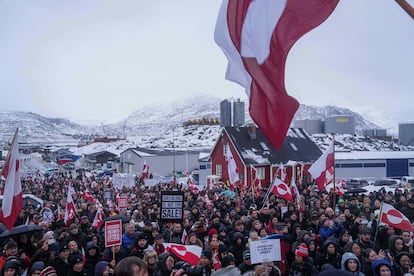
The new text explicitly recognizes Greenland’s right to self-determination and states that the United States will hire Greenlandic companies “to the maximum extent possible.” Sara Olsvig, a researcher at the University of Greenland, told public broadcaster KNR that the island gains greater influence over defense and security matters, even though those areas are not formally under its jurisdiction.
Trump presents the agreement differently. According to the U.S. president, it gives the United States “permanent control over security” in Greenland and ensures that no adversary will be able to establish a presence or invest there without written U.S. approval. The text itself, however, requires the consent of all three parties and leaves investment oversight in Greenland’s hands, in coordination with Denmark and in consultation with the United States. Arnaut summed up the prevailing sentiment in Greenland this way: “At least they’re leaving us alone now.”
The agreement has not yet entered into force. It still requires approval from both the Danish and Greenlandic parliaments, and neither has set a date for a vote. Hudson-Dean sees “genuine political will” in both countries to ratify it as quickly as possible, but notes that Greenland’s parliament typically meets only twice a year. Its autumn session is split into two periods: the first ends on November 19, and the second begins on January 29. In Washington, no vote will be required. Because the pact is an amendment to the 1951 agreement, it does not need congressional approval, sparing it from debate during the U.S. midterm election campaign.
In Nuuk, Prime Minister Jens-Frederik Nielsen’s governing coalition holds 19 of the parliament’s 31 seats. Naleraq, the pro-independence party and the largest opposition force with eight seats, welcomed the inclusion of some of its proposals in the agreement. But one of its lawmakers, Juno Berthelsen, told local media that the deal represented a missed opportunity. His party had hoped that an independent Greenland would negotiate directly with the United States as a NATO member in its own right.
Sign up for our weekly newsletter to get more English-language news coverage from EL PAÍS USA Edition









































