
Trump administration confirms use of punishment cages at Alligator Alcatraz
An investigation by the DHS Office of Inspector General found that dozens of migrants were confined in metal containers
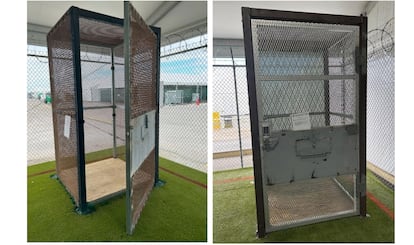

A report from the Department of Homeland Security (DHS) under the Donald Trump administration found that dozens of migrants held at the Alligator Alcatraz detention center in the Everglades were confined in small metal cages, which were referred to as “calming areas,” some for nearly two hours.
The center, which closed in June, had repeatedly been cited by human rights groups for poor conditions and abusive treatment amounting to torture, including leaving people as punishment in an outdoor cage that guards called “the box.” Amnesty International documented cases last year in which some people spent hours handcuffed with their feet fastened to the ground inside a structure in the facility’s yard, where they could not sit or shift position while exposed to the heat, sun, and insects. One interviewee said “people were put in the box just for asking the guards for something,” and that one person had spent “an entire day” there.
The new report, published Monday by the Office of Inspector General (OIG), the independent body that oversees DHS, confirmed and published photos of the metal structures measuring “approximately 1.30 meters by 1.30 meters and 2.36 meters high” — barely larger than a phone booth — covered in a small-square mesh.
The OIG obtained the information in January during an unannounced inspection when about 1,500 people were detained at the site. According to the report, authorities failed to meet detention standards for medical care, food, and detainee hygiene.
People detained for immigration reasons do not face criminal charges but an administrative process. More than 70% of detained migrants have not committed crimes, according to independent records.
The OIG report says center staff referred to the metal enclosures as “calming areas,” and that about 79 people were confined in those structures from the facility’s opening in July 2025 until the January visit.
The OIG warned in the report that “the use of these small metal enclosures for any purpose is unprecedented among the detention facilities” it has inspected and “poses significant risks to the health and safety of detainees.”
“The use of such restrictive spaces is highly unconventional and does not align with standards for humane treatment,” the OIG said, recommending that their use be suspended.
A DHS spokesperson responded to a request for comment from EL PAÍS on the report, saying that “Alligator Alcatraz complied with the same federal detention standards applied by previous administrations, including those of Biden and Obama. All detainee facilities are clean, and any allegation of inhumane conditions or excessive use of force is false.”
The spokesperson also said that “the DHS Office of Inspector General indicated that all recommendations have been administratively closed,” and referred questions to the Florida state authorities, “as the facility was operated by the State of Florida through the Division of Emergency Management.”
Governor Ron DeSantis’s communications director, Alex Lanfranconi, told EL PAÍS: “At least 10 million illegal immigrants entered our country during the Biden administration. Florida decided to do something about it. Left-wing media want to focus on one confinement area for violent criminal immigrants who have shown they cannot remain peaceful while awaiting deportation. Although it meets all federal standards for the confinement of detained persons, we would make it even smaller if we could.”
The Florida Division of Emergency Management did not respond to a request for comment for this report.
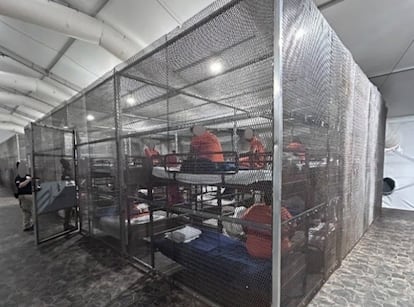
The State of Florida erected Alligator Alcatraz in about eight days at the end of June 2025 to support the Trump administration’s anti-immigrant push. The structure consisted of canvas tents, restrooms and portable generators in the Everglades wetlands on an old airstrip that was part of a 1960s megaproject halted after legal battles with environmental groups. Inside the facility, cells were a kind of metal cage six meters by six meters with three aluminum toilets and bunk beds for 32 people.
The question of who was responsible for Alligator Alcatraz was present from the outset. The State of Florida built the facility and operated it through the Division of Emergency Management (FDEM), using guards and private contractors, but detainees were held in ICE custody.
Florida authorities presented the center as the crown jewel that would solve “once and for all the problem of illegal immigration,” and Trump made a supportive visit for its inauguration in early July 2025, touring the facility with then-DHS secretary Kristi Noem and DeSantis.
Florida paid for construction and operation of the center with emergency hurricane and disaster funds, under a promise of $600 million in federal reimbursement, of which it has received only about $58 million. Operational costs exceeded $1 million per day, well above projections.

The remote site was shrouded in secrecy from the start, with complaints about poor food, lack of hygiene, and abusive treatment, and when some lawmakers tried to visit the facility, they were turned away.
The center faced several lawsuits, including from environmental groups and the Miccosukee Tribe, which argued the state violated federal laws. Civil rights organizations sued over detainees’ lack of access to lawyers and the justice system.
Former detainees have said they suffered inhumane conditions and degrading treatment by guards, and civil rights groups have called for an investigation that would treat the site as a “crime scene.”
Sign up for our weekly newsletter to get more English-language news coverage from EL PAÍS USA Edition









































