The ‘Borges protein’ reveals how to alleviate age-related memory loss
A monumental study involving millions of fruit flies shows that the same type of proteins associated with neurodegenerative diseases are involved in forming memories, and points to how to protect them in old age
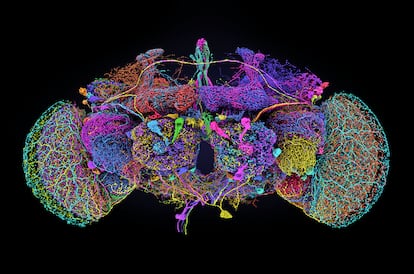

Our brain reaches its peak capacity before the age of 30. After that, some abilities begin to decline, albeit very slowly. The capacity to recall sequences of numbers, for example, is only slightly worse in healthy 60-year-olds than in people in their early twenties. Much more is known about how memories are created and maintained than about how they are lost. Memory decline is usually attributed to the fact that the brain shrinks with age and gradually loses connections between neurons. Yet from a biochemical and molecular perspective, exactly how and why we lose our memory over the years remains a major mystery.
In January, a team of researchers discovered a protein related to long-term memory and its maintenance. They named it Funes, after the story in which Argentine writer Jorge Luis Borges imagined Funes the Memorious, a young man who, after an accident, acquires a photographic memory of everything he saw or felt in life. “I, myself, alone, have more memories than all mankind since the world began,” Funes said, unable to forget anything.
The Funes protein is closely related to another large class of proteins, amyloids, which are normally associated with degenerative diseases such as Alzheimer’s or Parkinson’s. In the study published in January, the scientists described the first atomic-level structure of Orb2, an amyloid protein that plays a beneficial and essential role in forming and maintaining memories. Since then, several amyloids of this kind have been identified. Unlike the amyloids associated with dementia, they do not accumulate in the brain as harmful plaques. Instead, they are soluble and help create and preserve memories.
Now, a new study has shown that the Funes protein can restore memory in old age, and that an opposing version of the same molecule impairs memory in young individuals.

The work was done in fruit flies, and it was a monumental undertaking. The researchers spent six years studying the tiny brains of 10 million fruit flies at eight stages of their lives, from the first day after hatching to 35 days of age, the equivalent of old age in humans. The authors know of no other work of similar scale in this field.
The study, published in Cell, suggests that memory loss may be related to a progressive transition of amyloid proteins from their functional, benign form to a more rigid, harmful state.
The Funes protein belongs to a large group known as chaperones, which help fold proteins and give them their three-dimensional shape, a process that is essential to determining their function. A properly folded protein is a highly efficient molecular machine, whereas a misfolded one can trigger serious health problems, even death, as in prion diseases such as mad cow disease.
When researchers increased production of the Funes protein in aged flies, they saw the amyloids revert to more rejuvenated states, and memory improved. Conversely, when they increased production of another chaperone with opposite functions — CG6693 — they observed that even young flies accumulated misfolded amyloids and had worse memory.
“It is tempting to describe this as a transformation of the protein toward a state more similar to disease, and there is some truth in that,” says Rubén Hervás, the Spanish biochemist who led the study and has spent about 20 years exploring beneficial amyloid proteins.
Hervás, who heads his own research group at the University of Hong Kong, collaborated on the project with the team led by Javier Oroz at the Blas Cabrera Institute of Physical Chemistry of Spain’s National Research Council (CSIC).
Hervás believes this work, which required an immense effort to breed millions of flies and analyze their brains at atomic resolution, “uncovers a new mechanism that may explain part of why memory is lost with age.”
For now, it offers a possible explanation for the normal memory lapses that emerge naturally in later life. Hervás notes that, by examining not just a snapshot of what happens in fly brains but the entire process across the lifespan, researchers were able to observe how “the machinery of memory is silently remodelled until it adopts a form that functions less effectively.”
The beneficial amyloid proteins studied in flies, Orb2, have equivalents in humans, including CPEB3. “If what we found in flies is conserved in humans — that is, if CPEB3 undergoes structural changes during aging similar to those of Orb2 and certain chaperones can reverse them — in principle drugs could be developed to maintain or restore CPEB3 to more functional states, associated with more efficient synaptic translation [neural connections] and better memory,” Hervás reasons.
The scientist has received a €1 million ($1.12 million) grant from the Hong Kong government to determine whether what they have just discovered in flies also occurs in humans.
José Javier Lucas, a researcher at the Severo Ochoa Molecular Biology Centre (CBM-CSIC) who was not involved in the study, highlights its significance. “Something like this could be part of the explanation for something previously unknown: the molecular keys to the memory loss everyone experiences with age,” he says.
According to Lucas, one of the greatest achievements of Hervás and his collaborators was demonstrating the existence of “physiological” amyloids that perform beneficial functions in the body, despite having a structure traditionally associated with Alzheimer’s disease simply because the first amyloid ever discovered was linked to that condition.
Lucas believes the study represents “a complete paradigm shift in biology.” “Amyloids regulate many physiological functions in the body, not just in the brain and memory, and it is possible that this gradual loss of functionality explains many age-associated problems,” he says. “It is not far-fetched to think that something like this could occur in a human, but we still have to demonstrate it.”
Sign up for our weekly newsletter to get more English-language news coverage from EL PAÍS USA Edition