
The ordeal of Miami’s migrant mega-hearings: ‘If I don’t make it, they’ll issue a deportation order’
Many migrants now arrive before sunrise for fear of missing a hearing that could determine whether they remain in the United States

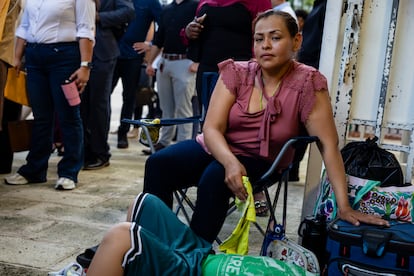
Roxana Valladares was at Homestead Hospital, southwest of Miami, with her six-year-old son when she started packing in the middle of the night. She grabbed a blanket, a change of clothes for the boy and a folding beach chair. She packed water and snacks into a cooler and called an Uber. By 4 a.m., she was outside the immigration court in downtown Miami, hoping to secure a good spot in line and make it into her hearing shortly after noon.
To her surprise, people were already waiting. She ended up third in line for the 1 p.m. hearing. She spread the blanket on the sidewalk and laid down her son, who had been running a fever and struggling to breathe and was still feeling unwell.
“They told me that if I don’t make it [to the hearing], they’ll issue a deportation order,” says Valladares, a 29-year-old Salvadoran woman, shortly after dawn as she fans her son with a handkerchief as he sleeps amid the growing crowd gathered outside the immigration court building by the Miami River.
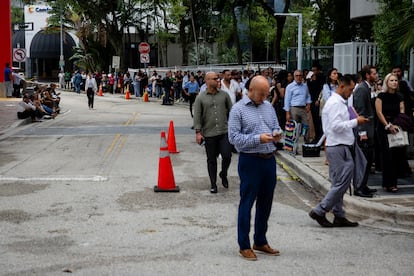
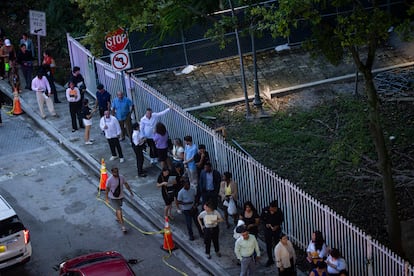
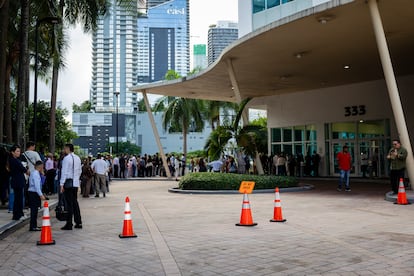
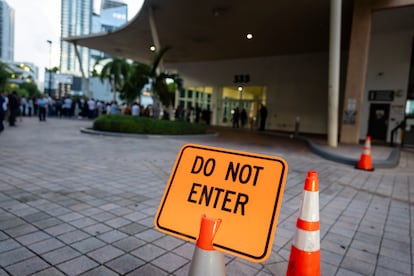
Since last month, when the courts began scheduling groups of 100 or more people at a time in so-called mega master hearings, the lines outside the building have stretched around the parking lot and underneath the Metromover station — the automated train in that area —all the way to the sidewalk on Southeast 3rd Street, nearly reaching the ramp of a neighboring hotel.
This week, the Miami immigration court restricted the use of the virtual hearing system, called Webex, and began requiring immigrants to appear in person. “It wasn’t like this before. You’d arrive, stand in a normal line, maybe wait half an hour or 40 minutes, but it never took more than an hour,” says immigration attorney Estefanía Echeverry, who had appeared in court that morning with clients. “Nowadays you can be out there for up to two hours exposed to the elements.”
Even inside the building, courtrooms hold at most about 20 people. “There are a lot of people waiting for their turn; they have to wait outside,” Echeverry adds. “People have to arrive hours in advance to make sure they can get into the courtroom. If the person doesn’t make it to court on time, they’re given a deportation order.”
Echeverry goes to immigration court three or four times a week. She explains that judges used to hear the cases of migrants with attorneys in the courtroom first, then those joining via Webex, and finally the migrants without legal representation. On some occasions, her clients have been stuck in the line outside, and she has had to tell the judge at the scheduled hearing time that they were still trying to get into the building.
The Donald Trump administration says it is trying to speed up immigration court proceedings in order to reduce a years-long backlog that now exceeds 3.1 million cases. More than 2.2 million of those cases are asylum applications that are still awaiting a decision, according to independent organizations that track court records. Miami-Dade County has the largest number of pending deportation cases in the country, according to court data compiled by TRAC, the nonpartisan research center founded at Syracuse University.
The mega hearings have created confusion among migrants, and some have received new court dates with little advance notice. Valladares, for example, had originally been scheduled to appear in September 2027, but last week she received a notice ordering her to appear last Wednesday instead.
The mother says she arrived at the U.S.-Mexico border two years ago and applied for asylum after fleeing domestic violence and fearing for her life and that of her son.
Deportation orders in absentia rise
Civil rights advocates warn that the new system increases the likelihood that people who fail to appear on time will receive removal orders. In recent months, in absentia deportation orders have surged nationwide, peaking at 56,523 in June — a 60% increase over previous months, according to an analysis by data platform bklg.org. In Miami, the number of orders rose from 1,383 in May to 2,886 in July, an increase of 108%. The average lead time between scheduling a hearing and the court date itself has fallen from about 200 days to less than two months.
The Department of Homeland Security (DHS) told EL PAÍS in response to an inquiry that “any foreign national in an irregular immigration status who has a final order of removal has been afforded all due process protections.” It added that it is “working rapidly and around the clock to transfer these individuals from detention facilities to their final destination: their countries of origin.”
The DHS referred questions about the courts to the Department of Justice (DOJ). A DOJ spokesperson said that “reducing the backlog in immigration courts remains one of this administration’s top priorities.”
Immigration courts operate under the Executive Office for Immigration Review (EOIR), an agency within the Department of Justice that reports to the attorney general. The EOIR told EL PAÍS it is making “scheduling adjustments” to speed up stalled cases.
According to DOJ, although hearings are scheduled “for large groups,” “each case is handled individually and due process is ensured.” “For an in absentia deportation order to be issued, the immigration judge must determine that the individual received proper notice and that the Department of Homeland Security has shown the person is removable,” the agency said in an email to EL PAÍS.
The move to require in-person appearances comes after months of anxiety among immigrants with cases before the courts. For much of that time, Immigration and Customs Enforcement (ICE) agents, often masked, were known to patrol courthouse hallways, waiting for people to emerge from hearings so they could be arrested. In June, a federal judge put a stop to those operations.
William Botsch, a volunteer with the American Friends Service Committee who has been observing hearings in Miami since last year, says that since officers stopped patrolling the courthouse hallways, government prosecutors have stopped asking judges to dismiss cases, except in exceptional circumstances.
Many immigrants with scheduled hearings had sought ways to appear remotely. “The opportunity to appear online was very helpful,” says Echeverry. “These situations cause a huge amount of distress and anxiety because people have to appear in court. Being online eased some of that fear that something might happen to them, because people are still very afraid of being arrested.”
Valladares spent much of the day at the courthouse, but the judge called her case a little earlier than expected. He told her that the date of her next hearing would be sent by mail.
Sign up for our weekly newsletter to get more English-language news coverage from EL PAÍS USA Edition









































