
Mexico investigates electricity theft after busting a crypto mining farm
Mexican authorities are searching for similar operations after dismantling a facility equipped with 300 computers dedicated to producing cryptocurrencies
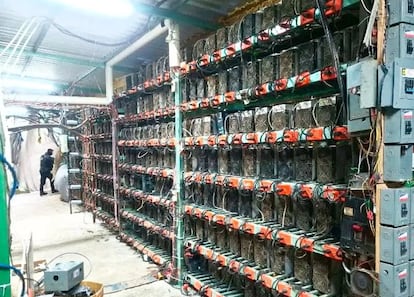

The discovery of a clandestine cryptocurrency mining farm in a remote area of Puebla has opened a new line of inquiry into large-scale electricity theft in Mexico. Puebla’s Public Security Secretariat said the main crime under investigation is energy theft and that authorities will expand their inquiries to neighboring municipalities in search of similar facilities. The announcement follows the dismantling of an operation consisting of some 300 computers used to mine digital assets that had been illegally connected to a dam forming part of a federal hydroelectric complex.
Francisco Sánchez, head of the state agency, said Monday that the mining farm was located in the municipality of Tlaola, in the northern highlands of Puebla, a small community of around 20,000 residents.
“This activity consumes a great deal of energy and generates a lot of noise, which is why operators seek out isolated and very remote locations. That is what alerted us,” he told reporters. “We had been tracking reports that this activity was taking place in that part of the state, particularly because of its proximity to the [Nuevo Necaxa] dam. There was a very large power connection.”
The official added that Mexico’s Federal Electricity Commission (CFE) is participating in the investigation, alongside Mexico’s Attorney General’s Office (FGR) and the Navy. “The crime is electricity theft. This illegal activity is also taking place in neighboring states,” he said, without specifying which ones.
Cryptocurrency mining, a process that uses computer equipment to solve complex mathematical operations in order to validate transactions and earn rewards in digital assets, is not prohibited in Mexico. What is illegal, however, is the theft of electricity, commonly known as huachicoleo of energy.
The investigation comes as the CFE steps up enforcement efforts to combat losses from power theft. Between January and July 2024, the latest period for which figures from CFE Distribución are available on non-technical losses, authorities recorded 6,346 GWh in losses linked to electricity theft, meter tampering and illegal connections, with an estimated commercial value of 13.8 billion pesos (about $817 million).
During the operation, authorities seized a large-scale electrical and technological infrastructure that included transformers, medium-voltage terminals, 300 specialized computing units (GPUs), and functioning satellite internet antennas.
Investigators have not ruled out money laundering as a possible motive. “Authorities are analyzing whether virtual assets generated by this infrastructure could have been used to give an appearance of legality to funds related to illicit activities,” the Puebla state government said on Sunday.
The operation comes amid increased scrutiny of cryptocurrencies as a tool for laundering proceeds of organized crime. Virtual currencies are increasingly being used to move funds quickly, discreetly and at relatively low cost across financial systems and national borders. In 2025, local and federal authorities dismantled three other cryptocurrency mining operations detected between Puebla and Tlaxcala.
According to SILIKN Intelligence, the research arm of the Mexican cybersecurity firm SILIKN, the use of cryptoassets for money laundering rose by at least 55.8% in 2025, particularly through currencies such as Bitcoin, Monero and Tether (USDT). The unit says criminal organizations including the Sinaloa Cartel and the Jalisco New Generation Cartel (CJNG) have used cryptocurrencies to transfer funds and purchase supplies, taking advantage of the speed and relative anonymity they offer.
Sign up for our weekly newsletter to get more English-language news coverage from EL PAÍS USA Edition









































