
New Yorkers born after 9/11: ‘I know it was tragic, but I don’t have many more details’
The country faces the challenge of passing the memory to the first generation with no recollection of the worst attacks in US history. Around 100 million Americans were not yet alive on the day the Twin Towers were attacked
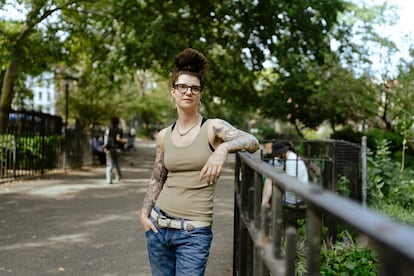

“What were you doing when the planes crashed into the Twin Towers?” It is a question that has marked several generations. Almost everyone who was old enough in 2001 remembers the moment they were glued to the television watching images they would never forget. Now, for the first time, there is an entire generation of around 100 million Americans with no memory at all of that day, simply because they had not yet been born on September 11, 2001. The United States now faces the challenge of passing on the memory to people who cannot draw on personal experience but must rely on what their parents or teachers tell them.
When you go out into the streets of New York and ask young people, the first impression is that many details of the story are being lost. The informal survey has no sociological weight, but it is interesting to hear the opinions of young men and women up to 25 years old who live in the city that bore the brunt of the attacks.
One early conclusion is that it is a mistake to generalize. The knowledge gap between individuals is enormous: one young man believes the terrorists’ planes crashed into the Empire State Building, while another one can list the details of how the 19 jihadists organized the hijacking of four planes (two in New York, the one that struck the Pentagon, and the one that crashed in Pennsylvania). Most answers, however, are very general. Only one of the six people interviewed could name Osama Bin Laden.
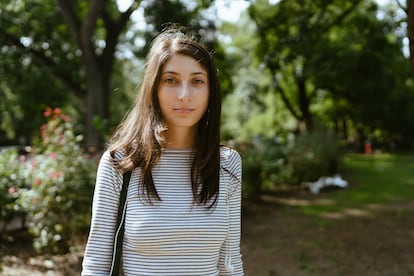
“I know it was something tragic and that there are many conspiracy theories. But to tell you the truth, I’m not sure who did it,” says Josephine Stenquist, 21, a fashion business student. Another common trait: they may not be clear about exactly what happened, but they sense that their lives today would be different if those events they have heard about in their homes or at school had not taken place. The New York Post reported on Sunday on a study in which two-thirds of Middle East studies professors say college students cannot identify who or why the United States was attacked on 9/11.
$75 million to raise awareness
In New York schools, students study the history of the attacks over three school years. The City will allocate $1 million to expand the educational programming at the September 11 Memorial & Museum, offering free visits for 20,000 students. In addition, the museum launched a campaign in June to raise $75 million to increase awareness among young people. Former mayor Michael Bloomberg has already given $25 million. Despite these efforts, there are huge differences in what some young people know compared with others.
Lucia Zadroga is the only one interviewed for this story who was alive on 9/11. She had been born six months earlier. The brutal attack affected the first months of her life. Until then she had lived in the East Village, in lower Manhattan, not far from where Mohamed Atta and his accomplices crashed the two planes. Worried about the effects that airborne dust might have on a newborn, her parents decided to move to upstate New York. Zadroga says the neighborhood stigmatized her family for leaving the city at its darkest hour. She remembers hearing about the attacks from a very young age, with stories such as the one about the brother of one of her parents’ friends who died in the towers, or a priest close to her family who got involved in the rescue efforts.
Perhaps because she lived close to the attack site, her memory focuses more on the consequences for neighbors than on the attacks themselves. “I feel there were many things that were not talked about then that probably would have helped the families. There was no talk about contamination and the terrible air quality. There are cancer cases affecting many people who lived nearby,” she says.
This young woman is absolutely right. This Tuesday, New York Mayor Zohran Mamdani declassified 170,000 pages of documents showing how city authorities concealed the harmful health effects suffered by those near Ground Zero. “Now, close to 25 years later, more people have died from 9/11-related illnesses than were killed on the day itself,” the mayor said.
Dafry, 21, who lives in the Bronx, seems more confused. He admits he does not know much about what happened then—only that someone hijacked planes and crashed them, but he is not sure into what. “It was against the Empire State Building, right?” he asks. When told it was actually the Twin Towers, he replies that he had heard something but wasn’t sure. “Sorry, I’m a bit disconnected,” he apologizes. He does know, however, that the attacks changed many things, especially airport security. “It’s crazy. It happened 25 years ago and people still get emotional and keep talking about it,” he concludes.
School is the medium through which knowledge of 9/11 is most often transmitted. According to a Pew Research Center survey, 60% of people aged 18 to 24 learned about the attacks in class. Other methods are much less common: 16% say they learned from family or friends and 8% from reading or seeing something on their own.
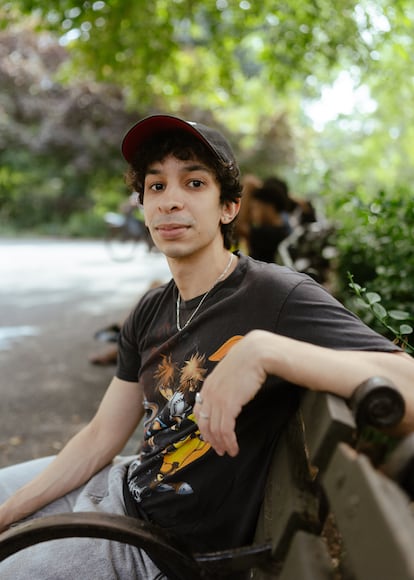
Tarek Elbali, who has just started working as an engineer, was born in New York 23 years ago to an Egyptian father and a Moroccan mother. He is much clearer about what happened. “It was a terrorist attack organized by a radical Islamist group, I think from Afghanistan,” he says. He hesitates, however, when trying to recall words like Al Qaeda or Bin Laden.
But what he most remembers about the attacks is the wave of Islamophobia that followed and its effect on his family: “My father arrived in the United States shortly after 9/11. He made a living however he could, doing whatever work was available. He suffered prejudice because of his origins. At his job they told him not to speak Arabic in public, that he wasn’t welcome. Then the situation gradually normalized,” he recalls.
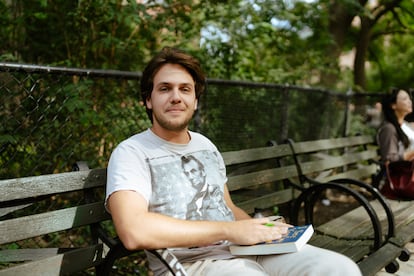
Boaz Segal, 24, who was born in Israel and moved with his family to New Jersey when he was two, has a very different perspective. He is one of the few who, when asked how things have changed in the last 25 years, goes beyond airport restrictions. “All countries reinforced measures after that. People started taking terrorism much more seriously,” says this dual U.S.-Israeli citizen.
Segal thinks it is a pity that people his age cannot name Al Qaeda or Bin Laden when talking about this attack: “It is something that must never be forgotten, like the Holocaust. There are people who deny the facts, who do not like to look at things as they really are. It is natural not to want to even know that there are people who can commit such an atrocity.”
Sign up for our weekly newsletter to get more English-language news coverage from EL PAÍS USA Edition









































