
Folarin Balogun, the US striker who wouldn’t be American if it were up to Trump
While the nation awaits the Supreme Court’s imminent decision on the future of birthright citizenship, which the president wants to eliminate, the U.S. team’s top scorer at the World Cup can only play for the country thanks to that right
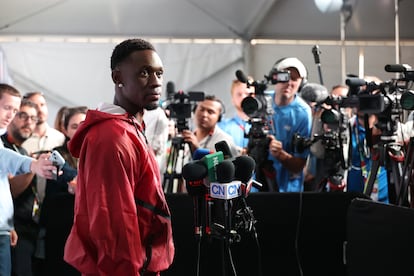

The World Cup in Donald Trump’s United States is full of paradoxes. For the first time, one country, Iran, is playing on the territory of another with which it is at war. The host, which is supposed to open its doors to the world to celebrate football’s biggest global event, is denying entry to officials and fans from nations it considers unwelcome. Contradictions emerge even within its own national team. Folarin Balogun, the United States’ striker and leading scorer, embodies them: while the Supreme Court is expected this week to rule on the future of birthright citizenship that the president wants to eliminate, the U.S. team’s top scorer at the World Cup can only play for the country thanks to that right.
In the multicultural U.S. team—with players of Mexican, Croatian and Liberian descent, among others, reflecting the real composition of American society—Balogun, the son of Nigerian parents, born in the U.S. and raised in the United Kingdom, became the first player to score more than one World Cup goal in a match for the Stars and Stripes since 1930 thanks to a quirk of fate.
In the summer of 2001 his parents traveled to New York, but when they tried to board the return flight to London, where they lived, they were denied boarding because his mother was in an advanced pregnancy. Folarin was born in Brooklyn but never lived in the United States. He grew up in London, came through Arsenal’s academy and played for England’s youth teams. For the past three years, however, the forward whom Monaco signed from the London club in 2023 for more than $45 million has worn the U.S. flag in international matches thanks to the nationality conferred by his place of birth.
The Trump administration has targeted that right—enshrined in the 14th Amendment, which abolished slavery after the Civil War and declared that anyone born on U.S. soil would be considered a citizen—since day one. One of the dozens of executive orders Trump signed on January 20, 2025, sought to end it, but civil-rights groups immediately challenged the move and, over the past year and a half, the case has climbed the judicial ladder all the way to the desks of the Supreme Court’s nine justices. A decision is expected this week that could alter the very foundations of the United States.
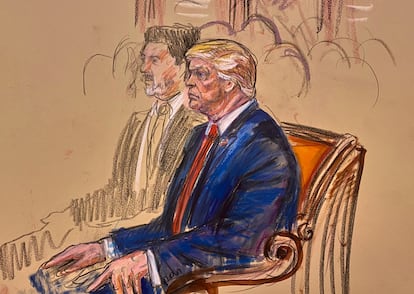
On April 1, before the president—who, in an unprecedented move, attended the oral arguments—the Supreme Court justices, divided 6-3 in a conservative majority that has repeatedly backed Trump’s agenda, though it has also ruled against him in several major cases such as on tariffs, expressed skepticism about the administration’s measure. Alongside the three liberal justices, three conservatives—the court’s influential chief justice, John Roberts, and Justices Brett Kavanaugh and Neil Gorsuch—voiced unambiguous doubts. Their pointed questioning of Solicitor General John Sauer suggested a ruling against the White House’s position. Roberts went so far as to call the administration’s arguments “very peculiar.” But until the court issues its opinion, any outcome remains possible.
The president seeks to prevent U.S. citizenship from being granted to children of undocumented immigrants and temporary visitors. The move could affect more than 250,000 babies a year—or nearly three million children over the next decade—who would be denied U.S. citizenship. In principle the measure would not be applied retroactively, so the team currently coached by Argentine Mauricio Pochettino would not be at risk of losing its striker Balogun. Still, the administration’s aggressive rhetoric and anti-immigration offensive leave open the possibility that abolishing the right might only the start of a broader erosion.
For now, Balogun—who was heavily courted by U.S. soccer shortly before he was set to play in the 2023 Under-21 European Championship with England, which went on to beat Spain— is focused solely on football. After his two goals in the opener against Paraguay, including a left-footed shot into the top corner following a dribble that left a Paraguayan defender on the ground, he hopes to spearhead a United States side aiming for its best World Cup performance in recent history. With two convincing wins already secured, Pochettino’s men are well on their way. Keeping Balogun firing on goal will be essential.
So said Christian Pulisic, the team’s icon: “The kid’s insane. Right now he is lethal in front of goal. We’re really lucky to have him and let’s hope he keeps going like this.” If it were up to Trump, he wouldn’t even be American.
Sign up for our weekly newsletter to get more English-language news coverage from EL PAÍS USA Edition









































