
ICE arrests one of the soldiers linked to Mexico’s Ayotzinapa case in California
The immigration authority reports the arrest of 32‑year‑old Enrique Martínez Chávez, who is wanted in Mexico for the crime of enforced disappearance
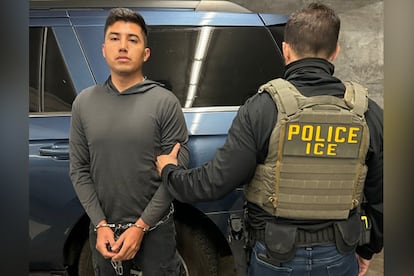

U.S. Immigration and Customs Enforcement (ICE) detained Enrique Martínez Chávez on Wednesday in Los Angeles, California, according to a statement the agency released Thursday on social media. The 32‑year‑old detainee is one of the military officers linked to the disappearance of 43 student teachers in the Mexican municipality of Iguala, Guerrero, in 2014. Martínez Chávez is wanted in Mexico for the alleged crime of enforced disappearance and has been a fugitive from justice for years. ICE says he will remain in its custody “until he can be sent home” to Mexico.
Martínez Chávez was still an active soldier on the night of September 26, 2014, when the disappearance of 43 student teachers in Guerrero ignited outrage across Mexico. The Ayotzinapa case, as the events later came to be known, remains under investigation, shrouded in information gaps and competing theories about what happened. In all of those hypotheses looms the shadow of organized crime — specifically Guerreros Unidos, the group that attacked and allegedly disappeared the students. According to information made public in recent years, before becoming a fugitive, the former soldier belonged to the 27th Infantry Battalion.
Yesterday, ICE LA arrested 32-year-old Enrique Martinez-Chavez in Hawthorne, California. Martinez is wanted in his home country of Mexico for enforced disappearance of persons while a member of the Mexican military. He'll remain in ICE custody until he can be sent home. pic.twitter.com/NVYGfnnkIe
— ICE Los Angeles (@EROLosAngeles) June 4, 2026
In August 2022, a judge granted Mexico’s Attorney General’s Office (FGR) 83 arrest warrants against figures linked to the case. A month later, in September, the FGR canceled at least 21 of them. At the time, EL PAÍS obtained the document in which prosecutors requested the cancellation of the warrants. The name of Enrique Martínez Chávez appears there, in a document listing 16 soldiers accused of organized crime. Among them was also Rafael Hernández Nieto, commander of the 41st Infantry Battalion, based in Iguala at the time of the attack on the students. All of the soldiers named in the document — except Hernández Nieto — were also accused of enforced disappearance.
Documents and sources close to the case revealed a conflict between the FGR and the Special Unit for the Investigation and Litigation of the Ayotzinapa Case (UEILCA), a branch of the agency focused on the events. Sources close to the investigation said the request to cancel those warrants did not originate within the unit.
Twelve years after the events, the Ayotzinapa case remains a sensitive issue in Mexico, and the investigation has yet to answer the central question of what happened that night in 2014. Three months ago, a judge ordered the Defense Ministry to hand over “all” the information gathered in 2014 by the Regional Intelligence Fusion Center (CFRI) in relation to the case. The ruling responded to a lawsuit filed in 2023 by relatives of the missing students, who escalated their demands after military authorities refused to provide the full documentation. It was only one example of the investigation’s slow progress.
Sign up for our weekly newsletter to get more English-language news coverage from EL PAÍS USA Edition









































