
Trump scores a victory in Indiana primaries and demonstrates his control over Republicans
The president gets his revenge on the senators who dared to challenge him by opposing his plan to redraw the state’s congressional map
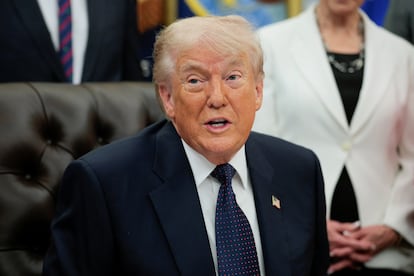

On Tuesday, President Donald Trump secured a victory within his own party, demonstrating once again that those who defy his dictates pay a heavy price. In the Indiana state Senate primary, the president ensured that a majority of his seven candidates (at least five) won. Trump nominated these challengers to exact revenge on the current senators who dared to oppose his proposal to redraw the state’s congressional map. These state elections, which might have gone largely unnoticed, instead became a barometer of support for the president among his voters. And Trump emerged victorious.
“Any Republican that votes against this important redistricting, potentially having an impact on America itself, should be PRIMARIED,” Trump warned on social media in November, referring to two senators as Republicans in name only.
Trump’s redistricting plan would have made it easier for the Republican Party to win Indiana’s two House seats, currently held by Democrats, in the November midterms. The state House approved the new map, but it failed to pass the Senate because some Republican lawmakers joined all the Democratic senators in rejecting the bill. Trump then took revenge by supporting their challengers.
The new importance of the Indiana election drove up advertising spending by the candidates. The campaign cost more than $13 million, mostly paid for by Trump’s allies. In previous elections, spending didn’t even reach $1 million, which gives an idea of what was at stake for the president.
Incumbent senator Travis Holdman, a legislator of 18 years and representative of the Fort Wayne area, attributed his defeat not to his vote against state redistricting in December, but to the more than $1.3 million spent on attack advertising funded by committees organized by Indiana Governor Mike Braun and Senator Jim Banks. “Welcome to Washington, D.C., politics in Indiana, because this means that’s what’s coming,” he said. “I did what my constituents asked me to do and it cost me my job,” he added.
These elections tested whether voters are willing to disregard the president’s wishes and give their elected representatives the leeway to pursue a different course. Trump-aligned groups, such as the Club for Growth and Turning Point, campaigned extensively to mobilize voters loyal to the president. Turning Point co-founder Charlie Kirk, who was murdered in September, had already warned that his group would work to remove incumbents who voted against the new map. The far-right activist was instrumental in mobilizing young voters for the 2024 presidential election.
Ramaswamy, candidate for governor in Ohio
In Ohio, former presidential candidate Vivek Ramaswamy will be the Republican nominee for governor in the November election. The billionaire biotech entrepreneur is a newcomer to state politics and has aggressively positioned himself from the outset, with the help of Trump and the state Republicans. Ramaswamy largely ignored his Republican rival, Casey Putsch, focusing his rallies and television ads on the general election, and he won the primary with 82% of the vote. In the midterms he will face Democratic nominee Amy Acton, former state health director, who ran unopposed in her party’s primary.
In that state, the redistricting approved last fall offers a good opportunity for Republicans to gain a seat in the U.S. House of Representatives in the midterms. The Ninth District, based in Toledo, is currently represented by Democratic Congresswoman Marcy Kaptur. Among those vying for her seat are former state representative Derek Merrin—who lost to Kaptur by less than one percentage point in 2024—state representative Josh Williams, and former deputy director of Immigration and Customs Enforcement (ICE), Madison Sheahan.
No competition was expected in the Senate primaries. Former Democratic Senator Sherrod Brown will face Republican Senator Jon Husted in November. This state offers Democrats one of their best opportunities to flip control of the Senate. Brown, who served as a senator from 2007 to 2015, is a much more well-known name than Husted, who was appointed last year to replace J.D. Vance when the latter moved to Washington, D.C., to become Vice President of the United States.
These primary elections are taking place a week after the Supreme Court ruled in a way that benefits Republicans in the November elections. The conservative-majority Court sided with Trump’s party and ruled against the state of Louisiana for creating a second majority-Black district. The decision changes the interpretation of the Voting Rights Act and opens the door for Republicans to redraw districts where a minority group, such as African-Americans, represents more than 50% of the population and is more likely to support Democrats.
The Supreme Court struck down section 2 of the law, which prevented the design of electoral districts (the practice known as gerrymandering) from discriminating against the voting power of minorities, such as Blacks, Hispanics, Native Americans and Asians.
The primaries held this Tuesday are not the only ones in which Trump could play a dominant role this month. In the Kentucky House of Representatives race, the president is seeking to unseat one of his main conservative opponents, Representative Thomas Massie, whom he has insulted on several occasions. A Senate runoff in Texas will also be significant, a race that Trump has avoided despite Republican leaders’ expectations that he would endorse Senator John Cornyn against Attorney General Ken Paxton.
With six months to go before the November midterm elections, the president’s popularity has plummeted, foreshadowing a poor showing for the Republican Party, which is fighting to retain its majority in Congress. His handling of the war in Iran and the economy have weighed heavily on Trump’s support, according to all polls. The latest poll, conducted by The Washington Post-ABC News-Ypsos, shows that 66% of the population disapproves of his handling of the conflict, and only 34% approve of his economic performance. Gasoline prices have skyrocketed as a result of the attack on Iran, and 76% are dissatisfied with the rising cost of living.
Sign up for our weekly newsletter to get more English-language news coverage from EL PAÍS USA Edition









































