
New report denounces abuses and cruelty at ICE family detention center in Dilley
Human Rights First warns that the detention model used in facilities such as the one in Texas results in psychological harm to minors, medical failures, and violations of due process
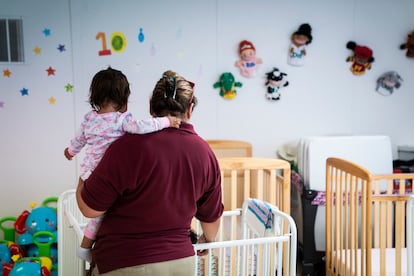

Children speaking of depression, families reporting spoiled food and inadequate medical care, detentions lasting for months: this is the picture painted in a new report on the family detention center in Dilley, Texas. An analysis published by Human Rights First and the organization RAICES concludes that the detention of migrant families in the United States has resulted in a system marked by structural abuses, substandard conditions, and systematic rights violations. The report, titled A New Era of ICE Family Prisons, focuses on operations in Dilley, where this model is currently concentrated.
Based on interviews with dozens of families, legal work, and firsthand documentation, the report argues that practices such as prolonged detention, limited access to legal assistance, and ICE’s use of threats of family separation are part of a widespread pattern, not isolated cases. “Our findings make it clear that there is absolutely no rights-respecting or safe way for DHS to incarcerate families and children,” said Robyn Barnard, director of refugee advocacy at Human Rights First, a nonpartisan human rights organization.
“The systemic neglect, denial of due process, and state-sanctioned harm under the Trump administration constitute a humanitarian crisis for immigrant children and their families,” said Fais Al-Juburi, co-executive director of RAICES (Refugee and Immigrant Center for Education and Legal Services), an organization that advocates for justice for migrants.
The findings align with recent investigations that have documented the human impact of these policies. A ProPublica report, based on interviews with children detained in Dilley, includes testimonies reflecting the emotional distress caused by detention. “Since I got to this center, all I feel is sadness and mostly depression,” said 14-year-old Ariana Velasquez after weeks of detention alongside her mother. Another minor, 13-year-old Gustavo Santiago, expressed the uncertainty shared by many: “I feel like I’ll never get out of here. I just ask that you don’t forget about us.”
EL PAÍS also gathered similar accounts from the center. In a statement to this newspaper, a young woman detained alongside her family summed up the conditions there: “They don’t treat us like human beings.” She described a lack of medical care, difficulties accessing food, and the emotional toll on the children, including episodes of anxiety and constant nightmares.
Complaints about inadequate medical care, spoiled food, and unsanitary conditions also appear in more extensive accounts. A report by The Texas Tribune documented the case of an Egyptian family detained for more than nine months, one of the longest stays recorded in Dilley. “This prolonged detention has and continues to destroy our lives. It is slowly killing us on the inside,” one of the teenage children wrote in a letter to the publication. The family described food with mold and worms, a lack of adequate medical care, and a progressive deterioration of their mental health.
These accounts align with the findings of the Human Rights First report, which identifies structural flaws in the center’s operations. The analysis argues that many families remain in detention beyond the limits set by the Flores Agreement — which generally restricts the detention of minors to about 20 days — and that the government has sought to undermine that legal framework in court.
The document also details systematic obstacles to exercising their right to seek asylum. According to the report, some families face expedited proceedings without adequate access to legal representation or without fully understanding their options, which increases the risk of wrongful deportations. In other cases, it describes direct pressure on them to accept deportation, including warnings regarding possible separation from their children.
Similarly, the report documents recurring complaints about inadequate medical care, delays in treatment, and a lack of follow-up, especially in cases involving minors. These shortcomings, it notes, are not isolated incidents but are consistent with a detention model that prioritizes immigration control over the well-being of families.
Furthermore, the analysis emphasizes the psychological impact of confinement. Uncertainty about the duration of detention, fear of deportation, and environmental conditions contribute, according to the report, to high levels of anxiety, depression, and stress in children. In some cases, researchers documented developmental regressions and behavioral changes associated with prolonged confinement.
Another key point in the report is that a significant proportion of detained families do not fit the profile of “new arrivals” at the border but rather are people who were already living in the United States — some for years — with family networks and ongoing immigration proceedings. This, the report argues, amplifies the impact of detention, as it entails an abrupt disruption of school, work, and community environments.
The Dilley facility, operated by the private company CoreCivic, has become the hub of this system. Although the Department of Homeland Security maintains that detainees receive medical care, food, and adequate conditions, the report concludes that these guarantees are not consistently met in practice.
Based on these findings, Human Rights First and RAICES argue that no form of family detention is compatible with basic human rights standards. Instead, they propose alternatives such as supervised release and effective access to legal representation, noting that these measures have proven more effective in ensuring appearance in immigration proceedings without resorting to detention.
Sign up for our weekly newsletter to get more English-language news coverage from EL PAÍS USA Edition









































