
Federal judge rules ICE cannot make warrantless arrests in Oregon
In a decision that redefines the limits of federal immigration power, the court said that agents cannot carry out such detentions unless there is a real flight risk
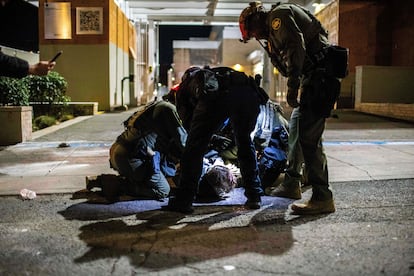

In a decision that redefines the limits of federal immigration power in Oregon, Federal Judge Mustafa T. Kasubhai ruled that Immigration and Customs Enforcement (ICE) agents may not make arrests without a warrant unless they determine, on a case-by-case basis, that there is a likelihood of escape. The judge described the agents’ practices as “violent and brutal” and warned that they continue to cause “great, significant, and severe” harm to individuals, families, and entire communities.
The preliminary injunction, issued Wednesday after an all-day hearing in federal court in Portland, comes in the context of a class action lawsuit against the Department of Homeland Security. With it, Oregon joins Washington, D.C., and Colorado in imposing restrictions on immigration arrests without a warrant.
Kasubhai said there is “ample evidence” of a systematic pattern in which federal agents detain people without assessing whether they might actually flee before a warrant is obtained. “Likelihood of escape considerations are not being made on a far-reaching scale,” he said from the bench, while warning about raids that end in the arrests of people who were not even the targets of the operations.
During the hearing, the judge reviewed videos of multiple ICE detentions in the state, which he described as disturbing. They show agents pointing guns, people thrown to the ground and handcuffed for civil violations. “To be arrested by agents in the way that plaintiffs are being stopped is not a theoretical action,” he said. “It’s violent, it’s brutal... It’s excessive and defies human decency.”
The case was brought by Innovation Law Lab, a Portland-based nonprofit legal organization. Its executive director, Stephen Manning, described the challenged policy as a system of “arrest first, justify later.” In court, he warned that entire communities live in a constant state of fear. “Going to work, coming home from work, driving on the highway, buying bread or hanging out with your family at home. Those are not existential threats for most of us,” he said. “But they are for immigrants and people perceived as immigrants”
Among the most impactful testimonies was that of Victor Manuel Cruz Gámez, a 57-year-old construction worker, grandfather, and resident of Oregon for more than two decades. Cruz Gámez tearfully recounted how he was detained last October while returning from work, despite having a valid work permit and being preliminarily accepted for a U visa as a victim of fraud. He spent three weeks detained at an ICE facility in Tacoma, Washington.
“They told me, ‘You’re still an illegal,’” he recalled, covering his face with his hand. During his detention, he said he suffered extreme anxiety and constant fear. Upon returning home, his family spent weeks without opening the door for fear that ICE would return. “I suffer from a lot of anxiety whenever I see any officer,” he said.
Another case cited was that of a woman identified as MJMA, who was arrested without a warrant on her way to work. At the hearing, it was revealed that an ICE supervisor signed an arrest warrant after she had already been detained. For the judge, these facts represent a direct violation of the due process guaranteed by the Constitution.
The order states that every arrest made by federal agents without a warrant must be “documented in narrative form,” detailing why it was considered that there was a flight risk, along with information about the detainee’s family ties, employment, and community ties.
Federal government attorneys argued that in a recent directive, ICE Acting Director Todd Lyons already reminded agents that they can only make arrests without a warrant when there is a real likelihood of escape. However, Kasubhai said he did not think Lyons’ memo reflected the reality on the streets.
By also granting class action status, the judge extended the scope of the ruling to thousands of people in Oregon potentially exposed to arbitrary detention. Manning said he expects a return to “decency, normalcy, and due process”.
Since last year, Oregon has become one of the main stages for intensified immigration operations by the federal government, with ICE and Border Patrol agents deployed on streets, highways, apartment complexes, and rural areas of the state after protests were held at ICE facilities in Portland, a sanctuary city. In September, President Donald Trump described the city as “anarchy” and “war-ravaged,” after which he announced a plan to send in the National Guard, which was canceled on December 31.
Civil organizations and lawyers have documented an increase in arrests, as well as entries onto private property without warrants, as part of a more aggressive nationwide immigration enforcement strategy that has sparked months of protests, lawsuits, and growing tension between federal authorities and local communities.
Sign up for our weekly newsletter to get more English-language news coverage from EL PAÍS USA Edition









































