
Democrats and the White House reach an agreement to avoid a partial US government shutdown
The deal will allow five spending packages — which account for roughly 75% of federal expenditures — to move forward, while keeping Homeland Security funded on a temporary basis
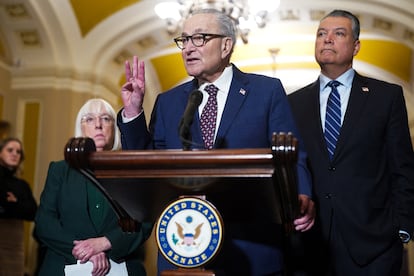

With just 24 hours left before the deadline expired, Senate Democrats and the White House have reached an agreement to avoid a partial shutdown of the U.S. government because no budget had been approved.
The Senate has until midnight on Friday to approve six spending bills totaling $1.3 trillion, which account for roughly 75% of federal expenditures. Among them is an increase in the Department of Homeland Security’s budget, set at around $64 billion. This department, led by Secretary Kristi Noem, oversees Immigration and Customs Enforcement (ICE) and the U.S. Border Patrol (USBP). Both agencies have been deployed in Minneapolis and other cities across the country, where they are carrying out indiscriminate raids targeting undocumented immigrants and using highly aggressive tactics.
The agreement between Democrats and the White House includes separating the Department of Homeland Security (DHS) spending bill from the rest of the budget package. Lawmakers have committed to maintaining DHS funding for two weeks to prevent it from running out of resources.
“I am working hard with Congress to ensure that we are able to fully fund the Government, without delay. Republicans and Democrats in Congress have come together to get the vast majority of the Government funded until September, while at the same time providing an extension to the Department of Homeland Security (including the very important Coast Guard, which we are expanding and rebuilding like never before),” U.S. President Donald Trump shared in a post on Truth Social. “Hopefully, both Republicans and Democrats will give a very much needed Bipartisan ‘YES’ Vote.”
Trump became directly involved in negotiations that had grown complicated after Democrats demanded reforms to the Department of Homeland Security following the killing last Saturday in Minneapolis of Alex Pretti, a 37‑year‑old nurse, at the hands of federal agents.
Democrats demanded several measures to end the impunity enjoyed by some federal agents from ICE and the Border Patrol. They are pushing for a comprehensive overhaul of immigration law that would require federal agents to wear body cameras, mandate clear identification and ban the use of masks, and oblige them to obtain judicial warrants before entering private property, including citizens’ homes.
Both Republicans and Democrats were keen to avoid a repeat of last fall’s experience, which saw the longest government shutdown in history. For 43 days, hundreds of federal agencies were closed or operating at reduced capacity, thousands of employees went unpaid, and public services were paralyzed.
Talks have accelerated in recent days. Democrats initially proposed splitting the budget package to approve the five bills that include funding for the Departments of Defense, Health and Human Services, Labor, Education, Transportation, State, and agencies related to financial services. In exchange, they demanded a separate National Security budget.
In the end, both sides agreed to approve the Homeland Security package only on a temporary basis while negotiations continue over reforms to the department and new regulations that would place limits on ICE and Border Patrol agents.
Under the deal, DHS funding would be extended for two weeks, giving negotiators time to reach an agreement on immigration enforcement tactics.
Despite the agreement, it’s unclear whether a partial government shutdown, even for just a few hours, can be avoided. Any modifications to the budget package must be approved by the House of Representatives, which already passed it last week. The House has no further sessions scheduled for this week and is not expected to reconvene until Monday. In addition, some Republicans in Congress are reluctant to back the spending bills because they include funding increases, and they may seize the moment to oppose them.
So, even with a high‑level deal in place, lawmakers still need to translate it into concrete action to prevent parts of the federal government from grinding to a halt.
Sign up for our weekly newsletter to get more English-language news coverage from EL PAÍS USA Edition









































