
The new victims of the Republican war on Obamacare: Millions hit by soaring health insurance premiums
The controversial extended ACA subsidies expired on December 31, and across the country people are struggling to decide between paying the new prices or giving up coverage


Saray Pérez first saw on social media what her insurance agent, Mariela Feal, later confirmed: the new year would add another bill on top of her rent, water, electricity, car insurance, and food expenses — monthly costs that are making life increasingly difficult in the United States. She and her husband, who had been paying nothing for MyFlorida Blue insurance, will now have to pay $70 per month each starting in 2026, a significant sum for the stylist, just a year after starting a beauty and hair care company in Florida. It may seem small at first glance, but it amounts to over $1,600 a year for the couple, which, amid a cost-of-living crisis, can be decisive.
The situation is a direct consequence of the fact that the additional subsidies for beneficiaries of the public health insurance support system implemented during the COVID-19 pandemic came to an end on December 31. These cuts were part of the sweeping tax bill passed by the Republican majority in Congress last summer. The Democrats opposed the decision, and the ensuing dispute with the Republicans meant the two parties could not agree on a government funding bill, leading to the longest government shutdown in the country’s history.
“The news took us by surprise and, like many families, caused us concern,” says Pérez, a 37-year-old from Cuba. “It might seem like a small amount to some, but when we’re talking about families living paycheck to paycheck or entrepreneurs, as is my case, every new expense has an impact. It’s not just the amount; it’s the buildup of responsibilities that often go unseen. However, more than frustration, what I felt was the need to understand why and to approach it consciously.”
That’s when the call came from Feal, CEO of Marival Insurance, the life and health insurance advisory agency. Since November 1, she and her team had been working through the open enrollment period, which runs until January 15. It was a challenging task: they had to call each of their clients and inform them that they would no longer be paying the same amount for health insurance as they did a year ago. “It was difficult for us to contact all our clients and explain everything,” says Feal.
In 2021, amid the coronavirus pandemic — the most devastating in modern times, which left 1.2 million dead in the United States — then-president Joe Biden signed the American Rescue Plan Act, which reduced healthcare costs for many families across the country. On the 11th anniversary of the Affordable Care Act (ACA), popularly known as Obamacare, the Democrat increased subsidies. “A few clicks and a short conversation, and that’s all it takes to start seeing those benefits,” Biden said at an event in Ohio. “Increased coverage and lower premiums,” he proclaimed.
At that time, everything was very simple for Marival Insurance. “I would send a text message to clients saying, ‘Hey, your health insurance went down in price because of the new law the government signed. Now you pay 50 cents, instead of $20.’ And people were amazed,” Feal says. The new federal law brought a rapid increase in enrollments by expanding tax credits for premiums, so many more people were able to buy health insurance through the federal marketplace.
From then on, beneficiaries with incomes between 100% and 400% of the poverty level received larger tax credits for premiums, and those with incomes above 400%, who were previously ineligible, also qualified. “This excess credit allowed people to pay less, on average, between $700 and $1,000 a year. That is, an average of $70 or $80 per month. It made it easier for people to receive an additional subsidy on top of the subsidies already provided by Obamacare,” explains Luis Orlando Hernández, CEO of Dulcinea Insurance, an agency with clients in more than 40 states across the country, primarily within the Hispanic community.
But after the summer, people began to wonder what was happening. Why were the media claiming that many would lose their health insurance? How much more would be taken from customers’ pockets in a country that was becoming increasingly expensive to live in?
These were some of the questions many of the 24 million people enrolled in Obamacare began asking themselves. “It was a huge shock for me. Before, I didn’t pay anything, and now I pay $35 every month,” says William Ríos, a 38-year-old handyman from Miami who uses Oscar Health Insurance.
Diley Jiménez, a 37-year-old self-employed worker in Jacksonville, who previously paid nothing under Ambetter Health insurance and now pays $10, said that while she wasn’t “heavily affected by such a small amount,” unlike other families she knows who faced much higher increases, the news was nonetheless “not very pleasant.”

What was happening nationally was that Congress did not renew the expanded subsidies, which were set to expire on December 31. While a hairstylist, a handyman, and a self-employed worker counted every dollar of their end-of-month bills, Democrats and Republicans failed to reach an agreement to extend the subsidies. The former wanted to prolong the aid, but the latter insisted that such subsidies were too costly and prone to fraud by large insurance companies. An estimate from the Congressional Budget Office (CBO) indicates that continuing the financial assistance would increase the budget deficit by $335 billion between 2025 and 2034.
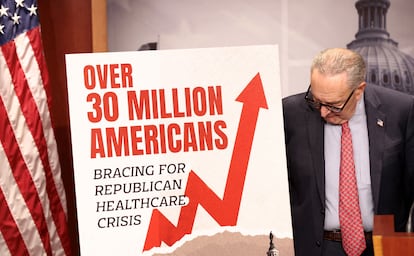
Amid the disagreement, Democratic politicians have argued that the Trump administration intends to “dismantle the healthcare system,” as Senate Minority Leader Chuck Schumer stated. Even so, U.S. President Donald Trump has said that the only healthcare he will support and approve is that which sends “money directly back to the people,” even though Republicans for years have failed to present an alternative healthcare proposal.
What is almost certain, according to CBO data, is that the number of uninsured people will increase by an average of 3.8 million each year between 2026 and 2034 if Congress does not permanently extend the expanded tax credits for health insurance premiums. And the consequences of this decision are already beginning to be seen.
More and more people giving up health insurance
Yeanny Gonzalez, a health insurance agent with Harmonia Insurance in Illinois, reports that one of her clients, a 26-year-old with cancer, saw his monthly premium jump from zero to $58. “Since he won’t be able to work much this year, it’s going to be difficult for him to make the payments,” she says. In Cook County, near Chicago, premiums are even higher. A policy that had a monthly premium of $19 in 2025 now exceeds $139 for a minimum-income family.
According to González, the people most affected right now are self-employed workers, middle-income individuals who don’t qualify for Medicaid, families with children, and many legal immigrants who rely on Obamacare for healthcare. “During renewal calls, many clients told me that the premium increase put them in a tight spot. This is especially true for migrant women nearing 60 who are alone in the country and have a minimum income to qualify for Obamacare. These women need health insurance because they are alone and at an age where they require routine checkups, so they are forced to pay the new prices.”
Even though prices are rising, many have no choice but to continue paying for their increasingly expensive health insurance. “Stopping insurance payments was never an option. Health isn’t something you can postpone or improvise,” says Saray Pérez. “You can adjust in other areas, but going without health insurance is a decision that can have serious consequences.” Nevertheless, some have decided to forego enrolling in health plans this year due to the situation.
The Centers for Medicare & Medicaid Services (CMS) reported that nearly 950,000 new people enrolled for coverage in 2026, down from more than 3 million new enrollees in the previous two years. Other reports indicate that recent enrollment of customers under the Affordable Care Act fell to 15.6 million, down from approximately 16 million last year. CBO projections indicate that if the enhanced tax credits expire indefinitely, the number of uninsured could increase by 2.2 million this year and by 3.7 million in 2027, when benchmark premiums are projected to rise by 4.3% and 7.7%, respectively.
Luis Orlando Hernández, from Dulcinea Insurance, says he has clients whose insurance premiums increased from nothing to $40 and who refuse to pay, “because they say they don’t need it and prefer to save some money.” “At my agency, and others I’ve spoken with, customer losses are between 12 and 20%, because many people didn’t respond to renewal requests, or said they didn’t want to renew. The most worrying thing is that they were left without insurance as a result of this situation.”
A study by the Urban Institute, a Washington, D.C.-based organization, shows that the states of Alabama, Florida, Georgia, Kansas, Mississippi, South Carolina, Tennessee, Texas, Wisconsin, and Wyoming would account for 63% of the decline in enrollment in subsidized insurance plans. Young and middle-aged adults are the most likely to lose their insurance coverage going forward.
González, for her part, has no doubt that the strict anti-immigrant policies implemented in the country a year ago “are contributing to the exodus of program members.” “Many are in the immigration process and are simply afraid that the subsidies will affect their applications and cause them to be canceled,” she says. “Here in Chicago, there’s a strong working Latino population, and many depend on these subsidies; but at the same time, there are those who don’t want to accept them for fear that their applications won’t be approved by USCIS [U.S. Citizenship and Immigration Services].”
Health and politics
At a time like this, many people are reminded of one of the most frequently repeated and controversial phrases in the country: that in the United States you can only be very poor or very rich, never middle class. The argument some people make is that while the wealthy can afford private insurance and the poor can access Medicaid, a two-person household reporting $85,000 a year could end up paying 15 times more for the lowest-cost Gold plan compared to what they paid in 2025, according to Health Insurance company data.
Still, Mariela Feal insists that even if the expanded subsidies are eliminated, the government continues to subsidize far more than it did before Obamacare. “What we have is the best healthcare system this country has implemented in many years. Someone who came to the country after 2021 and whose insurance was $0 until now, and suddenly has to pay $60, says, ‘But how is this possible?’ Are they not subsidizing me at all? I’ve had to explain to clients that they are indeed receiving subsidies so they can pay $50; otherwise, it would be much more.”
If Republicans and Democrats continue to fail to reach an agreement on the cuts, as they did during the nearly 40-day government shutdown, more and more people will live in fear of getting sick, visiting the emergency room, or simply accessing preventative medicine in a country where healthcare remains the most contentious and sensitive issue. What’s more, some insurers, such as Aetna and Molina Healthcare, have begun withdrawing ACA plans for 2026 as a result of this situation.
“If the subsidies aren’t renewed, the system will continue to exist because healthcare is too expensive in the U.S., but fewer people will benefit from it,” says González, who also acknowledges that many families will end up in debt with bills of up to $20,400 a year, according to researchers’ calculations.
Luis Orlando Hernández, for his part, says he is quite “skeptical” of the situation. “What Trump and the Republicans are doing is weakening Obamacare and promoting alternative healthcare options. Republicans have always been enemies of Obamacare.”
Sign up for our weekly newsletter to get more English-language news coverage from EL PAÍS USA Edition









































