
Discovery of 24 bodies in Houston’s bayous this year fuels fears of a serial killer
Authorities have not confirmed any connection between the corpses due to the difficulty in analyzing the bodies, and to date none have been declared a homicide
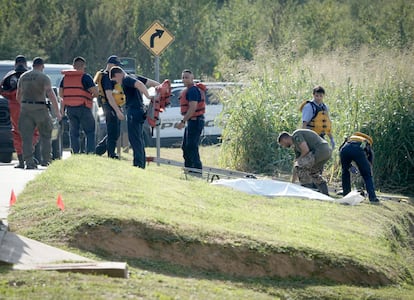
Houston is facing a growing public safety crisis as more bodies continue to turn up in its bayous. According to the Harris County Institute of Forensic Sciences, at least 24 people have been found dead in the city’s waterways so far this year, nearly triple the nine deaths recorded during the same period in 2023 and the same number as in all of 2024. This increase has fueled theories about a possible serial killer, though police and local officials insist there is no evidence the crimes are connected.
Speculation and fear began on September 15, when the body of Jade McKissic, a 20-year-old University of Houston student, was found in Brays Bayou, near the campus. McKissic was a university tour guide and social media editor. An autopsy revealed no signs of trauma or violence, but the cause and manner of her death remain unclear.
That same day, the body of Rodney Chatman, a 43-year-old military veteran, was also found in a bayou, a case that remains under investigation. In the following days, another body appeared in White Oak Bayou and three in Buffalo Bayou. Social media posts about a possible serial killer began to multiply. In total, seven bodies were recovered from the canals that month, six of them in less than two weeks.
“There is no evidence that there is a serial killer loose on the streets of Houston,” declared Mayor John Whitmire, a Democrat, on September 23. Captain Salam Zia, commander of the city police homicide division, asserted that they could not find typical patterns among the victims. “It runs the gamut — genders, ethnicities, age range,” he said. According to the medical examiner, 15 of the bodies found were African American, six were white, and three were Hispanic. The vast majority were men, and their ages ranged from 14 to 69.
Of the 22 deaths recorded by the end of September, the cause of death could only be determined for six: four by drowning, one suicide, and one “cardiac death.” To date, none have been classified as homicides.
Jay Coons, a criminal justice professor at Sam Houston State University, explained to local media that it’s common for a specific cause to go undetermined when people die in the water. “When you put a body in the water… evidence can be washed away, but also with our hot, humid environment, pretty quickly the body can putrify to the extent that you’re left with very little,” he said. He added that evidence is often lost, except in cases with visible injuries.
Officials have pointed to several possible causes for what’s happening in the city, the heart of the fifth-most populous metropolitan area in the United States. Mayor Whitmire, for example, suggested that many of these deaths could be related to homelessness. “Unfortunately, the homeless, when they pass, often end up in the bayou,” he said. Other theories point to substance abuse, mental health issues, and the condition of these waterways, which run some 2,500 miles through the metropolitan area.
On September 30, Councilwoman Letitia Plummer and Councilwoman Carolyn Evans-Shabazz held a press conference to pressure officials. “The less information you give to people, the more people make assumptions,” Plummer said. The community, she added, wants “more decisive information and in a more timely manner.” At the same time, she criticized the mayor for causing “more confusion,” referring to his theory about homelessness.
Meanwhile, Kenneth Cutting Sr., whose 22-year-old son was found dead in Buffalo Bayou last year, expressed frustration after the medical examiner ruled the cause of death undetermined. “I don’t know if there’s a serial killer, but the way they’re handling these bodies is ridiculous,” Cutting told local media. Likewise, Xzaviere Chatman, the sister of one of the deceased, said, “Something has to be done.”
Authorities have begun compiling a comprehensive list of people found dead in the city’s canals. Several homicide detectives are working with the department’s records division to gather information on the matter. City police spokeswoman Jodi Silva recently reiterated that there are no connections between the cases. “There’s nothing linking them, and we warn people to be cautious when they’re around the bayou. Don’t enter the bayou water. It has fast-moving currents, and there are branches underwater that you can get stuck in,” she said.
Some city council members have suggested creating a special task force to follow up on the issue. However, authorities have been cautious about taking additional safety measures, as many of the bodies found have not carried signs of violence. Mayor Whitmire, for his part, stated that there is no “foolproof” measure that can prevent all deaths.
Sign up for our weekly newsletter to get more English-language news coverage from EL PAÍS USA Edition









































