
Operation Lone Star 2.0: Texas turns into an ‘immigration police state’
Experts warn that Texas has taken on a role that belongs to the federal government. So far this year, the state Department of Public Safety has arrested more than 3,100 undocumented migrants
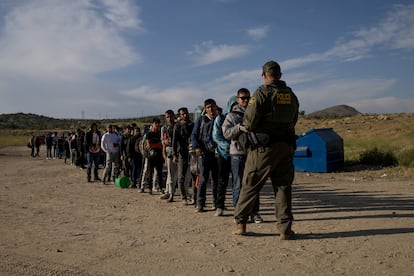
Operation Lone Star began as Texas’ strategy to curb migrant crossings at the southern border during Joe Biden’s presidency. Four years later, it has become a detention machine that reinforces the immigration crackdown launched under the Donald Trump administration. Now, under what several experts are calling Lone Star 2.0, Texas has taken on a role that normally belongs to the federal government: so far this year, more than 3,100 undocumented migrants have been arrested by the Texas Department of Public Safety (DPS).
“Constitutionally, it’s very clear that immigration law is a federal matter, not a state matter. The difference here is that Texas isn’t interfering with the wishes of the current president,” explains immigration attorney Kate Lincoln-Goldfinch.
During Biden’s term, Texas faced federal lawsuits for trying to manage immigration on its own. Courts blocked the state from placing barbed-wire buoys in the Rio Grande and struck down SB4, a law that authorized local police to detain and deport people suspected of being in the country illegally.
However, under Trump, that federal opposition disappeared. As a result, the Texas government, led by Republican and Trump ally Greg Abbott, has intensified its operations and begun acting with near-total freedom.
According to official records obtained by The Texas Tribune, nearly 700 of the 3,131 arrests made by the DPS this year took place in cities like Austin, Dallas, and Houston — hundreds of miles from the border. Lone Star is no longer just a border issue. With Trump back in the White House, “any immigration enforcement actions the state can or wants to take are now welcomed by the White House,” says Lincoln-Goldfinch, who is currently running for a seat in the Texas House of Representatives.
The original initiative
Operation Lone Star has been one of the most expensive operations in U.S. history, costing nearly $11 billion to date, according to the Immigrant Legal Resource Center, a national organization that provides legal training and advocates for immigration policy reform. That amount is more than double Texas’ usual annual budget for its public university system and exceeds the combined budget the state allocates for child healthcare, housing subsidies, and rural community development. Although exact figures for Lone Star 2.0 are not yet available, the operation is likely to increase spending significantly — for example, to fund DPS special units deployed across the state.
In its first two years, Operation Lone Star resulted in 340,000 immigrant detentions, over 23,000 criminal arrests, and 355 million doses of fentanyl seized. A statement from Governor Abbott’s office at the time said the goal was to “secure the border; stop the smuggling of drugs, weapons, and people into Texas; and prevent, detect, and interdict transnational criminal activity between ports of entry.” The statement also boasted that the operation had transported more than 9,100 immigrants to Washington, D.C., more than 4,900 to New York City, over 1,500 to Chicago, and more than 840 to Philadelphia in just a few months. Texas was essentially dumping arriving migrants in cities run by Democrats.
However, a report by the American Civil Liberties Union (ACLU) revealed that most arrests involved people with minor offenses. The program “spends billions of dollars to racially profile and arrest people who pose no threat to public safety, then forces them into a separate and unequal legal system run by the state,” the ACLU said.
“The immigrant community sees DPS as equivalent to ICE”
Traditionally, the Texas Department of Public Safety focused on public safety issues, such as traffic accidents. Now, much of its resources are devoted to immigration enforcement. Immigration attorney Pedro López considers it dangerous that this agency has effectively taken on the role of deporting people from the country. “For citizens, it’s an imminent danger to have state police directly involved in these arrests without oversight. Officers who make arrests can be subject to lawsuits for violating civil rights,” López points out.
Attorney Lincoln-Goldfinch points out that “the problem with state police or state law enforcement officers collaborating, cooperating, or enforcing immigration enforcement is that it destroys the relationship between the immigrant community and state law enforcement.” According to the attorney, the community now “sees DPS as equivalent to ICE [Immigration and Customs Enforcement], and so they will flee. They will refuse to talk to or cooperate with DPS because they perceive it as a danger. That breaks the relationship between law enforcement and the immigrant community, which is very large in Texas, and harms public safety for everyone,” she adds.
Moreover, if SB4 — the law currently blocked — were to take effect, local sheriffs would be required to cooperate with federal immigration agents. “This essentially turns Texas into an immigration police state,” Lincoln-Goldfinch warns.
Civil rights organizations have expressed concerns about the new version of Lone Star. The Immigrant Legal Resource Center said it was misallocating resources that should be directed toward meeting Texans’ basic needs. The ACLU, for its part, has questioned the operation’s lack of transparency. In a recent report, the organization noted that DPS data do not match court records and that in many cases there is no clarity about what happens to people once they leave state custody. It also said the operation undermines the immigrant community’s trust in authorities and creates a “separate and unequal” system that allows DPS to act as an immigration enforcement force without sufficient judicial oversight.
“Under the current president, I don’t anticipate any resistance or lawsuits from the federal government against Texas over immigration enforcement,” says Lincoln-Goldfinch. “On the contrary, the only thing expected is cooperation.” She is also concerned that other states may implement similar programs, particularly because “the more Republican states do this, the more it will be welcomed by the Trump administration.”
Sign up for our weekly newsletter to get more English-language news coverage from EL PAÍS USA Edition









































