
ICE’s deadly tally: 14 migrants have died in custody in Trump’s first year
Since 2019, 69 people have passed away while in the custody of US Immigration and Customs Enforcement


His name was Lorenzo Antonio Batrez Vargas. He was Mexican, 32 years old, and was declared dead on August 31 while detained at the Central Arizona Correctional Complex in Florence. Batrez joins an infamous list. Since 2019, 69 migrants have died while in the custody of U.S. Immigration and Customs Enforcement (ICE). Since Donald Trump won the election in November 2024 alone, 14 people have died in ICE facilities, three of them Mexican.
Lorenzo was known as Lenchito. According to a fundraising page his family in the United States has set up to transport his body and arrange for his burial, he died alone, likely due to complications from Covid-19, without receiving “the medical attention he deserved.” “No family should have to wonder if their loved one’s life could have been spared with more compassion, more care, or more justice,” the statement reads.
His name joins those of Chaofeng Ge, Tien Xuan Phan, Isidro Pérez, Johnny Noviello, Jesus Molina Veya, Abelardo Avelleneda Delgado, Marie Ange Blaise, Nguyen Nhon Ngoc, Brayan Rayo Garzón, Maksym Chernyak, Serawit Gezahegn Dejene, Genry Ruiz Guillen, and Ramesh Amechand. Migrants from Mexico, Guyana, Canada, Ukraine, Ethiopia, China, El Salvador, and Haiti, ranging in age from 27 to 75, many of whom had called the United States home for decades.
This was the case of Isidro Pérez, a 75-year-old Cuban citizen who, after entering the country in 1966, was detained on June 5 in Key Largo, Florida, and transferred to a center in Miami. Less than a month later, he died of what is being described as a heart attack. Another case is that of Jesús Molina Veya, a Mexican who at 46 had already been deported from the United States twice and, after being detained in April in Atlanta, killed himself on June 7.
“We are facing a policy and pedagogy of cruelty that, although it has been in place for 35 years, seems to be one of the facets of the U.S. government’s policies, which is to turn this cruelty into a spectacle and use undocumented migrants as supporting actors,” explains Amarela Varela, a migration scholar and professor at the Autonomous University of Mexico City. “And, although there are nuances, it’s the same policy with both Republicans and Democrats; Trump didn’t invent it, he’s just making it more cruel.”
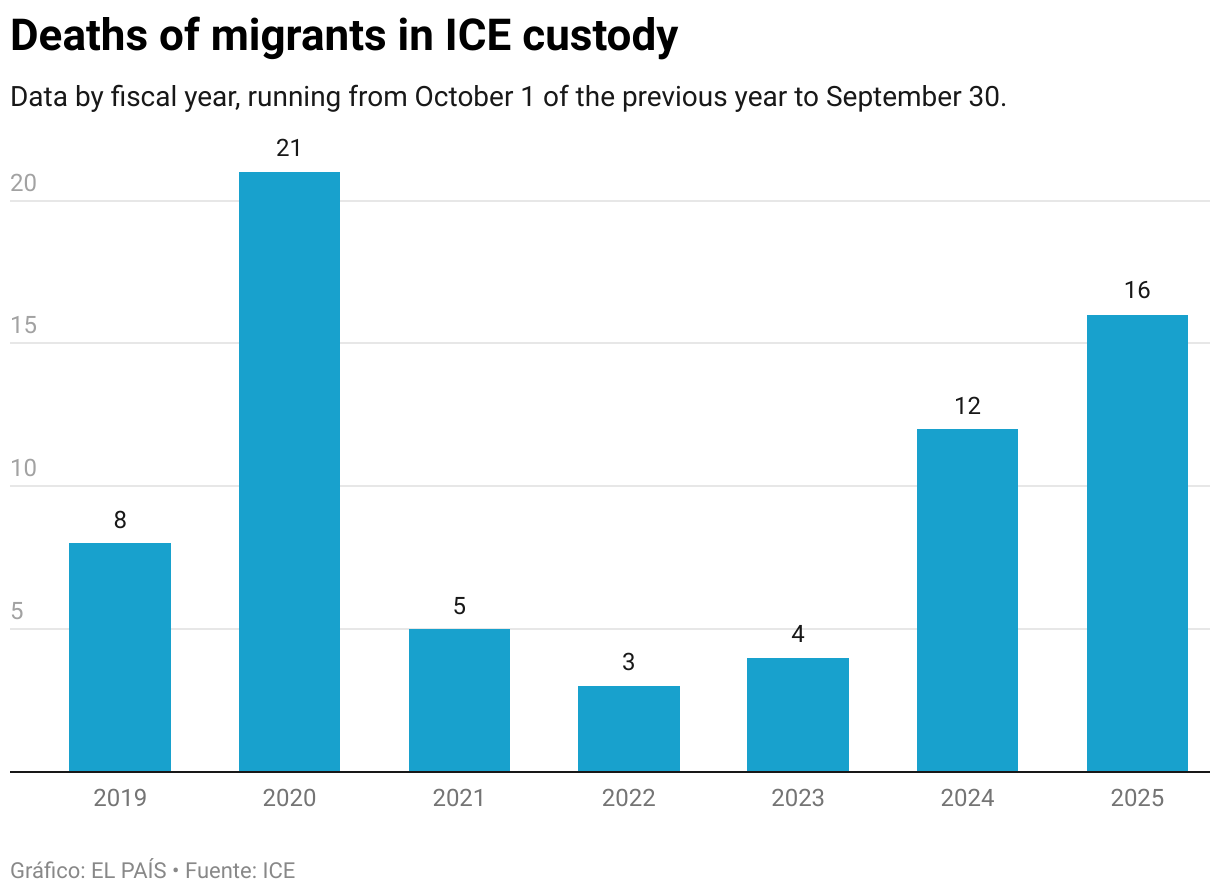
Since 2019, 69 people have died in ICE custody, according to the agency’s own data. Only 2020, the last year of Trump’s first term as president, surpasses the beginning of his second. In that fiscal year, which runs from October 1 to September 30, 21 migrants whom U.S. authorities should have protected died.
There are more than 200 migrant detention centers across the United States. These include public and private prisons, which currently hold 61,000 people, almost double the 37,000 when Trump returned to power. Seventy percent of those detained have not been sentenced, and of those who have been convicted, a significant number are for minor offenses such as violating traffic rules.
It can’t be said that Trump isn’t keeping his promises. One of the pillars of his electoral platform was to offer an iron-fisted policy against immigration. “On day one, I will launch the largest deportation program of criminals in the history of America,” he declared in his closing campaign. As soon as he took office, he signed an executive order declaring the border with Mexico a national emergency; he closed entry to U.S. territory to asylum seekers, announced a physical wall again, and sent law enforcement officers to act as a human barrier; he ordered the detention of all undocumented migrants and the filing of criminal charges against them, in addition to seeking a legal path to strip their children of their birthright citizenship.
Since then, human hunting season has been declared. ICE agents patrol areas near schools and workplaces across the country looking for victims; there have been raids against day laborers while they were harvesting crops in American fields, during one of which a Mexican worker was killed; federal operations have been announced in cities and jurisdictions that refuse to cooperate with these policies... The list is too long, but the irony was served last June, when Trump acknowledged that mass deportations were affecting sectors like agriculture and hospitality, which depend precisely on migrant labor.
“Trump is on the other side of the wall, but U.S. immigration policies have been exported to Latin America for 30 years by blackmailing governments of all political persuasions,” reflects Varela. Mexico, one of the busiest migrant corridors on the planet, crossed by thousands of people from all over the world seeking to reach the United States, is no exception.
Under Mexican president Enrique Peña Nieto, the Southern Border Program was established, which sought to stop migrants as soon as they entered Guatemala. Although Andrés Manuel López Obrador began his term (2018-2024) with the promise of more humane treatment for his “migrant brothers and sisters,” Trump threatened to impose tariffs if Mexico did not meet his demands. The country went from detaining 180,000 migrants a year in 2018 to 1.2 million in 2024. Furthermore, the inhumane treatment in Mexico’s detention centers became evident with the deaths of 40 people during a fire at an immigration station in Ciudad Juárez. It remains to be seen how Claudia Sheinbaum’s term will go, but for now, these numbers have declined.
In the United States, every time a migrant dies in an ICE detention center, the agency issues a statement. They all end with the same paragraph: “ICE remains committed to ensuring that all persons in its custody reside in safe, secure, and humane environments.”
Sign up for our weekly newsletter to get more English-language news coverage from EL PAÍS USA Edition









































