
Stephen Breyer, former Supreme Court justice: ‘Every judge is aware of the climate of the year’
Appointed by Bill Clinton, the retired justice advocates for temperance and common sense in polarizing times
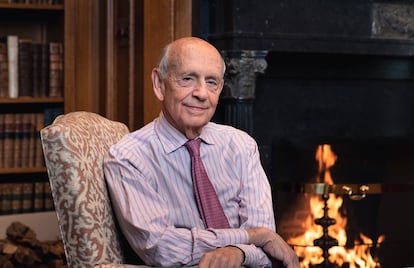

Retired Supreme Court judge Stephen Breyer carries around a worn copy of the Constitution in his pocket. “Somebody might ask me a question. I don’t know the answer, I’ll look it up,” he says. Never mind that he stepped down in 2022, 28 years after Bill Clinton appointed him as one of the nine magistrates of the Supreme Court. Once a judge, always a judge. And this Boston son, former collaborator of Senator Ted Kennedy, is clear on his continuing responsibilities: at 87 years of age, he is still a teacher, giving talks to young people on the importance of the juridical system as a pillar of democracy.
His office, with its wooden coffered ceiling in the imposing Supreme Court, provides its own course in U.S. history. Photographs from each year he served, alongside his judicial assistants; paintings on loan from national museums; antique books, inherited from a relative; and a fireplace that, regardless of the weather, is almost always lit. That being said, on the September Thursday of his interview with EL PAÍS, along with a group of other European media, it is so hot that even he has given up on its cheerful blaze.
Before beginning the conversation, he specifies that he is unable to talk about pending Supreme Court cases, or expand on what is already known about past cases. Nor is he able to speak about politics.
Question. The Supreme Court’s new term began on Monday and the justices have before them an enormous amount of cases that are fundamental to U.S. democracy. A huge responsibility, given the polarization of the country. How does a judge approach that?
Answer. Paul Freund, who was a great law professor, put it this way: He said no judge — no decent judge — will decide a case on the basis of the political temperature of the day. And of course, I say to the students, do you want a judge looking over his shoulder in a criminal case to see what the public thinks, whether he’s guilty or not? Of course you don’t. No judge decides a case according to the temperature of the moment. But every judge is aware of the climate of the year. That goes for the Supreme Court as well. You can’t say that the judges aren’t aware of what is happening in the world. But they are judges.
Q. And the political temperature this year is characterized by a Republican president.
A. When you have a president of the same party that appointed a judge to the Supreme Court, you’ll find some similarities. In what purposes are important, in how things fit together, freedom of speech, perhaps, or due process of law, where it applies and how it applies. Of course you will find some, but that doesn’t mean the judge is acting according to politics.
Q. This administration in particular is moving so quickly that the courts can barely keep up, even when it comes to fundamental decisions. Is that dangerous?
A. The difference between the court and Congress is time. It’s what British Prime Minister Harold Wilson once said [in parliament]: “A week is a long time [in politics].” And somebody said, “No, a day is a long time.” Nowadays, it is.
Q. Especially in this country, and right now.
A. But that is not the job of a judge. The job of a judge is to think. Read what people have done, find out what the framers or others have thought. Find out what some of these articles are. In the right to die case, we had 80 briefs of up to 50 pages of legal opinions. Briefs I read! In the affirmative action case, 100 were presented. In a year, you can receive between 4,000 and 5,000. The judge has to take their time to examine the different perspectives and decide.
Q. Then there is the confusion that is created when Supreme Court decisions are reversed, as in the case of abortion and Roe v. Wade after that decision was in effect for a half-century. How can a majority suddenly arrive at the conclusion that a decision was in error, after 50 years?
A. You’re talking about a case that I think was wrongly decided. I was one of the three judges who dissented and I wrote a 12-page opinion. But you can’t say, never overturn a case. For example, the ruling of Plessy v. Ferguson [in 1896 in this case, the Supreme Court determined that racial segregation based on the principle of “separate but equal” was constitutional. In 1954, the court overturned that decision by deciding against school segregation in the case of Brown v. Board of Education.] Was Brown wrong? Of course it wasn’t.
Q. Does it come back to what you were saying, the political climate of the era?
A. Well that helps, but you can’t point to it, exactly. You can’t reverse decisions very often, because people rely on the law. You might overdo it, too. You might substitute your values. I’m not saying they did, but you might.
Q. How does one know how to judge, the line between honestly examining the laws and being swayed by personal opinions?
A. Seeing that line is what makes a great judge. You have this document [holds up his wrinkled copy of the Constitution], you have what other people think, you have your experiences, in my case, 40 years of it. Does that make me right all the time? No, but it does mean I have been right. The word of compliment for a judge is not “brilliant,” it’s “sound.” “He’s written sound opinions.”
Q. Amid the tremendous current amount of polarization, the public is losing confidence in institutions, including in the Supreme Court itself. How can it respond?
A. It’s a big problem. In his book The Pursuit of Happiness, the author Jeffrey Rosen wrote about philosophical texts the founding fathers read: Cicero, Seneca, Aristotle, some from the French Enlightenment, Scottish Enlightenment. And they came away, says Rosen, with the view that if you want to pursue happiness in your own life, you have to take the classical virtues; temperance, courage, wisdom; put them together; and try to tame your emotions. And they asked themselves, “Can we create a country like that?” And they thought, “We can try to be run not by a king, but by a democracy.” But passions will come and complicate the system of government.
Q. That happened 250 years ago. How can we put that in practice today?
A. The United States is a big country, with a complex system of government. These questions keep coming up. Every country is worried about this. How do we maintain democracy? How do we maintain our values? Lincoln said in his Gettysburg address, “Now we are engaged in a great civil war, testing whether that nation, or any nation so conceived and so dedicated, can long endure.” That is to say, it’s an experiment. Now, we will see if that experiment will work.
Q. How can it be made to work?
A. I can’t tell you that. What I tell the schoolkids I teach is to talk to people who disagree with you. That’s what Kennedy taught me.
Q. At the beginning of the Biden administration, there was a lot of debate about reforming the Supreme Court, expanding the number of justices or setting a term limit. What is your take on such changes?
A. You can play that game, but you have to keep in mind that each party could use it to its own benefit. I’m not really looking into it that much. Term limits might be a good idea. It might take a constitutional amendment, which is hard to get. I’ve said it has to be long-term, because you don’t want somebody in the job worried about what their next job is, within 18, 20 years, something like that. It takes four, five years before you do your best. And there are few rewards, once you get past the fact that anybody you decide for will applaud you.
Q. What will be your legacy?
A. I hope to have contributed to decisions that have helped to create and maintain a better democracy.
Sign up for our weekly newsletter to get more English-language news coverage from EL PAÍS USA Edition









































