
The future of same-sex marriage rights in the US is at stake in the Supreme Court
The appeal by a former official who prevented a gay marriage for religious reasons calls for the repeal of the law, in force since 2015
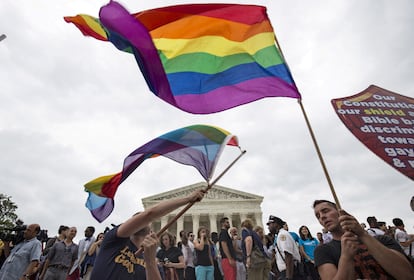

Same-sex marriage in the United States, the right to which was expanded 10 years ago nationwide, may be in danger of disappearing if the Supreme Court rules in favor of a government official who, on religious grounds, refused to issue a marriage license to a gay couple. The official was sentenced to a substantial fine and six days in jail for contempt of court for doing so. The case of Kim Davis, who was the county clerk for Rowan County, Kentucky, in 2015 was followed by others such as the pastry chef who, in 2017, refused to make a wedding cake for the marriage of two men, also citing religious beliefs, and whom the Supreme Court ruled in favor of a year later, during Donald Trump’s first term in the White House.
Davis’s appeal — which will reach the Supreme Court in the fall in an attempt to overturn the ruling that ordered her to pay a $100,000 fine for emotional damages to the couple, plus $260,000 in legal fees — transcends the individual case and threatens to deal a setback to the LGBTQ+ community amid the ultraconservative offensive. In a ruling filed last month seeking a review of lower court decisions — all of which went against the plaintiff — Davis, a Republican, argues that the First Amendment’s protection for the free exercise of religion exempts her from personal liability for refusing to process the paperwork for same-sex marriage. But her appeal goes much further.
The Supreme Court, with a conservative supermajority — six of its members versus three liberals — has ruled in favor of the Trump administration in numerous emergency appeals to lower court decisions, so its decision in the Davis case will be decisive for the future of marriage equality. Because, in essence, the former county clerk’s appeal asserts that the Supreme Court’s decision in Obergefell v. Hodges — which expanded the right to marry for same-sex couples under the 14th Amendment — was “flagrantly wrong.”
“This error must be corrected,” Davis’s attorney, Mathew Staver, wrote in the appeal, calling the majority opinion in Obergefell a “legal fiction.” In June 2015, the Supreme Court narrowly ruled (5-4) that same-sex couples have a fundamental right to marry and that states must recognize same-sex marriages performed in other jurisdictions. Moreover, the right to marriage is a fundamental freedom, inherent in individual autonomy and protected by the 14th Amendment, according to the ruling read by Justice Anthony Kennedy.
So the action by Davis, who, as Rowan County clerk, was the sole authority charged with issuing marriage licenses on behalf of the government, is more than a remedy: it’s an amendment to the entire case. In fact, her petition is the first in a decade to formally ask the court to overturn the landmark marriage ruling. Davis has the standing to do so, according to her attorney, because “if there was ever a case of exceptional importance — that of the first person imprisoned for following their religious convictions regarding the historic definition of marriage — it’s hers,” Staver said.
For a decade, lower courts have dismissed Davis’s claims, and most legal experts consider her attempt to have little chance of success. A federal appeals court concluded earlier this year that the former clerk “cannot invoke the First Amendment as a defense because she is held liable for state action [the issuance of licenses], something the First Amendment does not protect.”
Conservative offensive
But the appeal comes as opponents of same-sex marriage are ramping up their campaign to overturn the Obergefell precedent and move the legislation to individual states, even though Congress overwhelmingly passed legislation in December 2022 to secure it. Ten years ago, when the landmark ruling was handed down, 35 states had legal or constitutional bans on same-sex marriage. Only eight had enacted laws explicitly permitting such unions. Ten years later, at least nine states have introduced bills aimed at blocking new marriage licenses for LGBTQ+ people or passed resolutions urging the Supreme Court to overturn the Obergefell case as soon as possible, according to the advocacy group Lambda Legal. Davis’s appeal could catalyze the conservative crackdown on millions of Americans.
Something similar happened with another landmark ruling, Roe v. Wade, which constitutionally enshrined the right to abortion in 1973 and was overturned in 2022 by a Supreme Court made in Trump’s image. As in the case of abortion — in which the Republican is keeping a low profile so as not to upset his electoral base, especially evangelical Christians — by advocating for states to legislate instead of the federal government, the repeal of Obergefell could be the final blow to a right that has been fought for over decades. A month ago, the Southern Baptist Convention, the largest Christian denomination in the country, voted overwhelmingly in favor of “repealing the laws and court rulings, including Obergefell v. Hodges, that defy God’s design for marriage and family.”
Although a large majority of Americans back equal marriage rights, support appears to have weakened in recent years, according to the Gallup Institute: 60% of Americans supported same-sex marriage in 2015, a percentage that rose to 68% in 2025 but has stagnated since 2020.
Incidentally, the couple to whom Davis denied a license eventually married after her office staff issued the licenses by proxy, removing their names from the form. To prevent similar cases, the state of Kentucky enacted a law removing the names of all county clerks from marriage licenses.
Sign up for our weekly newsletter to get more English-language news coverage from EL PAÍS USA Edition









































