
FBI releases images of suspect wanted in the killing of Trump supporter Charlie Kirk
The MAGA leader died from a gunshot to the neck during a public event on a Utah campus. Authorities say they have recovered a ‘high-powered’ rifle


The search for the suspect in the killing of conservative activist Charlie Kirk continued relentlessly on Thursday. The FBI announced at a press conference in Salt Lake City, Utah, that the man who shot Kirk from a distance, hitting him in the neck and killing him instantly, used, according to initial findings, a “high-powered, bolt-action” rifle that was found in a wooded area close to the crime scene. Within hours, the FBI posted two photos of the suspect on its X account.
The images show a man wearing a black cap and sunglasses, dressed in jeans and a black T-shirt with a print that appears to include an American flag.
Kirk — a close ally and personal friend of U.S. President Donald Trump — was at the start of a public event on Wednesday around midday local time, debating with hundreds of attendees at one of the events he regularly organized on campuses across the country. He was killed at Utah Valley University, in the town of Orem, near Salt Lake City. He was 31 years old.
We are asking for the public's help identifying this person of interest in connection with the fatal shooting of Charlie Kirk at Utah Valley University.
— FBI Salt Lake City (@FBISaltLakeCity) September 11, 2025
1-800-CALL-FBI
Digital media tips: https://t.co/K7maX81TjJ pic.twitter.com/ALuVkTXuDc
At the press conference, an FBI spokesperson said they had images but were not planning to release them at that time. In those images, the spokesperson said, an individual could be seen who “appears to be of college age.” They did not rule out that he might be a student at Utah Valley.
The spokesperson also said agents were canvassing the areas around the university to locate him. Nearly 24 hours after the tragic incident, that operation had not yielded results. “If we are unsuccessful in identifying them immediately, we will reach out for the public’s help and the media’s help in pushing those photos,” the spokesperson announced. The FBI ultimately released the images around noon (Washington time), and television networks began broadcasting them repeatedly in the hope that someone would provide information about the fugitive’s whereabouts.
Later, Robert Bohls, who identified himself as the lead on-site agent for the investigation, spoke about the weapon used: a .30 caliber hunting rifle, an older model. It was found discarded in the woods, wrapped in a towel, with one spent cartridge and another still in the chamber, according to anonymous sources cited by The Wall Street Journal. The New York newspaper also reported that investigators had found “ammunition engraved with expressions of transgender and anti-fascist ideology.” At the moment of his death, Kirk had just answered a question from a student, who has not been identified, about mass shootings carried out by transgender individuals.
Authorities said they had received 130 tips and appreciated the public’s assistance. Bohls added that they also had the suspect’s fingerprints. The FBI confirmed that they had mapped the suspect’s movements from when he approached the building from which he fired from the rooftop, to his escape from the crime scene.
Kirk, evacuated by his security team to a nearby hospital, died within minutes. Dozens of cell phones captured the killing, and the horrific footage quickly circulated online, though none of the cameras at the scene captured the location of the shooter at the time — an elevated rooftop about 100 meters away, from which he could comfortably aim at his target. Some videos shared on social media showing the moments immediately after the shot do depict someone appearing to run at full speed across the rooftop from which the shooter apparently fired.
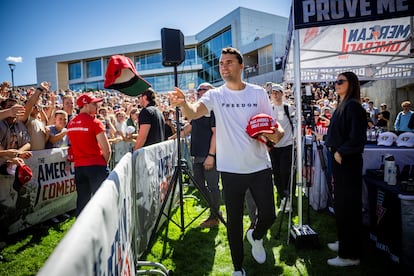
Kirk, a staunch defender of the Second Amendment, which guarantees the right to bear arms, was in the middle of a discussion about the recurrence of mass shootings in the United States when the bullet struck his neck, and blood began to gush out.
Confusion in the early hours
The university quickly announced that a suspect had been detained. Shortly afterward, the police contradicted the academic authorities: someone had indeed been arrested, but only for “obstruction of justice.” Moreover, that individual was quickly released.
Confusion continued when, hours later, FBI Director Kash Patel wrote on X that they had found the person they were looking for. “The subject for the horrific shooting today that took the life of Charlie Kirk is now in custody. Thank you to the local and state authorities in Utah for your partnership with,” Patel wrote. He had been appointed by Trump to a position for which he had no prior experience. Embarrassment followed soon after, when it was announced that the second suspect was also not Kirk’s killer.
Once apprehended, the suspect faces the death penalty in the state of Utah, according to Republican Governor Spencer Cox, who spoke at an emotional press conference on Wednesday, just hours after the killing. Cox also ruled out the involvement of any additional persons.
If charged with a terrorism offense, the case would enter the federal criminal system, and the Department of Justice could also seek the death penalty. Given Trump’s close relationship with Kirk and the outrage with which the president received the news, there is little doubt that, if the case proceeds, he will urge Attorney General Pam Bondi to ensure that the full weight of the law falls on the killer of the young MAGA leader.
Sign up for our weekly newsletter to get more English-language news coverage from EL PAÍS USA Edition









































