
Miami’s scooter boom fizzles amid Trump’s immigration crusade: ‘If you’re on a moped, they assume you don’t have papers’
A few years ago, they were the preferred transportation mode for recently arrived immigrants — today, they have all but disappeared from the city
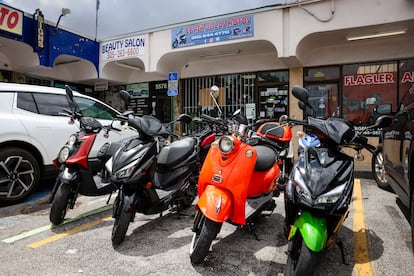

The avalanche of scooters and mopeds that flooded Miami was as fleeting as Joe Biden’s temporary protective immigration programs. The small vehicles were trending after the arrival of hundreds of thousands of foreigners from Latin American countries, where in large metropolitan areas like Caracas, Bogotá and Mexico City, mopeds are a popular form of transportation. Many of those individuals settled in southern Florida. In Miami, where public transportation is not up to the task of transporting all residents, these new arrivals saw in the scooters an economic and familiar option.
The moped boom of 2022 and 2023 changed the face of the city. Mopeds are able to dodge between cars, making it easier to navigate the streets and main thoroughfares’ heavy traffic. Their numbers appeared to grow every day.
But now, it’s rare to spot a scooter. The boom went up in smoke at the beginning of the year following the crackdown on immigrants led by Donald Trump, who has promised mass deportations and a quota of 3,000 arrests per day.
The Trump administration has canceled the visas of hundreds of thousands of people who arrived through the humanitarian parole program enacted for Cubans, Haitians, Venezuelans and Nicaraguans (known by the initials of the nationalities, CHNV) and CBP One. As a result, many were thrust into limbo from one day to the next.
Driving a moped in Miami “is like having a tattoo on your face. Authorities say, ‘Hey stop, if you’re driving a moped, you probably don’t have papers,’” says Yonathan Rodríguez, a 40-year-old Venezuelan who has sold parts for the vehicles to local shops for 20 years. “You can see the fear of deportation in the street. You saw so many more mopeds before than you do now.”
According to Rodríguez, many recently arrived immigrants who didn’t have the money to buy a car took advantage of the fact that you can get a moped without a credit score and pay for it on an installation plan, in order to have a way of getting around. But now, driving a moped means exposing oneself to the risk of being detained by immigration officials, who are carrying out raids in workplaces, farms and on highways around the state of Florida.
“You have to commit a violation for them to stop you in a car, but the police assume that if you’re getting around on a moped, it’s likely that you don’t have papers,” he says.
Sales plummet
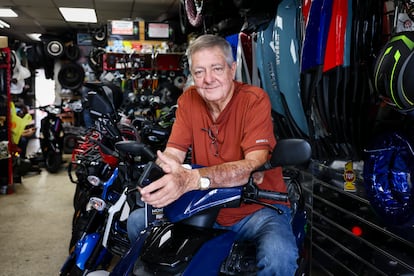
Boris Pedraza, owner of a store called El Rey de las Motos (The King of the Mopeds), tells EL PAÍS that sales have plummeted. “A lot of people have been deported and others are in hiding, because if they catch them on the moped, if they get stopped for any reason, and they don’t have papers, they’re going to jail,” he says. “This scooter, for example,” he adds, pointing to a small black model, “belonged to a girl who was leasing it. They deported her.”
Pedraza’s business has managed to survive because he has had the store for 20 years, and has a level of seniority that exempts him from occupational licenses. He pays $1,500 a month in rent for the space, which is located in a small shopping plaza next to a veterinary clinic, a parcel delivery business and a store called Lo Más Barato Para Cuba (The Cheapest for Cuba). It stands west of Flagler Street, one of the city’s main thoroughfares, which divides Miami between north and south. When he opened, the rent was $700. “If I close here, I can’t open up anywhere else,” he says.
With the rise in demand, new moped shops sprang up, but many have since closed, according to Pedraza. “Some people opened up a little shop, they said, ‘This is what’s in style. Let’s sell scooters.’ But that’s all over.”
During a period of time between 2022 and up until the beginning of 2024, Pedraza estimates that he sold some $5 million worth of vehicles — more than 10 mopeds a day. He had six employees, between mechanics, salespeople and assemblers. “We were non-stop,” he says. But now, he’s lucky to sell one or two mopeds a week, between new and used models. Many of those he does sell are sent by his clients to Cuba via shipping services.
Due to plummeting sales, one of the newer stores, located on the corner next to Pedraza’s business, has squeezed a jeweler, a small market and a kind of cafeteria into the same storefront, alongside the mopeds, which now take up less than a third of the space. An employee who asked not to be identified because they weren’t authorized to talk about the business says that they have had to close two of their locations. Another entrepreneur in the Miami neighborhood of Hialeah says they have had to close two shops.
Pedraza doesn’t know how much longer he can last. “Right now, we’re back to basics. Plus, the price of parts have gone up because of tariffs. A piece of rubber that once cost $15 now costs $57.” His son opened a shop in Orlando, but has since had to shut it down and come to work with his father.
Rodríguez, who sells parts wholesale, says that “the mass deportations that have taken place during the last six months have affected all the shops” specializing in mopeds. Many “have had to restructure” to stay afloat. “In two years, the business has really changed,” he says.
There are also difficulties when it comes to financing new mopeds, according to Pedraza. Many people have stopped using the scooters, out of fear of being in the street or because they were deported, couldn’t keep up with payments, or couldn’t get a loan from the bank, he says.
Firms that lease mopeds only require a piece of identification, which can be a foreign passport. That’s in contrast with the banks that lease cars that ask for a Social Security number, driver’s license and other requirements. Moped payment plans tend to last for three months, during which clients pay $500 to $600 a month, with no collateral. In exchange, they get the scooter and its title, which makes it difficult for shops to get the vehicle back if they fall behind on payments.
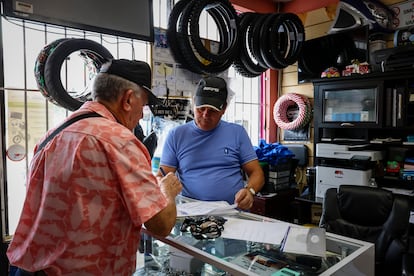
Pedraza only knows of one bank that is still financing mopeds up to $1,500, but that sum doesn’t cover the more expensive 150 and 200 cubic centimeter models. To drive a vehicle of 150cc and up, the state of Florida requires a motorcycle endorsement on your driver’s license. Smaller motorcycles do not require an endorsement. Smaller vehicles don’t require that endorsement, making them the more popular models among recent arrivals, according to Pedraza.
Diosday Monzón, a 49-year-old Cuban who drives a 150cc scooter, says that it is an economic alternative to a car, even more so now that he has lost his job as a security guard. His moped doesn’t require insurance, and he can fill its tank with less than $5 to drive 93 miles. “I’ve been driving for four days on $5 worth of gasoline. After three or four months on a moped, you’re up, you’re saving money,” he says. Before, he had a 2005 Toyota Camry, but he was paying $200 a month for insurance.
“The jobs that are letting people go aren’t hiring anyone,” says Monzón. “With Trump, everything’s gone like this,” he continues, flashing a thumbs-down. “Right now it’s like people are in survival mode,” says the Cuban, who has lived for many years in Miami and, he says, has “all my papers.” That’s why he’s still using his moped, despite the fact he’s “a target” for authorities.
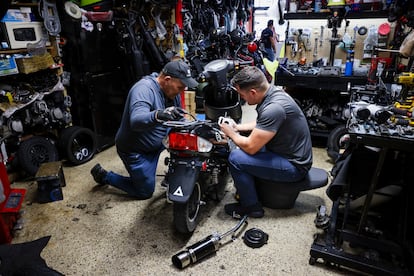
Pedraza sits down while fixing a brake light. “A few months ago, before this administration began, when there weren’t so many problems with the immigrants, people came in, they bought a moped off you, and everything turned out,” he says. “Now, those people are out on their moped, they stop them, the tow comes and they deport them.”
Sign up for our weekly newsletter to get more English-language news coverage from EL PAÍS USA Edition









































