
Republican senators call for special counsel to follow up on Trump’s claims of ‘treason’ against Obama
The government declassifies documents that, according to the administration, incriminate the former president in a conspiracy to implicate Trump in a Russian interference plot during the 2016 election campaign
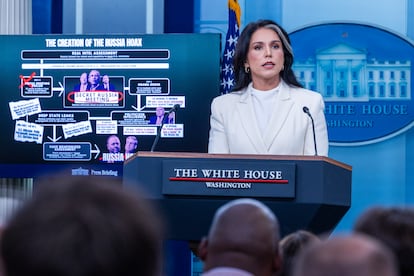

Since last Friday, the Donald Trump administration has been insisting on accusing former President Barack Obama and several senior officials of fabricating a false conspiracy to exaggerate Russian interference in the 2016 election, which Trump won.
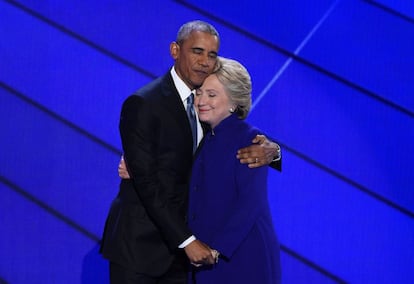
On Thursday, as pressure mounted on the president over the Jeffrey Epstein case, a group of Republican senators called on the Justice Department to appoint a special counsel to investigate Obama’s actions toward the end of his second term. Trump called it “treason” on Tuesday and suggested over the weekend that he would welcome the arrest of his predecessor, as part of his campaign of revenge against political adversaries he has waged since returning to power.
National Intelligence Director Tulsi Gabbard, who has declassified two batches of documents, including emails from Obama allies, said she has referred documents to the Justice Department to consider whether Obama should be criminally prosecuted.
According to Gabbard, there is irrefutable evidence that the former president and his team produced intelligence reports damaging to Trump that they knew were “false.” The information declassified these days proves that Obama ordered an investigation into Russian efforts to influence the election, but it does not prove that he instructed the investigation to reach a specific conclusion.
Senators Lindsey Graham (South Carolina) and John Cornyn (Texas) took the lead in calling for a special counsel, later followed by other Senate Republicans. It is unclear how they believe the work of an independent counsel appointed by the Department of Justice could reach conclusions different from those of the various congressional investigations, one of which was conducted by a Senate committee, and the intelligence community. All of them have agreed that Russia interfered in the 2016 election and that those orchestrating the campaign preferred Trump to win rather than Hillary Clinton.
“A weak attempt at distraction”
An Obama spokesperson said in a statement Tuesday, after Trump accused his predecessor of treason: “Nothing in the document issued last week undercuts the widely accepted conclusion that Russia worked to influence the 2016 presidential election but did not successfully manipulate any votes.” He also called the operation “ridiculous and a weak attempt at distraction” amid the Epstein case.
U.S. intelligence services and the FBI determined in January 2017 that Russian President Vladimir Putin had orchestrated a campaign of election interference aimed at favoring Trump. Moscow has consistently denied the accusation.
That was also the month that the now-defunct news website Buzzfeed News published the Steele Dossier, named after its author, Christopher Steele, a former member of British intelligence. The 35-page document cited anonymous sources claiming a “conspiracy” existed between the Trump campaign and the Russian government, and that Moscow possessed a recording of the then-candidate with prostitutes and was blackmailing him with it.
Steele’s investigation was paid for by Hillary Clinton’s campaign and the Democratic Party. The law firm Perkins Coie hired an investigative firm called Fusion GPS, which subcontracted Steele to investigate Trump’s business dealings in Russia.
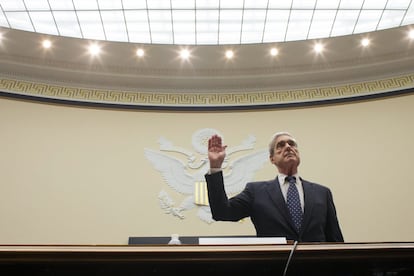
Amid suspicions of collaboration between some members of Trump’s circle and the Kremlin, the FBI and Congress launched an investigation, led by Special Counsel Robert Mueller, to determine whether there were any ties or coordination between the two sides. The outcome of the investigation exonerated Trump of all suspicions, although it left open the possibility that he had obstructed justice. Since then, the Republican president has referred to it as “the Russia hoax” and ridiculed the Democrats’ insistence on “Russia, Russia, Russia.”
According to Gabbard, the newly released documents prove that “Putin chose not to leak the most damaging and compromising material on Hillary Clinton prior to the election; instead planning to release it after the election to weaken what Moscow viewed would be an inevitable Clinton presidency. If Russia wanted to help Donald Trump get elected, they would have released this material prior to the election to harm the Clinton campaign,” she says in a press release from the Office of the Director of Intelligence. According to this statement, some of the material that Putin chose not to release before the election includes “emails detailing that Hillary Clinton suffered from “psycho-emotional problems,” “uncontrolled fits of anger, aggression, and cheerfulness.” Clinton was allegedly on a daily regimen of “heavy tranquilizers,” and while she was afraid of losing, she remained “obsessed with a thirst for power.”
Gabbard’s alleged revelations have found little traction in the mainstream media, which has interpreted them as efforts by Gabbard, a former Democratic congresswoman, to curry favor with the president after falling out of his favor for denying that Iran was on the verge of obtaining the atomic bomb, and also as an attempt to divert attention from the Epstein case. Pro-Trump media, on the other hand, have followed up on the story.









































