
Feinstein returning to Senate after facing resignation calls
The California Democrat announced in early March that she had been hospitalized in San Francisco and was being treated for a case of shingles, forcing her to be absent for two months
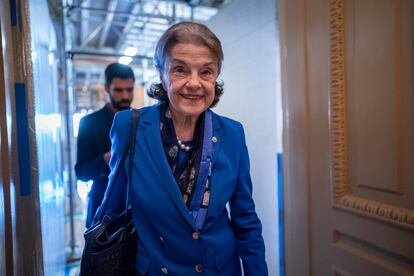
Senator Dianne Feinstein’s office disclosed Tuesday that she is returning to Washington following an absence of more than two months in which the oldest member of Congress faced calls from within her own party to resign. The 89-year-old California Democrat announced in early March that she had been hospitalized in San Francisco and was being treated for a case of shingles. But an expected return later that month never happened.
Few details emerged on Feinstein’s condition, and some Democrats openly complained that her lengthy absence was compromising the Democratic agenda in the Senate, including slowing the push to confirm President Joe Biden’s judicial nominees. Some in the House urged her to step down.
Earlier this month, Feinstein said in a statement that “there has been no slowdown.”
Senate Majority Leader Chuck Schumer confirmed Feinstein’s return in a statement and said he was pleased “my friend Dianne is back in the Senate and ready to roll up her sleeves and get to work.”
Feinstein’s office said she was traveling and expected to be in Washington Tuesday evening. It wasn’t immediately clear when she would appear in the Senate for evening votes.
Feinstein, who took office in 1992, announced earlier this year she would not seek reelection in 2024. The senator has faced questions in recent years about her cognitive health and memory and has appeared increasingly frail, though she has defended her effectiveness.
Last month, facing pressure over her extended absence, Feinstein made the unusual request to be temporarily replaced on the Judiciary Committee. At the time, she said her recovery had been delayed because of complications and provided no date for her return. Republicans in the closely divided chamber rejected the request, saying Democrats only wanted a stand-in to push through Biden’s most partisan judicial nominations.
California Rep. Ro Khanna, a progressive, was the first to call for Feinstein to resign, saying in mid-April: “This is a moment of crisis for women’s rights and voting rights. It’s unacceptable to have Sen. Feinstein miss vote after vote to confirm judges who will uphold reproductive rights.”
The politically moderate Feinstein has long had strained relations with the Democratic Party’s left wing. A handful of other progressives have also called for her resignation.
But leading national Democrats remained largely silent about her absence. The White House has expressed support for the long-serving senator and wished her a speedy recovery.
Given her age and health problems, Feinstein is likely to face continued questions about her ability to serve.
If Feinstein decides to step down during her term, it would be up to Democratic Gov. Gavin Newsom to fill the vacancy, potentially reordering the highly competitive race to succeed her. Newsom said in 2021 that he would nominate a Black woman to fill the seat if Feinstein were to step aside.
The leading candidates include Democratic U.S. Reps. Barbara Lee, Katie Porter and Adam Schiff.
Lee is Black, and becoming the incumbent could be a decisive advantage in the contest, but it’s not known if Newsom would consider Lee, given that she is already running for the seat. Porter and Schiff are white.
Feinstein has had a groundbreaking political career and shattered gender barriers from San Francisco’s City Hall to the corridors of Capitol Hill.
She was the first woman to serve as president of the San Francisco Board of Supervisors in the 1970s and the first female mayor of San Francisco. She ascended to that post after the November 1978 assassinations of then-Mayor George Moscone and City Supervisor Harvey Milk by a former supervisor, Dan White. Feinstein found Milk’s body.
In the Senate, she was the first woman to head the Senate Intelligence Committee and the first woman to serve as the Judiciary Committee’s top Democrat. She gained a reputation as a pragmatic centrist who left a mark on political battles over issues ranging from reproductive rights to environmental protection.
Sign up for our weekly newsletter to get more English-language news coverage from EL PAÍS USA Edition









































