
Mount Nelson, the luxury hotel in Cape Town where John Lennon was mistaken for a homeless person
The legendary South African establishment is home to Amura, chef Ángel León’s first restaurant outside of Spain
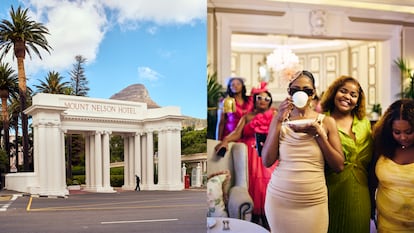
Of all the famous guests that the Mount Nelson Hotel in Cape Town has hosted in its 126-year history, none is more enigmatic than John Lennon. In 1980, the former Beatle — who, at that point, had been retired from music for five years — spent a week alone in a city where he knew no one, in a country ruled by the sinister apartheid government that had blacklisted his records.
It’s interesting how little is known about that stay. He checked into the Mount Nelson under a false name – Mr. Greenwood – and only two photographs exist to prove that this wasn’t just a myth. “It’s said that he was very tidy and made his own bed,” says Gabrielle Palmer — Gaby — the hotel’s enthusiastic communications director. “A taxi driver he befriended took him to meditate on Table Mountain. He spoke [on the phone] with his wife, Yoko Ono, regularly. And, apparently, he was planning to bring her to the hotel the following year.” She recounts this while strolling with EL PAÍS through the gardens surrounding the main building. “It’s said that a guest complained about a homeless man sitting on the grass. It turned out to be [Lennon], doing yoga in the garden.”
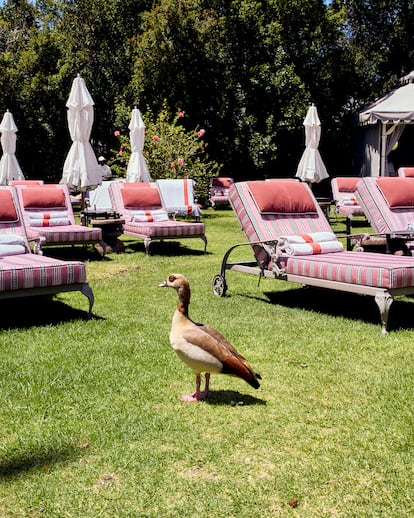
“What I love most about the hotel is that it’s an oasis in the middle of the city. It’s three hectares of green space… a sanctuary in the upper part of Cape Town,” she points out.
The first thing that strikes you about the Nelly (as it’s known throughout the city), almost more than the striking pink color of its façade — painted that way in 1918, to commemorate the end of World War I — is the activity in its gardens and buildings. The hotel’s architectural structure, a complex made up of six wings, surrounded by trees and lawns, encourages movement and serves as a meeting point for locals and visitors. From 6 a.m. until well into the night, it’s a lively place, quite unlike the stuffy luxury hotels of Europe. There’s always activity in the restaurants and on the terraces. And, from 11 a.m. onward, the lounge fills with guests arriving for afternoon tea.
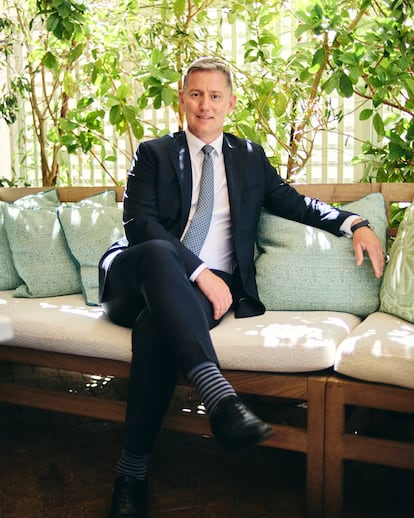
Patrick Fisher is the new general manager of the Mount Nelson. He’s only been in the position for five months, but he knows the establishment well. “My first job was as pool manager, 21 years ago,” he explains. “For Cape Town, this is much more than a hotel; it’s an icon, a landmark. Everyone knows it and has a story related to the Nelly. We want everyone to feel like they’re part of it.”
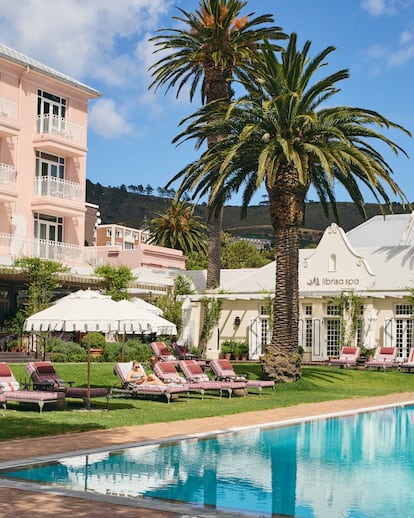
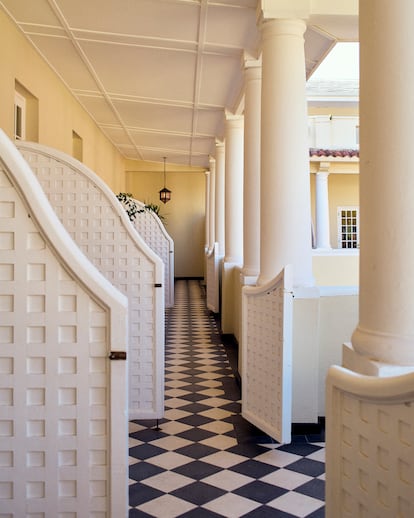

Cape Town, South Africa’s legislative capital, is situated on a peninsula. To the south lies the harbor; to the north, Table Mountain, the two-mile-long landmark that overlooks the city. Relatively close to its base sits the Belmond Mount Nelson Hotel, which opened on March 6, 1899, to accommodate first-class passengers on the Union Castle Mail Steamship Company’s UK-South Africa cruises. “Since there was no luxury accommodation in the city, first class didn’t sell many tickets. So, the company owner acquired the former governor’s residence and transformed it into a hotel,” Palmer explains. It was the first hotel in South Africa to offer running water (hot and cold) and was described as “even better than its London counterparts.”
During the Second Boer War (1899-1902) — in which the fierce farmers of Dutch descent fought against the all-powerful British Empire — the British army used it as its headquarters. Lord Kitchener, then a legendary British officer, stayed there, as did an ambitious 25-year-old correspondent named Winston Churchill, who described it as “a most excellent and well-appointed establishment which may be thoroughly appreciated after a sea voyage.” In dispatches written from a corner of the hotel, he portrayed the Boers as a noble enemy (“they fought not for victory, but for honor,” he described). This view contrasted sharply with that of another journalist who also covered the conflict from the hotel: another future Nobel laureate in Literature, Rudyard Kipling, who saw them as a people with “a primitive lust for racial domination.” It’s tempting to imagine the two arguing in the elegant bar, which still retains the aura of the colonial era.
A then-unknown Agatha Christie stayed there in 1922, while traveling around the world. Sir Arthur Conan Doyle scandalized the guests with his séances. Marlene Dietrich, Liberace, David Bowie, Margaret Thatcher and Nelson Mandela all have their own stories at the Nelly. Perhaps the funniest, though, is that of Bill Clinton, whose security team requested the removal — “for security reasons” — of 56 majestic Canary Island date palms. These trees had stood for 70 years on either side of the road leading to the main building from the hotel’s principal entrance, the Prince of Wales Gate. The monumental arch owes its name to a coincidence: in 1925, the visit of the future King Edward VIII coincided with the opening of the gate facing Orange Street.
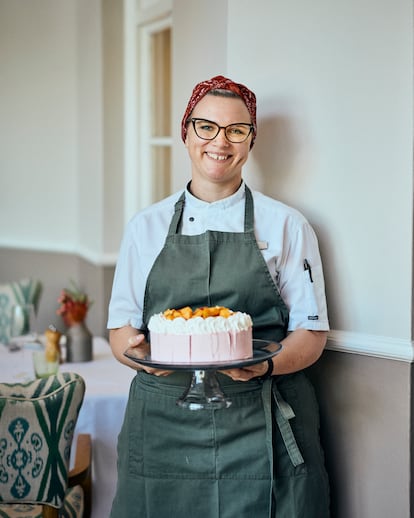
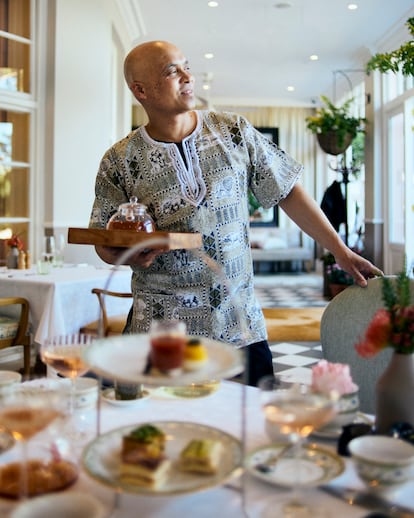
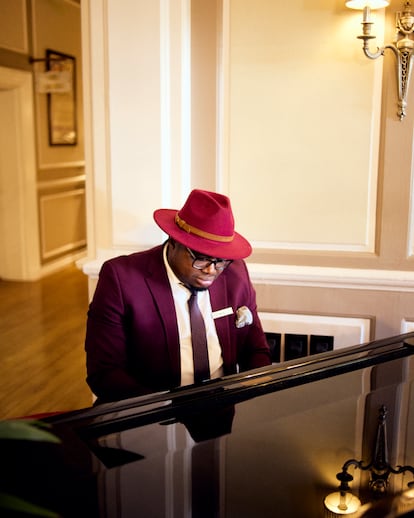
“Please allow me to refrain from naming any famous guests who have stayed at the hotel recently. It’s something we handle discreetly,” the general manager says. “What’s more important is that the Mount Nelson is a true family institution. The grandmothers and great-grandmothers of many local families were married here. Baptisms and bar mitzvahs have been celebrated here. It’s a place of joy and, at times, even sadness. You see people who have lost their partners or parents, but they return to commemorate the moments they shared. Sixth and seventh-generation families still come.”
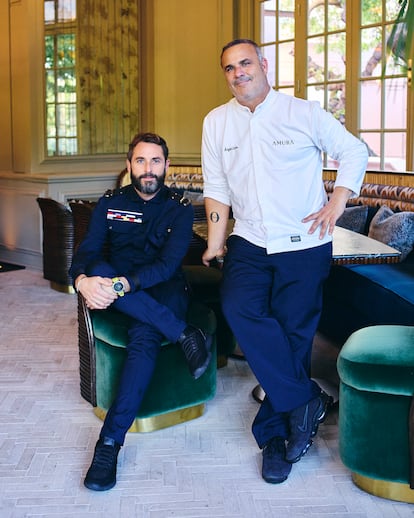
It’s early December, springtime in South Africa. And today is a significant day: the hotel is opening a new restaurant, Amura, chef Ángel León’s first venture outside of Spain. The chef from Cádiz — who boasts three Michelin stars at Aponiente, his restaurant in El Puerto de Santa María — has chosen a seemingly challenging location, 6,000 miles from home and outside the circuit that attracts big names. Cape Town has yet to be featured in the Michelin Guide.
“There wasn’t anywhere else I wanted to start something, besides Aponiente. I’ve always been a bit skeptical about starting anything new,” he explains, in his new establishment. “I’ve had offers. Many, some of them quite outrageous. Especially in big cities, like Hong Kong, Tokyo… very ambitious projects. But when I went to [those places], I felt like I didn’t connect with anything. [But] the first time I came here, five years ago, to explore the coast, I was blown away, because it reminded me a bit of the Bolonia or Tarifa beaches from many years ago. This place has a unique sea… and I loved the people.”
The luxury Belmond chain — which owns the Mount Nelson and invited EL PAÍS to the hotel — also had an interest in expanding the culinary offerings. This explains the restaurant’s bold venture of selling South Africans products from their own sea: “Here, it’s all [water], but very little fish is consumed. [It’s] a city that doesn’t value the sea,” the chef notes.
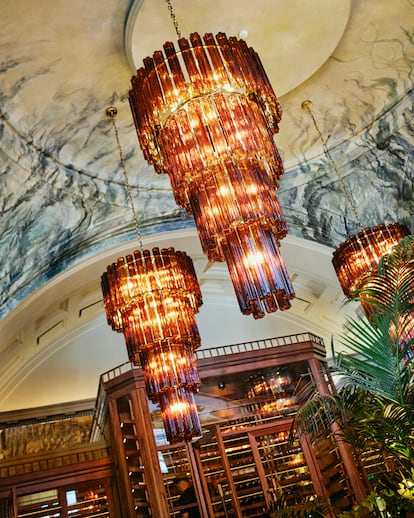
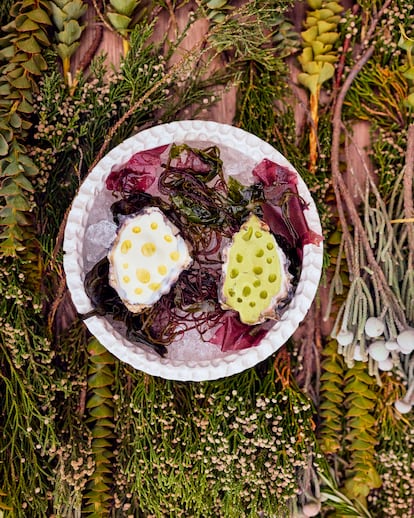
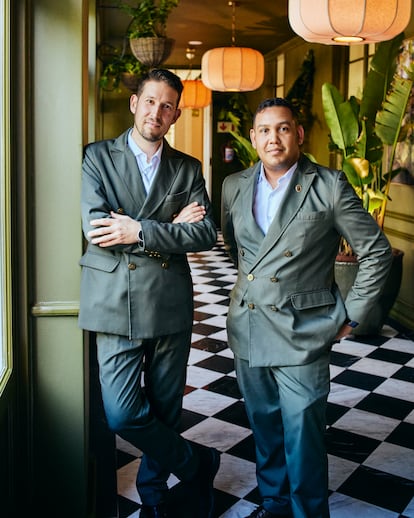
“That’s what makes Ángel’s offering so interesting,” the hotel director elaborates. “A synergy has developed between us, Ángel, his brother Carlos and their team. We needed a restaurant that would stand out. And that’s exactly what he’s delivered, with the added benefit of showcasing local produce. We’ve been working on this project for two years now and we’re very excited.”
Located in an area of the hotel previously used for banquets, Amura’s kitchen, which opened at the end of November, is overseen on a daily basis by chef Guillermo Salazar, a member of the Aponiente team: “What we bring is Aponiente’s technique, but above all, Aponiente’s flavor, which has a very specific profile: powerful, very marine, very saline flavors that are immediately noticeable. We’ve simply transformed [the menu] with local products. The idea is to attract a local clientele, while remaining aware that this is a place where people are passing through.”
In reality, a restaurant like this is the final touch that the Mount Nelson needed to complete its delightful blend of English colonial style with a hint of gold-and-pink maximalism. Palm tree prints, potted plants and mirrors are everywhere. The rooms have private terraces, enormous beds, marble bathrooms and tastefully-decorated living areas.
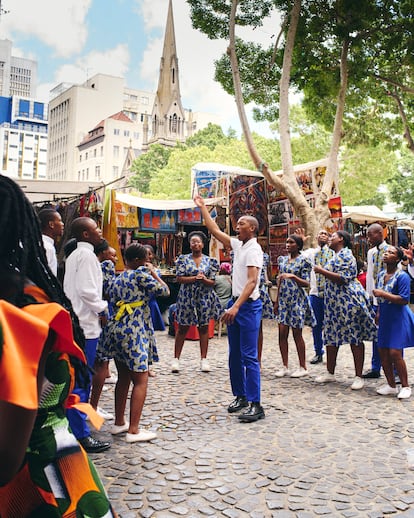
It’s this blend of history and modern glamor that makes the hotel a unique place in a unique city. Cape Town could easily be mistaken for an exotic European metropolis. And the Mount Nelson contributes to that feeling, with its luxury, its anecdotes and its famous guests, such as John Lennon.
Incidentally, the musician’s most renowned biographer, Philip Norman, dedicated a few lines to the reason for that mysterious trip: “The all-powerful numerologist Takashi Yoshikawa told him that clouds of evil were forming over his head and calculated the direction in which [Lennon] should travel to escape them,” he wrote. That auspicious direction, it seems, was southeast of New York, which led Lennon to the other side of the world: the tip of Africa. Unfortunately, that trip didn’t avert tragedy. Months later, in December 1980, Lennon was murdered in New York City. But a fragment of his memory lives on at the Mount Nelson.
Sign up for our weekly newsletter to get more English-language news coverage from EL PAÍS USA Edition









































