
Techno utopia or AI nightmare? The problem with music made by machines
Songs created by artificial intelligence are being met with disgust, but isn’t the whole point of electronic music that it’s made by robots?
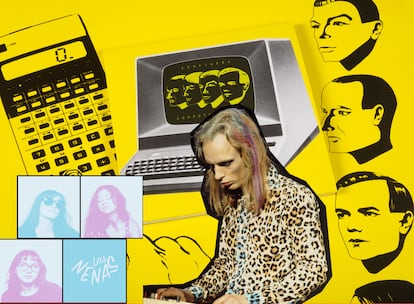
Last year, Exit From BIG D, a Detroit techno album from an unknown artist named Marcellus Young, attracted attention from leading electronic music forums. It was presented as a lost gem from 1994, a convincing story with an even more convincing sound. Even experts in the field were nearly taken in. Then the truth was revealed: Marcellus Young was AI. At this point, the questions shifted. Wasn’t this the ultimate and desired evolution of electronic music? Isn’t this what many have imagined and simulated, made reality? Artificial, synthetic music, created for and by machines, the closure of a mythological circle.
Many have fantasized about the idea of music made by machines. Or, in the case of Brian Eno, music made with minimal human intervention. The concept of generative music created by autonomous systems in perpetual variation had been explored long before the arrival of AI. It had already been predicted by Alvin Toffler in his seminal book among Detroit techno pioneers, The Third Wave (1979). Technology would transform creativity. Pioneers like Juan Atkins, Derrick May and Kevin Saunderson spent afternoons reading the book, then imagining music that would have a decidedly cybernetic essence, but also capture the deterioration of its socioeconomic surroundings.
For others, such technology was just empty talk. Kraftwerk dreamed of robot-made music, but they also initiated two decades of legal proceedings when Sabrina Seltur’s 1997 hit Nur Mir featured a sample of little more than two seconds of the group’s song Metal on Metal. In short: one of the bands responsible for popularizing the futurist calling of electronic music on a global scale led the first major judicial battle over plagiarism and use of advanced technology in musical production. But futurist thought is not always linked to a widening of perspective. James Mtume, another legendary producer in the world of funk and disco, who was responsible for popularizing the use of beatboxes and other tools in dance music, called sampling “a glorification of mediocrity.” He used even stronger language when he referred to it as “artistic necrophilia.”
But the problem has never been the technology, or even its use. The problem is creative ego. Nowadays, in our desperate reality, electronic music is clearly in a state of dissociation. On one hand, it finds itself on the frontlines of resistance against the expansion of AI, and on the other, use of tools like SUNO and UDIO are spreading like a pandemic. On the SUNO platform alone, 800,000 songs have been created via prompts — “Make a song that is an ode to my country, sung by Michael Jackson”, for example. Some are memes, jokes among peers, but it’s all the same: their formulas have been so assimilated that it’s hard to tell the difference between something that has been made by a human producer and a neural network. Many are raising their voice every day against the feared AI slop, a phenomenon that sees AI-generated junk saturating the internet and its cultural ecosystem, to the point of reducing both to a state of chronic, premium mediocrity.
There are theories that refer to all this as “the semantic apocalypse” or the infinite white noise once foreseen by Walter Benjamin: thousands and thousands of copies of the same thing, diminishing the meaning and value of what is being reproduced. But the construct lacks context: we are the ones who are optimizing our creations to fit into the design of the algorithm, and we are the ones who have turned music into replaceable formulas.
Others pass by this internal dilemma, and are contributing to the reach of these tools in the music industry. We have the example of Las Nenas, a project created entirely by AI that led to a pop group of three mysterious young people who do not, strictly speaking, exist. Also based in Spain, there’s the AllMusicWorks label, which purports to be the first of its kind: it only signs AI-created artists. The key question is if the rise of such projects is further compromising an ecosystem that becomes more saturated and precarious every day. That is to say, taking space from real musicians who struggle on a daily basis with the dissolution of an absolutely terrible market.
Just a reminder: at the beginning of the year, researcher Liz Pelly published her book Mood Machine, in which she deeply explores the tactics Spotify uses against artists. In it, the U.S. journalist uncovers the secret program Perfect Fit Content, with which Spotify is financing the creation of music made by anonymous producers and generative artificial intelligence in order to include it in the playlists it offers to users. Why? To control the highest amount of royalties possible, limiting revenue for millions of artists around the world. The Swedish company is betting on a future of cultural disengagement from music, which will go from being a shared experience to a private language. A world of total personalization and passive listening, based on moods, lacking context. We haven’t yet gotten to this point, but albums like those of Marcellus Young and Las Nenas help to lead the way. Perhaps we will someday have musical forms that adapt to a user’s environment and reality, like those imagined by J.G. Ballard in his short story Venus Smiles.
Artificial intelligence optimists argue that these entities are not so different from ourselves. That at the end of the day, this has to do with aggregating coherent information, processes and results. Perhaps they will one day face the attendant dilemmas. But for now, they have no creative ego and think of a single thing: the future.
Sign up for our weekly newsletter to get more English-language news coverage from EL PAÍS USA Edition









































