
This is how extortion campaigns target small businesses on Google Maps: ‘They can ruin you’
Organized groups in Pakistan or Bangladesh write dozens of negative comments and then delete them in exchange for money. Google is slow to remove the fake reviews

It was a Saturday in early-November of 2025. Pablo Sánchez, a manager of the moving company ServiMoving , noticed something strange online: a one-star review on their Google Maps page.
“We checked with the team to find out what had happened, which customer was unhappy,” he explained to EL PAÍS. “A little while later, another one appeared, then another… we started to get alarmed,” he added.
They quickly realized that the reviews weren’t being written by real customers. “We were baffled,” he sighed. Shortly after, they found out what was really going on. They received a message from a foreign cell phone number: they were told that a company had paid individuals to write those reviews. And, for €200 ($235), the party contacting them would delete the comments and reveal who was responsible.
Sánchez hesitated. He even spoke to the attackers on the phone: “It seemed organized, like a call center where many people were making calls,” he explained.
In the end, he didn’t pay. The company dealt with the campaign by reporting the profiles to Google and responding to each review with an explanation. Within a few weeks, the reviews disappeared, but for many days, ServiMoving’s rating dropped to just over four stars, with all recent reviews showing just one star. “Customers see your reviews, call you up, and you just insist that everything’s fine,” says Sánchez.
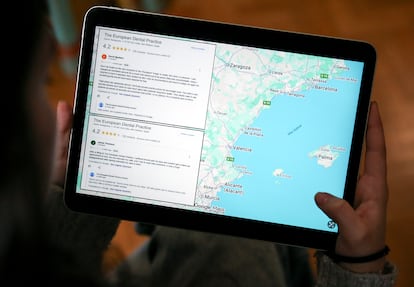
This Barcelona-based company wasn’t the only one targeted in Spain. EL PAÍS has uncovered other cases involving dentists in Mallorca, car dealerships in Alicante, locksmiths in Málaga and air conditioning installers in Murcia. The only possible commonality is that most firms had websites in English, or catered to international clients. But the reviews were in Spanish and specific to their sector: “Terrible service. I called ServiMoving Moving for a local move and everything went wrong. They didn’t stick to the schedule, [they] handled my belongings roughly and left [marks] on the walls,” wrote a certain “Paul Leisure” in one of his reviews. It was one of the fake profiles, now deleted.
‘They seemed to know a lot’
“They seemed to really know what they were talking about,” says Heidi Langkafel, from the European Dental Practice Clinic near Palma de Mallorca, another of the affected companies. “They must have used artificial intelligence. They included some pretty technical things. Then, they also started saying that our clinic was dirty, that there were traces of the previous patient’s blood on the chair, things that could completely ruin your business,” she adds.
Someone familiar with this ecosystem is Kay Dean, a former U.S. federal criminal investigator, who has been exposing cases worldwide for eight years. The owners of the dental clinic in Palma contacted her for help. Dean runs a YouTube channel called Fake Review Watch: “Google is an ocean of fake reviews, both positive and negative. And some of the negative reviews are part of extortion campaigns. I started investigating after a personal experience with a medical provider,” Dean explains.
Google ends up deleting most of these fake reviews, many of which are posted from Pakistan or Bangladesh. But those affected endure weeks of anxiety, and it’s precisely this complex digital ecosystem that allows such distress to occur. After receiving inquiries from EL PAÍS, Google replied that its systems detect and remove the vast majority of fraudulent content. The company cites staggering figures: since 2024, they have blocked or removed more than 240 million reviews and 70 million edits to Maps locations that violated policies, along with more than 12 million fake business profiles. Google says it launched a new form in the fall to prevent such extortion attempts.
The affected users, however, see things differently after experiencing one of these cyberattacks: “Google is very slow with these things; they only give very basic automated responses,” says Steve (who declined to give his last name), a salesman at Catalexcars, a car dealership in Alicante.
“I contacted Google a bunch of times. Their system for helping you is ridiculous, because they don’t let you explain; then, you have to wait for them to review [your report],” says Langkafel, from the dental clinic. Sánchez, from ServiMoving, also didn’t get much help: “There’s no phone number; I felt completely lost. Who do I call? Who do I complain to? Who do I vent to?”
During the days leading up to the publication of this article, the reviews gradually disappeared from the businesses and their ratings rose again. A few remained, but they were permanently deleted when EL PAÍS sent Google a list of the affected businesses.
One of the problems with this system is that Google forces companies to react: “Google shifts a large part of the responsibility onto businesses, forcing them to go through the hassle of reporting these reviews. They must endure the stress of a drop in ratings and, possibly, revenue, even if only for a short period of time,” Dean notes. She has seen reviews that sometimes disappeared in two days and others that remained for more than a month.
From the attackers’ point of view, the process is quite simple. They create profiles and make them restricted, thus preventing anyone from reading their reviews. To find them, Dean has to wait for the scammers to make a mistake: “It’s a lot of work, because I haven’t automated my research: I just have my eyes and my spreadsheets. The scammers sometimes forget to block one of their profiles and that gives me an opening. Then, I can piece together what they’re doing by cross-referencing the data in spreadsheets. Many of the scam profiles post fake, negative reviews against businesses on all six continents.”
“The fraudulent patterns are obvious,” says Dean, exasperated. “How is it possible that I can expose these scammers and their networks before Google can?”
Google sometimes removes fake reviews when a business reports them. However, it doesn’t necessarily remove other fake reviews posted by the same profile. “Google has created such a lax environment that scams can run rampant. And honest businesses suffer,” says Dean.
And do the scammers actually make money through this system? “Many businesses are being targeted,” Dean says. “Most businesses don’t pay, but if an extortionist manages to convince one in 20 to pay $200, I guess it’s worth it for them. I know of a couple of businesses that have admitted to paying. One of them received more fake one-star reviews a month later,” she adds.
Sign up for our weekly newsletter to get more English-language news coverage from EL PAÍS USA Edition









































