
Lamine emulates Pelé and denies Messi a second World Cup title
Spain’s winger gets the better of the Argentine and matches the precocious achievement of the legendary Brazilian player
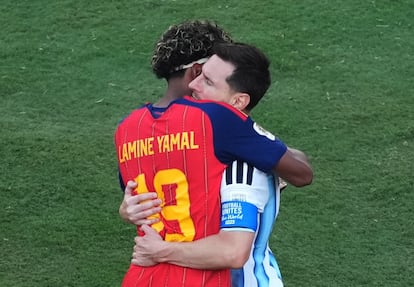

In New Jersey, soccer’s past and present converged with its most immediate future. In other words, Lionel Messi and Lamine Yamal. And they did so on the biggest stage of all: the World Cup final. The first ever between two countries whose footballing histories are as deeply intertwined as they are rich.
The meeting, and quite possibly the final itself, seemed as though it had been written by an optimistic screenwriter. Perhaps an overly optimistic one. How else can one explain a 39-year-old footballer defying time itself to arrive in the United States in dazzling form, even by his own standards? Messi refused to confirm his participation in the World Cup until the very last moment. In fact, he never publicly did so at all. Everything unfolded naturally. He wanted to prove that he could still compete at the highest level and not simply make a ceremonial appearance at his final major tournament, however much his extraordinary career might have entitled him to do so. He was no guest of honour. He was Argentina’s leader. He scored eight goals and provided four assists.
And how can one explain a 19-year-old defying conventional timelines to become the third-youngest player ever to appear in a World Cup final? Lamine Yamal was 19 years and six days old. The list is topped by Pelé, who played in the 1958 World Cup final in Sweden at the age of 17. Second is Giuseppe Bergomi, who was 18 years and 201 days old when he took the field in Spain in 1982. All three ended up lifting the World Cup.
Yet the remarkable story linking Messi and Lamine does not end there. Nor does its uniqueness lie solely in the fact that two soccer players so different off the pitch and so similar on it both emerged from Barcelona’s academy. Messi left a Barcelona bereft of hope when he departed in tears in 2021, creating a void that Lamine Yamal has gradually begun to fill, not least as the heir to his iconic No. 10 shirt.
New Jersey witnessed the third photograph in the Messi-Lamine Yamal story. The first was taken in 2007. At the time, the newspaper Sport was producing a charity calendar in which Barcelona players posed each month with a group of children. A shy but patient and engaged Messi shared a photo shoot with a six-month-old Lamine Yamal, who sat in a bathtub. They played with a small plastic duck. The image went viral two years ago, when Lamine burst onto the elite stage during the European Championship in Germany.
With the winger now a global star, even Jimmy Fallon devoted part of a monologue on his late-night show to that almost unbelievable scene: Messi bathing a baby who, years later, would find himself facing the Argentine legend in a World Cup final.

The second photograph was, if you like, less bizarre. But still, how else can one explain that four of Spain’s starters in New Jersey have childhood photos with Messi? One of them was Lamine; the other three were Dani Olmo, Marc Cucurella and Pau Cubarsí. Like so many youngsters in Barcelona’s academy, Spain’s No. 19 took the opportunity during an encounter with Leo at the Joan Gamper training complex to ask for a picture. It happened in 2017, 10 years after the famous bathtub photo.
And how can the third photograph be explained? This was the one everyone had been waiting for in the United States, Mexico and Canada. In fact, it was the only image anyone really wanted to see. Although both players are sponsored by Adidas — the German brand reportedly won over Lamine with a video message from the Argentine after Nike had tried to lure him using Mbappé — and although they have appeared in advertising campaigns for the company, their paths had not crossed again. They do not even follow each other on social media.
The hug
The greeting in New Jersey, however, was a warm one. As Spain and Argentina lined up to shake hands before the final, the world got the image it had been waiting for: Messi and Lamine together. They smiled at one another. The embrace they shared at the final whistle brought one chapter to a close and opened another.
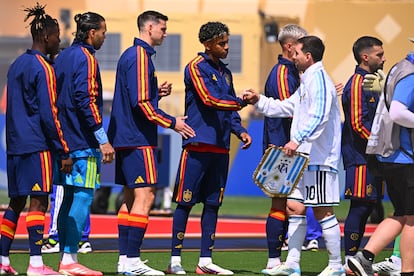
Their parallel stories reached opposite destinations at the World Cup. Messi, who had been expected to play a modest supporting role alongside his teammates, instead became Argentina’s driving force. Its only one. The problem was that Messi only plays when Argentina have the ball. Against Spain, Lionel Scaloni’s side barely saw it. Not with 11 players, and certainly not with 10.
Lamine, meanwhile, arrived at the World Cup hoping to shine in his own right. He did, but in harmony with his teammates. The number 19 lit up billboards at airports and on buildings; even in Times Square, his image rivalled Messi’s. Yet this was not Lamine’s tournament. It was Spain’s. That, ultimately, is the secret of La Roja: a team in which the whole is greater than the sum of its parts, even when one of those parts is a star like Lamine Yamal, who is seen as Lionel Messi’s natural successor.
In any case, the script could not have been more perfect for Lamine. On the day he emulated Pelé, he denied Messi a second World Cup title.
Sign up for our weekly newsletter to get more English-language news coverage from EL PAÍS USA Edition









































