
Cheikh Kane: From survival at sea to runway glory
The Senegalese migrant risked his life to reach Marbella — a photographer who spotted his potential as a model changed it forever
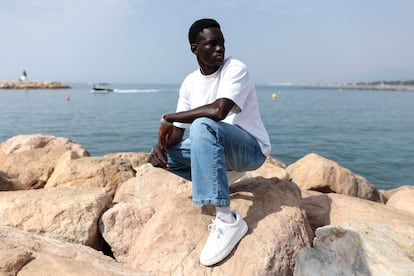

Nighttime was the worst. The uncertainty, the fear, the complete darkness. Waves beat against the boat, and the 120 Senegalese people bail out water furiously to keep from capsizing.
Cheikh Kane recalls that by the seventh day of the journey, no one could remember why they thought it was a good idea to board the boat in Senegal that was bound towards Spain. Death breathed down their necks. Some of his companions were having visions, while others vomited blood. He was losing his mind.
“I still ask myself if that was real, it’s like a movie,” he says as he watches a video he recorded with his phone during the journey, as if to convince himself that he was in fact there.
Four years later, he sighs, likewise unconvinced that this summer is real life. Kane’s professional modeling career is taking off, and he also works in public relations in the Spanish city of Marbella. “I’ve posed for Cartier, Ralph Lauren, Snipes. It’s incredible. And the best part is that I can help my family, which is the main reason why I came here,” he says in perfect Spanish with touches of an Andalusian accent.
Kane isn’t sure if he is 25 or 26 years old because his family never registered his birth. His passport says he was born in 1999 based on the decision of a Senegalese police office, who could have easily opted for the year before that, or the one after. Kane’s life started in Touba, a city with one million inhabitants located nearly 124 miles east of Dakar. He has four sisters on his mother’s side. He says that his family is “lower, extremely lower” class, and that he had few opportunities growing up.
One day towards the end of 2021, some of his fishing friends told him that they were getting ready to travel by cayuco — a long, canoe-shaped boat — to Spain’s Canary Islands, and he didn’t think twice about joining them. Soon, he was in Mbour, on the Senegalese coast, and in less than 24 hours, on the ocean after paying for a $700 ticket.
The boat’s trajectory followed the coastline for a distance of 250 miles to avoid law enforcement in Senegal, Mauritania and Morocco. They thought it would take five days to travel 1,500 miles in total, but the sea proved turbulent and soon, they thought they were all on the brink of death.
“After seven or eight days, I had lost hope,” he remembers. Then at dawn on the 10th day, they saw a tall, snow-covered mountain. It was Tenerife’s Mount Teide. When a helicopter spotted them, they joyfully broke out in celebratory song. He and his companions had survived, against all odds. Maritime rescue forces towed them to the port of Tenerife. Theirs was just one of many boats that had arrived during the same period, and although their particular journey didn’t make the TV news, they didn’t care. They were alive.
He said he was an adult, but even so, was brought to a juvenile facility. He was there for three months, until his family was able to send over his documents and he managed to get in touch with a compatriot who lived in Marbella. He took a ferry to Huelva in the Spanish mainland and then several buses to arrive at his final destination, passing through Seville and Málaga on the way. Kane wanted to start earning money as soon as possible, but his administrative situation prevented him from getting official work.
So he started selling purses on the boulevard that ran along the coast. His fear of the police and the lack of tourists — it was winter — led him to look for another option. He heard about the town of Jaén, and he went there, only to end up sleeping for three nights in a gas station until “a boss” paid him to pick olives, a gig he held for three months.
Afterward he returned to the Costa del Sol to work as street vendor, and then, in the construction industry. He also washed dishes in a restaurant. “Whatever I could do to send money home,” he says.
“The future looks bright”
Nearly three years after his arrival, he finally got a work contract and soon after, regularized his immigration status working in public relations at a Marbella boat trip company. He speaks Spanish, English and French fluently in addition to his birth language, and has managed to bring many clients to the business. Later, he began working at a watercraft rental agency. That’s when he was spotted by Aleksander Santo, a local photographer.
Santo saw potential in Kane, asked him if he’d ever worked as a model and whether he’d like to pose for a shoot. “I had no idea about any of that and I told him no. But then I agreed,” says Kane.
Santo remembers: “He came to my studio and we took some artistic photos for an exhibition, and then I took some for his modeling book.”
They put the photos on Instagram and that’s when the magic happened. “Soon other photographers were calling me, a lot of agencies, I began to go to runway shows, events… it’s been incredible,” says Kane. “
The future looks bright because he has all the requirements: height, a perfect body and he’s handsome,“ insists Santo, who is thrilled by everything that is happening to his friend. ”The only thing he lacks is work, getting more experience.”
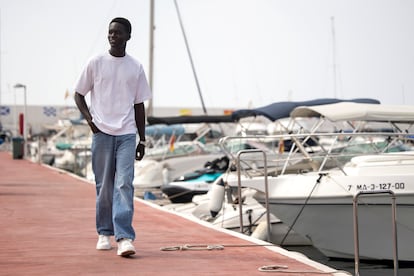
Walking alongside Kane at the port — where he now only works by day, having gotten a night job at a club named Taok — is quite an experience. He says hi to everyone he passes, changing languages like someone else might don another shirt. His smile is endless and as he walks, he also makes time to take some selfies.
It may not seem like it, but he’s been overwhelmed by the attention since an article about him appeared in SUR, a Málaga newspaper, a few weeks ago. It happened by chance: journalist María Albarral was reporting on the heavy police pressure that the Marbella city council has been exerting on street vendors this summer, and ran into Kane, who told her that he didn’t know much about the subject, but could tell her how he went from a cayuco to the catwalk. Her reporter’s instinct kicked in, and a few days later, he was front-page news.
“That changed everything. Since then, I’ve gotten a lot of work offers,” he says. “I also get messages from a ton of girls, who think I’m rich or something. I don’t answer the ones I don’t know, I don’t pay them attention.”
According to Kane, since he was in the newspaper, his number of Instagram followers has risen eightfold to over 16,000. “Not even Ana Obregón’s photoshoots get this much attention,” jokes one of his friends, making a reference to the Spanish television actress, when they see the young man accompanied by yet another member of the press. A camera clicks and Kane transforms, like someone born to be a model. “He has a good story, but then what? Instagram fame goes away fast. He should take advantage of all this to make contacts and work,” says Santo.
When the flashbulbs stop, the Senegalese man continues with his story. “The best part is that I can send money to my mother and sisters every month. Now I’m the head of the family,” he says.
But he says those words at the same time that far-right political party Vox is gaining more political presence in Marbella, under leader Eugenio Moltó’s promise that it will “combat violent bands of migrants” that are arriving to the city.
“There are all kinds,” says Kane, “but most of us are coming to look for a better life, to help our families. What other reason are we going to have to play with our lives out on the ocean?”
Though he was on the brink of death, he now thinks that suffering had a purpose. “I work, I pay taxes, I pay rent. My family is extremely happy and I know amazing people here. I don’t regret anything: it was worth it,” he concludes happily, before attending to the day’s first clients, smiling once again.
He fantasizes about walking runways in Paris, London, Milan and New York or even starring in the story of his life on Netflix. “It’s important to dream,” he says.
Sign up for our weekly newsletter to get more English-language news coverage from EL PAÍS USA Edition









































