
The Peruvian boy who commentated on the Copa Libertadores final from a hilltop and conquered Europe
Following his feat, Cliver Huamán’s channel has surpassed one million followers in a matter of days
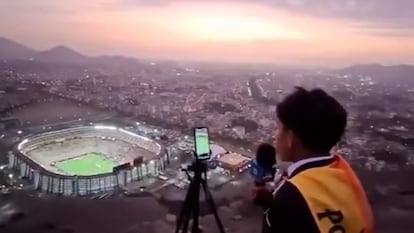

Many years before setting up his tripod high atop Puruchuco Hill — an Inca archaeological site east of Lima — like someone planting a flag to commentate on the Copa Libertadores final with a cell phone, Cliver Huamán Sánchez began training his voice with the only two videos on his father’s USB drive: one of Lionel Messi and one of Neymar. There was no cable television or internet connection in Huampica, a small town of fewer than 1,000 inhabitants, established in the early 1990s in the Peruvian Andes.
Before picking up a microphone and creating a sports channel on TikTok, Instagram, and Facebook — where his followers have grown from hundreds to over a million in a matter of days — Cliver’s hands held a pick and shovel. His palms became rough working the fields of quinoa and amaranth, at over 2,000 meters above sea level, in the province of Andahuaylas, in the Apurímac region. “You get what you work for,” his parents, two Quechua speakers who have never stopped thanking God and the land for their livelihood, would tell him.
Cliver and his Pol Deportes channel are the latest social media sensation. In the space of just a week, the 15-year-old has gone from a 16-hour road trip to Lima — that unfamiliar capital where the sky is always gray — to appearing on the main daytime television programs and being received with full honors at the presidential palace. While only neighborhood chicken restaurants used to sponsor him, now clothing chains dress him in exclusive suits and tech stores give him high-end cell phones. If security guards at the Monumental Stadium denied him entry to the final between Flamengo and Palmeiras, On December 10 the doors of the Santiago Bernabéu will swing wide open for him: he’ll be attending the Champions League match between Real Madrid and Manchester City.
Cliver had never been to Lima, and now he’s exploring Europe, arriving this weekend after getting his first passport. In his suitcase, he carries a Bible and the flag of Andahuaylas: red, orange, and yellow, colors that evoke the sunsets and the bloodshed of a fierce people from ancient Peru called the Chankas. It’s the same name given to the football club that, in 2023, became the first team from Apurímac to be promoted to the first division — a milestone that mobilized the entire region. In a world where it’s become commonplace for fans to boast about intimidating others, Los Chankas have distinguished themselves by spreading their infectious joy.
Cliver Huamán Sánchez is a product of those who still view sports with the innocence of an amateur. It was his brother Kenny, four years his senior, who convinced him that he had the makings of a sports commentator, one of those interpreters of uncertainty who cultivate the virtue of making a moment memorable. Those earthy voices that, with their intonation, rhythm, and wit, forge the myth of soccer. At first, Cliver had his doubts. For some reason, he wanted to be a policeman — that’s why they nicknamed him Pol in school — and commentary seemed like just a hobby. But Kenny reminded him that he had already made his debut on the radio. A decade ago, their father read the news on a station, and once he had Cliver, just four years old, recite fragments of stories.
“He didn’t want to make videos. I forced him. I pushed him. We even argued,” said Kenny, the blond-haired young man who has worked as a producer, cameraman, and in recent days even as his younger brother’s agent. He recently had to cut a live stream short because his phone overheated from the flood of WhatsApp messages requesting interviews or promotional material. And to think Cliver resisted appearing on camera. At first, only his voice could be heard over moving photos. But it had no impact. Nobody watched them. Then they set up a kind of studio in their adobe house. They painted a wall blue and hung posters of Messi and the Argentine national team amid his elementary school diplomas. Using a welding pole as a tripod, they pressed record and finished with a wish written on a piece of paper: until ESPN saw it.
And the Huamán Sánchez brothers’ dream has certainly come true. As soon as it was confirmed that Peru would host its second Copa Libertadores final in six years, they seized the opportunity. They organized a fundraiser to travel to Lima, which was joined by their neighbors, small business owners, and later, local authorities. The idea was to record several videos as a preview and then find a way to broadcast the match. When Cliver was denied entry — because he hadn’t arranged the trip and was underage — he felt he had let his people down. Climbing the hill by the stadium was the most desperate option to fulfill his promise to his fans.
And while from above the players were tiny, indistinguishable specks to a hawk, immediately after Danilo’s goal — which gave Flamengo victory — Kenny asked Cliver to narrate the goal as if it were happening in real time. The panoramic shot of that open-air broadcast booth… The pitch, the emptiness, and the sustained shout of “Goal!” — so professional, so amateurish — went around the world. Thanks to artificial intelligence, the scene has been animated as if Pixar or Disney had dedicated a film to it.
“I want to highlight Cliver’s attitude because he had the audacity not to get discouraged. That’s what you call resourcefulness,” says Luis Córdova, an experienced reporter who climbed the same Puruchuco hill 15 years ago, when he was covering the training sessions of the Universitario club, and the coach didn’t want the press to observe. “You only see miniatures, as if the players were pins. But it was our way of saying: we’re here. Coming down isn’t easy. It’s dead land,” he adds.
Midweek, after his image had already gone viral, Cliver set foot for the first time in the National Stadium, Peru’s main sports venue. A crucial match was being played between Alianza Lima and Sporting Cristal. The 1190 Sports production team surprised him live on air: they invited him to provide commentary for a few minutes, marking his official debut in mainstream media. But this wasn’t just any commentary booth. It bears the name of Daniel Peredo, the journalist who in 2017 narrated the historic goal that marked Peru’s return to the World Cup after 36 years — a celebration that triggered an earthquake — and who died of a heart attack months before the Russia 2018 World Cup. Peredo is the commentator Cliver admires most, after the Argentine Mariano Closs.
It was just a couple of minutes. That was all it took. After all, he’s a minor. “Cliver symbolizes the rebelliousness of the Peruvian who earns a living every day. It’s moving that a 15-year-old boy has such a clear idea of what he wants to do with his life,” says Peter Arévalo, the renowned commentator who handed him the microphone, and who became a social media phenomenon five years ago when he turned on his cell phone in his son’s room. “He was born with the talent. He has good, quite clear diction, although he needs to enrich his vocabulary. If he’s guided well, he’ll go far,” says Eduardo Combe, the reporter on the ground who interviewed him and noticed how overwhelmed he was by his popularity.
In the last few hours, advice for Cliver, or simply Pol Deportes, has multiplied. He should seize his moment. He should study. He shouldn’t get carried away. A few criticize his viral success, claiming he didn’t do much. Others are proud to have made the right person famous. “With my brother, I want to show that those of us who come from humble beginnings can also dream,” said Kenny, who has worked as a barber and baker to finance Cliver’s dream. They both remind us that soccer is also a sport where, from time to time, the underdogs triumph over the giants.
Sign up for our weekly newsletter to get more English-language news coverage from EL PAÍS USA Edition









































