
Gay man and heterosexual woman, happily married: Is this becoming normalized in 2025?
Marriage between people of different sexual orientations is not a new phenomenon, but it has ceased to be viewed as a smokescreen and now seeks to create bonds and legitimacy in a society that seems to take you more seriously if you are in a relationship


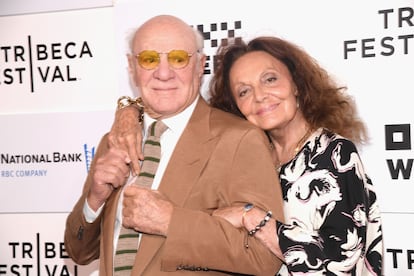
“I married two gay men,” Diane von Furstenberg told Variety. She was referring to her husband, Barry Diller, who comes out as gay in his memoir, Who Knew (Simon & Schuster, 2025), and Prince Egon von Fürstenberg. Despite their 24-year marriage, the relationship between Diller and the designer has been labeled a smokescreen. “For decades I’ve read about Diane and me being best friends rather than lovers. We weren’t just friends. We aren’t just friends. It was simply a burst of passion that lasted for years. And yes, I liked men too, but that didn’t conflict with my love for Diane,” the billionaire explained in his memoir.
In early October, The Washington Post published an article titled “He’s gay. She’s straight. They’re happily married” about “a small but growing community” of people who discuss “their non-traditional partner permutations” on social media. In doing so, the paper uses adjectives like “platonic,” “queerplatonic,” “aromanic,” or “mixed orientation.” This is how Jacob Hoff and Samantha Greenstone, for example, define their relationship. “Jacob and I are soulmates. We have a mixed orientation relationship, which means two people with different sexual preferences come together and discover that love is love, a love that transcends,” she explains on her social media.
“I am gay, and as a gay person, you can keep your identity as that even if your relationship doesn’t match that. We have a monogamous relationship. It’s beyond a visual lustful connection. It’s a soulful connection,” Hoff told The New York Times, which last year published an article about his wedding to Greenstone. Their love story isn’t far removed from the one in the eighth episode of the fifth season of Sex and the City, in which Bobby Fine, a legend of piano bars, marries Bitsy von Muffling. “Is it for money? For companionship?” the protagonists wonder, as they constantly joke throughout the episode that the groom is gay. Before the wedding, and to everyone’s surprise, Bobby and Bitsy claim they have a wonderful sex life. Together, of course. Later, in an episode where the character of Charlotte is talking to her friends about her fertility problems, a very pregnant Bitsy interrupts the conversation.
The reason for mixed-orientation relationships
Andrea Proenza Zoroquiaia, author of Cartografías del deseo amoroso (Cartographies of Loving Desire, Ediciones en el Mar, 2025), comments that relationships between gay men and heterosexual women are not new. “Historically, it has served as a safe passage to access the symbolic privileges of the heterosexual couple. Because, despite the advances of recent decades, the truth is that a gay man or a single woman still do not occupy the same symbolic place as the male-female binary,” she asserts before clarifying that she does not think these relationships are a response to contemporary heteropessimism (that current of thought which considers the love market increasingly complicated for heterosexual women), but rather to the conservative backlash that permeates both the social and the romantic spheres, and which attempts to reaffirm affective hierarchies.
“Looking back, we can see that these kinds of relationships can initially be satisfying due to social recognition or even the complicity between both parties; but in the long run, they generate frustration and unhappiness because they don’t provide what we expect from a romantic partner. So, it doesn’t seem to me that people are looking for an alternative to being fed up with heterosexual men, but rather an attempt to fit into the heterosexual puzzle on their own terms, without realizing that, from the beginning, they’re trying to put the pieces in the wrong puzzle,” she explains to EL PAÍS.
Iván Gómez Beltrán, a historian and PhD in gender and diversity, attributes the increasing number of these types of couples to several factors. “It may be linked to a certain crisis in traditional relationships and to realizing how these confine us to very specific and limited forms of affection. I think these ways of relating reflect a social context of disconnection and depersonalization through the individual needs they generate,” he explains. “The sociocultural conditions are different from the lavender marriages of the 19th century, which were performed as a mechanism of social protection against exclusion, while these current relationships have more to do with the need to give substance to other ways of connecting, as well as to find spaces of emotional intimacy that are not limited by the social code of relationships,” he asserts.
Gómez Beltrán points out that in a time of such uncertainty and sociopolitical upheaval, relationships are spaces of security and comfort. “This uncertainty coincides with processes of dislocation of the traditional heteronormative couple based on monogamy, romantic love, and modes of relating and communicating heavily influenced by gender socialization. Finding affection and intimacy with the same intensity that we were previously told was only possible within a couple means confronting the hierarchical structure of affection,” he asserts.
Gómez Beltrán also finds it interesting that many of the men who construct these norms are homosexual, because a heterosexual man wouldn’t consider a marriage that lacks love — understood in the traditional sense — in pursuit of union, stability, and legitimacy in the eyes of the world. Perhaps because, for heterosexuality, legitimacy has always been present. “This is an interesting fact when discussing the construction of heteronormative masculinity and how intertwined it is with the demonstration and expression of affection, as well as with the possibility of exploring other ways of relating. I believe that men and women are not exploring the space of intimacy and affection equally due to differential gender socialization,” he points out.
Juan Carlos R. de la Blanca, a health psychologist, sexologist, and couples therapist, points out that men in these relationships could find the affection they seek in women, without exposing themselves to some problematic dynamics present in part of the gay community, such as hypersexualization, excessive veneration of physical appearance, or certain behaviors shared with heterosexual men due to similar gender socialization.
The big question
The obvious question is: is there sex in these unions, is there passion involved, or is it a kind of legally legitimized friendship? Jacob Hoff and Samantha Greenstone certainly have sex, and in fact, when they announced Greenstone’s pregnancy, they had to clarify, given their followers’ doubts, that yes, it was the result of their intimate relationship. “We have sex. I can maintain my identity as a gay man, even though my partner is a woman, because that’s how I feel. I’m gay. When I go out into the world, I’m not attracted to women. That’s what it means to be gay!” he says.
And another question: do these couples allow themselves a fling, or is fidelity a reality? Let’s turn to a fictional novel that reflects many realities of relationships to find the answer. In Thesis on Domestication (by Camila Sosa, published in 2019 and adapted into a film in 2024), the protagonist marries a successful gay man with whom she maintains an open and sexually active relationship. “During the last few years, the zeitgeist has twisted the institution of marriage and the monogamous couple without ever quite landing on its feet, and it’s curious how the premise of this novel immediately reveals the farce behind the utopia: polyamory neither threatens nor resolves the domesticity of her bourgeois and boring marriage, but rather reinforces it,” writes Carlota Rubio in her EL PAÍS review. In another minor publishing phenomenon, Blanca Lacasa’s The Accident, the protagonist finds herself experiencing a platonic love affair that often transcends physical boundaries with a gay man in a relationship. Clearly, this possibility is becoming part of the conversation, both in real life and in literature.

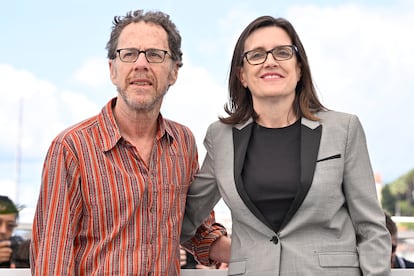
Editor and screenwriter Tricia Cooke identifies as queer and has been married to director Ethan Coen for over 30 years. “She’s queer and I’m straight and stupid,” Coen said in an interview with ABC News. They married in 1993, have two children, and both have partners outside their marriage, which they describe as polyamorous. De la Blanca explains to EL PAÍS that the fact that sex isn’t everything has long been demonstrated by couples on the asexual spectrum, and in their case, he refers to Sternberg’s triangular theory of love. “It establishes three components: intimacy, passion, and commitment. In their interaction, these could explain all types of human affective relationships. Every human being needs these three components in their life, although there are diverse ways of needing or expressing them. The important thing is that we don’t need these three components to come from a single relationship; we can obtain them from different types of bonds. This could explain the success of these kinds of relationships,” he asserts. In other words, according to this theory, yes: some of these relationships would last over time because the sexual and passionate aspects are satisfied outside their boundaries.
“Sexual agreements outside of a committed relationship require both parties to sit down and talk about what they want and what they are not willing to allow, establishing red, amber, and green lines; this is what we call a relational contract in couples therapy,” adds De la Blanca. It then becomes difficult to avoid discussing jealousy, an emotion that, as the psychologist clarifies, everyone feels to a greater or lesser degree. “What is within our control is deciding what to do with it, how to manage it so that it doesn’t turn into recriminations or passive-aggressive behavior.”
Friendship, temporary artifice, or real couples?
Andrea Proenza Zoroquiaia asserts that reclaiming — not romanticizing — bonds like friendship is truly revolutionary these days. And indeed, several recent books do just that, placing friendship on the same level as a romantic relationship (such as The Friend Who Left Me by Nuria Labari, Friendship and Its Drifts by Sabina Urraca and Marina Folguera, and My Friend by Raquel Congosto). “Through these bonds of friendship, romantic love is decentralized, and the importance of sex is diminished in an increasingly sexualized society (in this sense, people on the asexual spectrum have much to contribute). Furthermore, friendship is much more about building a network rather than focusing your life on a single person,” she explains. Gómez Beltrán emphasizes that these relationships can challenge the hierarchy of affections, but to do so, they must also question it, not simply shift it from one relationship to another. “We should question the expectations surrounding these relationships, since they are often defined by their specific duration. Unconsciously, they are contingent on finding a true partner. It would then be a kind of temporary fix until that person who meets the requirements for establishing a real bond appears,” he says.
“I think we continue to construct other ways of connecting as a temporary artifice that allows us to not feel so alone until that ‘Disney love’ emotionally completes us. Despite much reflection in recent decades, we continue to yearn for a completeness that we don’t seem to find in other relationships, especially when the social context generates so much anxiety, isolation, and loneliness. The question we might ask ourselves is how intimacy, affection, care, and responsibility connect with the relationships we create,” Gómez Beltrán concludes. Perhaps to answer that, it’s enough to consider a question as simple as it is profound: Do you love them?
Sign up for our weekly newsletter to get more English-language news coverage from EL PAÍS USA Edition









































