
Love and ageism in later life: ‘They say sexual pleasure goes away, that’s a lie’
Of the over-65 population in Spain, 24% have sex once a week, a reality that the health system tends to ignore — making it difficult to diagnose sexually transmitted infections in this age bracket
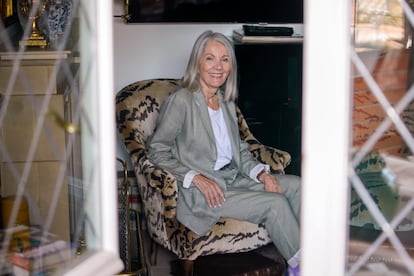

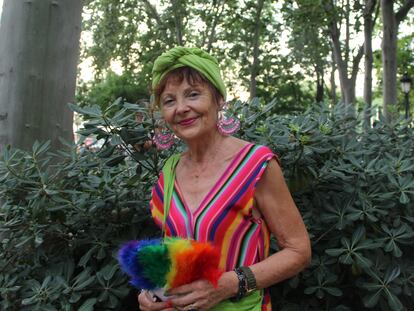
At 60 years of age, Amada was hit by Cupid’s arrow. “I felt like a 16-year-old girl,” the retired French professor confesses to EL PAÍS. “There’s no age limit to falling in love,” she says, nodding her head and causing her colorful earrings to sway back and forth. Today, there is a sexual freedom that was unthinkable in the past, yet ageism — a term that describes a silent form of social exclusion — still leaves its mark. According to a United Nations report, 45% of Spain’s population feels discriminated against because of their age.
Aging brings with it physical changes, but it doesn’t mean an end to pleasure. In a society where life expectancy hovers around 83 years — one of the highest in the world — life trajectories have lengthened, and so has the sexual life of Spaniards. Challenging the belief that such practices are the exclusive territory of youth, data reveals that 24% of people aged 65 and up in Spain have sexual relations at least once a week, according to the latest National Survey of Sexual Health.
And as increased longevity becomes nearly a global reality, similar statistics are popping up in various countries. In the United States, 40% of people between the age of 65 and 80 are sexually active, according to a survey of 1,000 people carried out by the University of Michigan. Another study in the United Kingdom found that 86% of men and 60% of women between 60 and 69 report having sexual relations. Even 10% of people over the age of 90 reported being sexually active in a study of 1,680 individuals carried out in Sweden. And while some research reduces sex to intercourse, others take a broader view, encompassing desire, affection, and physical intimacy.
Amada knows all about this. At 20, she says, “there is more strength and energy. Life wants to go on and on at that age, your hormones are running wild.” Now at 76, she takes on sex more calmly. “It’s less frequent because there’s less vitality, but it’s the same. They say sexual pleasure goes away, and that’s a lie,” she reports.
In reality, defining sexuality is getting more and more complicated. Aina Bertomeu has studied this evolution for years at the University of Valencia’s sociology and social anthropology department. What is certain, explains the sociologist, is that the term is a social construction influenced by cultural context. “Older generations have been socialized under a repressive model, one that is highly influenced by Francoism (1939-1975),” she says.
During the Franco dictatorship, value was placed on “purity,” especially for women, says Bertomeu. Sexuality was tied to reproduction and, in any case, shaped to satisfy male desire within monogamous, idealized relationships. “One single partner forever,” she says. In contrast, young people have grown up with a very different model, one that embraces a diversity of practices, identities and ways to experiment.
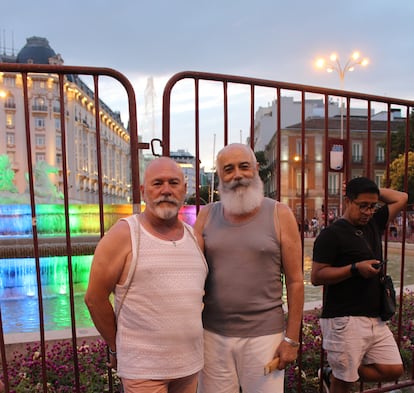
At 70 years old, Juan lived through the end of the dictatorship in his youth. He’s been with 61-year-old Enrique for more than two decades. They fell in love after meeting in a park. “I was really lucky because my family was open, but you couldn’t flaunt it. Everything was dark and covered-up,” he recalls. Despite the fact that Enrique is a decade younger, he has also had to obscure his homosexuality. “I’ve always felt a lot of pressure to hide my sexual preferences,” he says.
Today, they are able to experience their love more calmly, in a way that prioritizes coexistence. “We still have skin in the game,” says Juan. The Franco dictatorship built up a restrictive sexuality, but the sexual revolution broke many of its taboos, separating sex from reproduction, promoting pleasure and allowing for a more liberated lifestyle.
In the following decades, digitalization brought with it new ways of connecting. “Virtual spaces lead to new forms of communication, and older people can also participate in that,” reflects Bertomeu. That’s how Javier, a 60-year-old doctor and Juan, a 68-year-old former factory worker, met. They have been together for nearly a decade, and have been married for four years. “The passion of the first months doesn’t stay, but you’re left with another, more tranquil and fruitful way of spending time together,” says Javier. Are they in love? They don’t hesitate to answer in unison: “Yes.”
Desire never dies
Ageism is not just a phenomenon related to social relationships — it can also be deeply internalized. Roberto Sanz, a psychologist and sexologist at the Sepol Foundation, says that self-image is also an important aspect when it comes to enjoying sex. “Society sells us a youthful sexuality,” he says emphatically, adding: “If I stand in front of the mirror and think, ‘My whole body is sagging,’ I’m going to lose a lot of my sex appeal. I’m not going to feel comfortable alongside models.”
Bertomeu agrees: “It continues to be thought of through normative bodies. When we talk about aging bodies, they are excluded from the sexual imagination.” This is how society “robs old age of its sexuality,” says Sanza. And it does so through silence — an unease that works like censorship. If it doesn’t fit into what is acceptable, it is hidden. And that which is not visible, put simply, cannot be expressed.

Camino Villa, a 75-year-old fashion consultant, senior model and influencer born in León, is experiencing old age differently. She tenderly remembers her 30-year relationship with her husband, who died in 2020. “We were a couple in love. We were friends, but also lovers,” she says. “I liked his wrinkles, everything.”
Villa rejects outright the idea that desire disappears with age. “That is a taboo that must be erased. This thing that older people have no passion is a mistake,” she says. For her part, Amada has no qualms in discussing her romantic life: “Sex is life,” she says with a big smile. From the medical perspective, desire is energy, a biological impulse tied to the libido. But sociologically, it is thought of as something that is modeled to us by social norms, discourses and contexts. It is not “natural,” insists Bertomeu, but rather, subject to society’s values.
“Life surprises us. I don’t know know if at some point I will meet someone who I’m excited enough about to share time with. I’ve found fulfillment in what I do,” says Villa.
Uncomfortable truths
Managing desire is complicated, especially for many older women who spent decades learning to suppress it. Even when they want to get libido back, invisible norms persist, embedded in their thoughts and limiting expression in the long-term. There is in fact a clear intersection between ageism and sexism, says Dr. Vania de la Fuente, an independent consultant who is administering the World Health Organization’s Global Campaign to Combat Ageism.
“These social norms don’t affect men in the same way. They are often more legitimized when it comes to maintaining an active sex life in old age,” she says. The value placed on sexuality by older men and women varies. While 18.3% of women consider it “very important,” among men the percentage rises to 33.6%.
In De la Fuente’s opinion, sexuality should be understood as part of our general well-being. “We have to widen the approach to include desire, affection and to the diversity of ways in which people experience sex, without stigmas or prejudices,” she says. Some health professionals assume that no sexual activity exists in old age, which can lead them to skip questioning their patients about the topic.
And in a domino effect, says the expert, that oversight can lead older people to have a lower chance of getting routine tests for sexually transmitted infections, which makes their diagnosis and early treatment less likely. Sanz agrees: “The system places a lot of barriers to healthy sexuality.”
Although the absolute numbers of sexually transmitted infections among the group are not as high as they are in younger generations, rates are steadily growing. Data from Spain’s National Center of Epidemiology indicate that cases of gonorrhea, chlamydia and syphilis have tripled over the last decade among people over the age of 60. “The lack of privacy for sexual expression, together with the lack of clear policies pertaining to the subject, contribute to an ageist atmosphere,” says De la Fuente.
Health conditions like syphilis can be lethal if they are not treated promptly, and immune response can be diminished by old age, she continues. Spain’s 2011 National Sexual and Reproductive Health Strategy focuses on contraception and sexually transmitted diseases in the younger population, but none of its proposals are specifically directed toward the aging population.
“Ignoring the sexual health of older people in Spain means ignoring a significant and growing part of the population,” says De la Fuente. Excluding them from the sexual health agenda doesn’t just perpetuate ageism, it also “prevents us from responding to their needs and guaranteeing their right to a full and dignified sexual life.”
It all comes down to sex ed
Adolescents don’t want to know anything about their parents’ sexuality, and at the same time, their parents prefer not to know anything about their own progenitors. Ultimately, it’s possible to talk about sexuality in many context, but within the family, this continues to be unknown territory. Many old people get frustrated because they have desires that they can’t satisfy, or that they don’t feel free to express.
“With proper sexual education, it’s possible to talk about pleasure, intimacy, non-genital relations and of many other things that often go unsaid right now,” says Sanz. “Coital practice is, in reality, the only kind that requires having an erection,” he explains.
Sanz emphasizes that sex is not limited to penetration. “Oral sex with a flaccid penis can be very pleasurable. This is where a person’s experience enters into play: if they feel natural doing it, if its pleasurable or frustrating.” In his opinion, a range of sexual practices continues being completely viable in old age. The key lies in putting focus on erotic variables, not just in sexual mechanics.
“It’s not about the practice in and of itself, but rather how it relates to one’s lived experience,” Sanz says. In addition, he says that not all erotic experiences need involve genitals. “Cis men as well as cis women can face physical difficulties, but that doesn’t rule out pleasure. There are many sensitive areas that are worth exploring,” he concludes. Amada is well aware of this, and says, in her own words, “Sex continues until you’re gone.”
Sign up for our weekly newsletter to get more English-language news coverage from EL PAÍS USA Edition









































