
Physicists win prize for discovery of ‘magic angle’ that generates supermaterials
Pablo Jarillo-Herrero and Allan MacDonald received the BBVA Foundation Frontiers of Knowledge Award for pioneering work that allows the behavior of new materials to be transformed and controlled
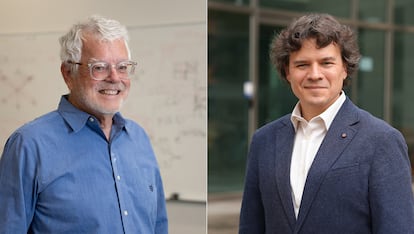

The creators of a new field of physics known as twistronics have won the BBVA Foundation Frontiers of Knowledge Award in Basic Sciences, which comes with €400,000 in prize money. Spanish physicist Pablo Jarillo-Herrero and Canadian physicist Allan MacDonald were honored at the 18th edition of the award for their pioneering work on the so-called “magic angle,” which makes it possible to modify and control the properties of two-dimensional materials.
A twist of around one degree managed to revolutionize the physics of materials. In 2011, MacDonald theoretically predicted that rotating two layers of graphene – single-atom-thick sheets of carbon – around a very precise angle of 1.1 degrees, would give rise to entirely new electronic properties. Seven years later, the Spanish researcher Pablo Jarillo-Herrero provided experimental confirmation of this idea, showing that this “magic angle” could turn graphene into a superconducting or insulating material.
Jarillo-Herrero, from the Massachusetts Institute of Technology (MIT), published the results of his research in the journal Nature in 2018. His contribution became one of the most cited worldwide that year. That discovery opened up a field of research known as twistronics, which studies how rotation between layers of overlapping two-dimensional materials allows their electronic behavior to be controlled. “It’s a recognition shared with a colleague and friend, MacDonald. Aside from that, I am the person named, but it is really an award for my research group,” explains Jarillo-Herrero.
MacDonald, who works out of the University of Texas in Austin, believes that what Jarillo-Herrero achieved is “science fiction.” Jarillo-Herrero himself states that rotating one layer of graphene on another at a specific angle was something that had never before been achieved in the history of physics. For years, Jarillo-Herrero’s team carried out a multitude of experiments until they managed to superimpose layers of very thin material at the desired angle, obtaining properties with promising industrial applications, such as the superconductivity of electricity and magnetism. The current process is still very much in the developing stage. Jarillo-Herrero compares himself and his team to “medieval monks making a manuscript.”
In a conversation with EL PAÍS, Jarillo-Herrero explains where this analogy comes from. “I am often asked what it takes to make technology or applications with these materials. I say that we know how to make a device, but only one at a time. The medieval monks made a manuscript with many flourishes that was unique, but then if they had to make another one, they did it from the beginning. We still need to invent the printing press of quantum materials to make thousands or millions of identical devices.”
This physicist admits that producing them on a large scale is still a problem. “If we could do this, they could be used for many applications in quantum technologies,” he says, providing examples such as quantum computing or ultra-sensitive light detectors, especially infrared. He gives another example: in neurological computing applications, “which is brain-inspired communication that can be useful for creating more energy-efficient artificial intelligence.”
The jury in the Basic Sciences category was chaired by Theodor W. Hänsch, Nobel Prize in Physics and one of the most influential figures in modern laser spectroscopy. In the previous edition of the award, scientists Avelino Corma, John F. Hartwig and Helmut Schwarz were recognized for laying the foundations for catalysts – substances that increase the speed of a reaction – that make it possible to have more sustainable and efficient chemistry by avoiding fossil sources, such as oil or gas.
Sign up for our weekly newsletter to get more English-language news coverage from EL PAÍS USA Edition









































