
The Iberian Peninsula is rotating clockwise, scientists report
New data shows how the approach of the African and Eurasian plates is forcing displacement that will eventually close the Mediterranean Sea
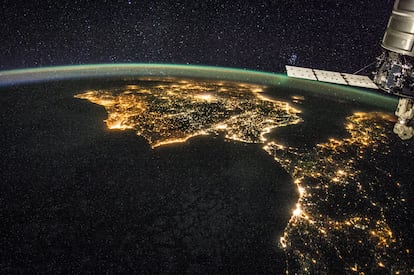

The fact the Iberian Peninsula and North Africa are coming together has been happening for hundreds of thousands of years. But how this is taking place — the way the upper part of the Earth’s crust is moving — follows a path that is still being defined. New data shows that the land that today forms Spain and Portugal is rotating from east to west, in a clockwise direction. The tectonic plates on which both sides of the Strait of Gibraltar rest are moving closer together and compressing a little more each year. The very long-term consequences will be enormous: the Mediterranean will once again become a closed sea, Africa and Europe will be joined to the west, and what is now southern Iberia will either face the Americas or will have merged with the area of Ceuta, a Spanish exclave in North Africa.
The Earth’s crust is fractured into portions that float and move on a nearly liquid and ductile lower mantle. This movement of tectonic plates is what causes continents to move closer together or farther apart, and seas to close or open. But it is also responsible for tensions that are eventually released in the form of earthquakes and volcanic eruptions. In this geological dance, “the Eurasian and African plates are moving closer together by between four and six millimeters each year,” notes Asier Madarieta, a researcher at the University of the Basque Country (UPV). “The boundary between the plates surrounding the Atlantic Ocean and Algeria is very clear, while in the south of the Iberian Peninsula it is much more diffuse and complex,” adds Madarieta, lead author of a new study that presents the latest data on the dynamics beneath our feet.
The study, published in the scientific journal Gondwana, details important dynamic processes taking place at this diffuse boundary. In the western Mediterranean, the boundary between the Eurasian and African plates is determined by the movement of the area beneath Alborán Island, off the coast of Almería in southern Spain. This area is shifting westward, causing the Baetic mountain range (from the Sierra de Grazalema to Sierra Nevada) to converge with the Rif Mountains in Morocco. This convergence is oblique, with southern Spain and Portugal rotating clockwise.
“Until now, we didn’t know exactly what that boundary looked like in that environment, and the geodynamic processes taking place there are the subject of debate,” explains the Basque researcher, a member of the Water Environmental Processes Group at the UPV. Thanks to the deployment of geopositioning sensors, and using deformation data measured from satellites or obtained from recent earthquakes, they observed “how crustal deformation and surface deformation in the western Mediterranean are related at the boundary between the two plates, located in the gap between the Iberian Peninsula and Northwest Africa,” Madarieta details.
The geologist highlights in a note the importance of the underwater mountain range connecting the two sides, the so-called Gibraltar Arc. “East of the Strait of Gibraltar, the crust of the Gibraltar Arc absorbs the deformation caused by the collision between Eurasia and Africa, thus preventing the stresses from being transmitted to Iberia,” the researcher says. But on the other side, west of the strait, “the direct collision between the plates occurs, and we believe this could affect the stresses transmitted to southwest Iberia, pushing Iberia from the southwest and causing it to rotate clockwise.”
Geodynamic changes — the result of plate tectonics — take time. The last time the Mediterranean was a closed sea was several million years ago, for example. And the data generated by satellites or human-made geodetic networks are a drop in the ocean of time, with the oldest dating back to the 1980s. “This data only offers a small window into geological evolution,” Madarieta acknowledges. So, accurately measuring geological changes that take millions of years is a science with a certain degree of uncertainty.
Sign up for our weekly newsletter to get more English-language news coverage from EL PAÍS USA Edition









































