
Hong Kong: How the Mecca of Chinese capitalism is attracting top Western scientists
The Beijing-controlled megacity is courting international researchers with astronomical salaries and cutting-edge equipment. After its success story with trade and capital flows, it now wants to do the same with science and tech
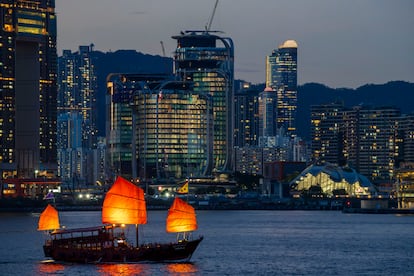

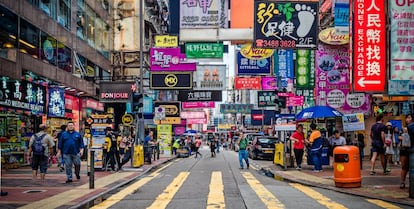
The skyscrapers, 70 stories high, are filled with tiny apartments. The streets are full of high-end shops and bustling markets. On the rooftops, the neon signs of the world’s leading banks are perched. This is Hong Kong, one of Asia’s megacities, where capitalism is late-stage. If an alien were to land here, it would never guess that the place belonged to a communist country like China. And today, the former British colony — which still maintains a degree of autonomy from Beijing and remains one of the country’s financial and commercial epicenters — is moving toward a new goal: to consolidate itself as the scientific capital of China.
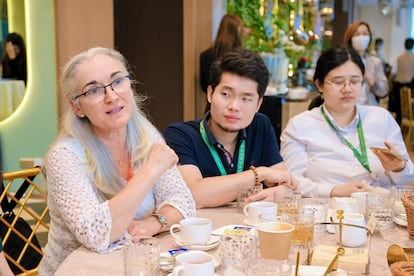
“We’re asking the international community for its support,” sums up Timothy Tong, a 73-year-old Hongkongese engineer who is also chairman of the Hong Kong Laureate Forum, which was held in early November to award the Shaw Prize, considered to be the Nobel Prizes of Asia. The event brought together 12 previous winners, as well as 200 young researchers from 20 countries, with the aim of strengthening international scientific collaboration. It’s a showcase for Hong Kong’s science sector, Tong acknowledges, as well as for the rest of China.
At the event, to which EL PAÍS was invited, there was an air of the future, mixed with echoes of the Cold War. China is already the world’s leading power in some scientific fields of research, the United States is hurtling toward an unprecedented decline in this area, and Europe is realizing that, if it wants to continue conducting world-class research, it will have to cooperate much more with the unstoppable Asian giant, even if that means swallowing its political prejudices.
In 2019, Hong Kong experienced violent protests against the Beijing regime. “Hong Kong is not China,” the demonstrators chanted. The uprising was ultimately crushed. And new national security laws have (for now) prevented any public protests, with the threat of severe prison sentences.
Today, the message is that the city can be the gateway to China for Western scientists, offering them astronomical salaries (a professor can earn around $14,000 a month), a level of freedom that’s unthinkable in mainland China, as well as easy visa-free entry. The enclave has always succeeded with trade and capital flows. It now wants to replicate this success in the field of science and technology.
Wolfgang Baumeister has just received the Shaw Prize in Life Science and Medicine for the development of cryo-electron tomography. This revolutionary technique allows scientists to see molecules atom by atom; it’s the next frontier in understanding biology and disease. For several years now, this emeritus professor from the Max Planck Institute in Germany has continued working at Shanghai Tech University, which was established in 2013 by the Shanghai municipality and the Chinese Academy of Sciences, which is the country’s top scientific body and is politically controlled by the Communist Party.
Baumeister is very clear about why he chooses to work in China. “In a 10-minute conversation with the rector, you can get a new microscope worth more than €10 million,” he asserts, in a meeting with journalists. China already has the most electron tomography microscopes in the world: 40 out of a total of 80. The Asian giant is far ahead of the United States and Europe.
The 80-year-old German molecular biologist explains: “In China, I also have no retirement age. And the authorities only require me to spend 100 days a year in the country.” The scientist maintains that things are becoming increasingly difficult for maintaining these collaborations, especially for American scientists. If they have government funding, they cannot partner with Chinese institutions. “It’s clear that science is no longer an activity without borders,” he warns.
The Shaw Prize Foundation was established in 2002 by Run Run Shaw, a Hong Kong resident (by choice) who amassed one of the city’s greatest fortunes. He produced musicals and kung fu movies for the world’s third-largest film studios after Hollywood and Bollywood. “I particularly like movies that make money,” the tycoon once replied, after being asked what his favorite films were. This quote was included in his obituary, which was published in The New York Times upon his death in 2014.
Before his death at the age of 106, Shaw donated a significant portion of his wealth to educational and medical projects, as well as to fund the three annual Shaw prizes in medicine, astronomy and mathematics, which are often considered to foreshadow some of the Nobel Prizes.
This is something that German astronomer Reinhard Genzel knows very well. He was the winner of the Shaw Prize in 2008 and the Nobel Prize in 2013 for discovering the supermassive black hole at the center of our galaxy, the Milky Way. These days, however, he’s more concerned with politics than with research. “It’s clear that the United States is falling apart; its president is destroying everything that made America great.” And yet, this “critical” situation may have a silver lining: “Europe has always been better than the United States at [partnering with others],” he explains. “There’s no doubt that there will be more collaboration with China; the question is whether the Chinese government will seek its own triumph, or accept being part of a broader objective even if this means losing recognition,” he adds.
The only woman among the 12 award recipients who were present at the recent forum was Eva Nogales, a biophysicist from Madrid, who has spent half her life working in the United States. She’s now beginning to see the consequences of the current geopolitical situation. Like other U.S.-based scientists, the American authorities allowed her to visit Hong Kong, but she couldn’t bring her computer. The reasoning for this was to prevent it from being attacked or spied on by China. “In my field, cryogenic electron microscopy, China is ahead of everyone else. They have excellent scientists [and] enormous resources… they take considerable risks and they’re carrying out the most ambitious projects,” she emphasizes.
Astronomer Simon White is a foreign member of the powerful Chinese Academy of Sciences. This director emeritus at the Max Planck Institute pioneered academic collaborations with the Asian country in the late 1980s. He has since witnessed its rise from underdevelopment to global dominance. “China has already overtaken the United States as the world’s leading producer of scientific studies. It’s only a matter of time before it also leads in quality,” the researcher notes.
After decades of collaboration, White says that German immigration authorities are making it increasingly difficult for Chinese students to study in the country, due to new laws on strategic technologies. Global geopolitics puts Europe in an advantageous position in its relationship with China, “but if we put up barriers, we won’t take advantage of it,” he warns.
One of the most striking examples of China’s new dominance is the gigantic Five-hundred-meter Aperture Spherical Telescope (FAST), which has a power that’s unattainable by any Western facility. Mathew Bailes, who was awarded the 2023 Shaw Prize in Astronomy, says that, thanks to this investment, China already dominates several areas of radio astronomy. The scientist points out that the quality of Chinese and Western studies and researchers in many fields is now indistinguishable. But he does highlight one major difference. “In the West, we advance by questioning the ideas of our elders. In China, there’s still resistance to a young student proclaiming, ‘Professor, you’re wrong’ – even if they are.” He ventures that it will be interesting to see if this cultural issue ends up changing, now that China is at the same level of investment and talent as the U.S.
EL PAÍS visited four of the 30 new research centers opened by the Hong Kong government since 2020, following an investment of over $1 billion. This is a considerable sum for an autonomous city of seven and a half million inhabitants.
In some of these research centers, there’s a feeling that one is witnessing the future of medicine. For instance, at the center specializing in neurodegenerative diseases, researchers are creating one of the largest biobanks, with samples from thousands of Hong Kong residents. Their blood is analyzed and, subsequently, they’re given an Alzheimer’s risk score, based on dozens of biochemical markers. The goal is to advance diagnosis by about 10 years and slow the progression of the disease with new drugs.
Furthermore, scientists at the center are developing several molecules that could treat the disease by modulating the immune system’s response. “[This is being done in lieu of] curing Alzheimer’s, since we still don’t understand the true causes of the disease,” explains Dr. Kin Ying Mok, chief physician at the Hong Kong Center for Neurodegenerative Diseases (HKCeND). “What we’re aiming for is to intervene so early on that people don’t fully develop the worst symptoms of the disease.”
The center, with an annual budget of over $10 million, also creates replicas of human brains with functional neurons, in order to test the effectiveness of its molecules. Staff members include leading Western experts, such as John Hardy of University College London and Swiss scientist Tony Wyss-Coray, from Stanford University. Wyss-Coray is one of the foremost experts on blood proteins that are associated with aging.
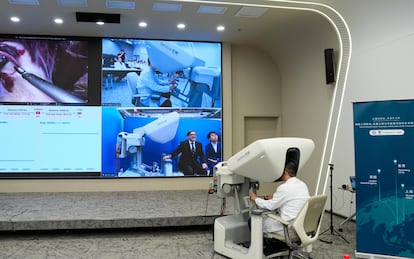
In the same technology park, another research center is developing new surgical robots that are being tested on human cadavers, which have been donated to science. One of the main objectives is to create devices with a third arm — including camera, scalpel and forceps, integrated into a single catheter — so the robots can lift tissue and remove entire areas affected by gastric tumors, which are increasingly prevalent in China and other countries.
This center is also working on developing capsules which contain millions of nanorobots. These would be inserted into a patient and guided externally by a magnetic device. In animal studies, these have already demonstrated effectiveness when it comes to dissolving clots in arteries. Once the procedure is complete, the nanorobots return to the capsule and are extracted.
The technical team at this center includes Lord Ara Darzi, a professor at Imperial College London and a world-renowned expert in minimally-invasive surgery. One of the institute’s most recent milestones is having successfully tested robotic surgery on a pig: the procedure was performed simultaneously from Shanghai, Hong Kong and London. In the coming years, these robots could bring cutting-edge medicine to remote areas.
A third center specializes in developing new drugs derived from traditional Chinese medicine. The main goal here is to get global drug agencies to approve the first compound of this kind. Such a move would vindicate a form of traditional knowledge that has been in use for 2,000 years but currently lacks scientific backing.
At the Chinese University of Hong Kong, the aim is to do more with less. American-trained astronomer Renbin Yan is developing the Affordable Multiple Aperture Spectroscopy Explorer (AMASE), a new telescope intended to have the world’s largest coverage of its kind. It’s based on the use of many low-cost lenses, not unlike those in a professional camera. Meanwhile, his colleague, Li Huabai, is finalizing an instrument that he plans to install on the Greenland Telescope, which will be deployed to the highest point of the Arctic island.
“Besides finance and dim sum, we do excellent science,” Cheng Shuk Han chuckles. She’s the director of one of Hong Kong’s largest research and development centers. And even though the city isn’t currently experiencing its best economic period (nor is China), she points out that the island’s government is still investing heavily in science and innovation. “Our message is for everyone, regardless of nationality: if you’re good, come.”
Sign up for our weekly newsletter to get more English-language news coverage from EL PAÍS USA Edition









































