
‘Messor ibericus’: The ant that lays eggs of two different species
The discovery, published in ‘Nature,’ could force scientists to redefine what constitutes a species
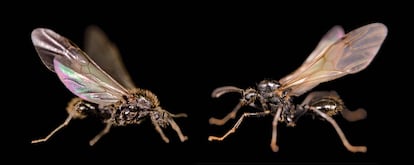

With the first warm days of spring or summer, after the initial rains, frenzy breaks out among the ants. Virgin queens go in search of one of the many males of their species, who, in a synchronized manner, also leave their colonies. During this nuptial flight, they mate with as many males as they can, storing their sperm. It will be the only time in their lives that they do so. Back in their colony, they will use it to produce new queens, a few males, and an army of workers for years. This is what most of these hymenopterans do.
But there is one queen that mates with males of two different species and, not only that, lays eggs from both. The discovery, published in Nature, could force scientists to redefine what constitutes a species.
The Messor ibericus is, as its name suggests, native to the Iberian Peninsula. But its colonies are found across the entire southern belt of Mediterranean Europe, from southern Spain to Greece. It is a harvester of grasses, so it is easy to see it marching in single file across pastures, carrying a grain many times its weight.
By analyzing the genes of several hundred ants of the genus Messor, a group of entomologists discovered that 164 of them were actually hybrids. What caught their attention was that all of them were M. ibericus workers. When they examined their mitochondrial DNA (inherited from the mother), the scientists confirmed that they belonged to this species. But when they analyzed their nuclear DNA (inherited from the father), they saw that the father was a Messor structor. The mystery did not end there. In fact, it was only beginning.
Among ants, it is not uncommon for queens to mate with males of other species. There is even a term for the most extreme situations: sperm parasitism, where a queen forces males outside her species to mate with her. Here, the queen parasitizes a male who does not follow a basic rule of evolution: ensuring the survival of his own species. What is rarer — but not unheard of in the world of ants — is that this union produces the workers that every queen needs to maintain her colony, as is the case with M. ibericus.
But what is truly extraordinary — and has left entomologists astonished — is that she lays eggs of her own species and of M. structor.
“Queens can produce males of their own species (as typically happens in other animals), but they also produce males of another species,” explains Jonathan Romiguier, an entomologist at the Institute of Evolutionary Sciences at the University of Montpellier in France and senior author of this research.
What makes this surprising is, first, that ibericus and structor, though belonging to the same genus, diverged more than five million years ago, so they are neither sisters nor even distant cousins. And second, and more surprisingly, the distribution of M. structor colonies stretches from the fields of Bulgaria and Romania, across several other Eastern European countries, to Austria, Switzerland, and eastern France. Only in Swiss territory and in a small part of France do they coexist with M. ibericus nests.
So how are there hybrids as far south as Sicily or the Spanish town of Jaén? How do queens of one species each spring manage to find males of another species living thousands of miles away?
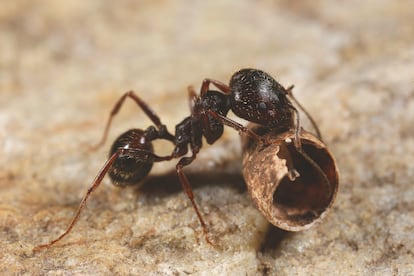
“M. ibericus can now clone M. structor males, so it doesn’t need M. structor colonies in its environment,” explains Romiguier.
In the past, thousands or perhaps millions of years ago, the two species shared the same geography. As they still do today in a small part of France and Switzerland, the queens of the former found wild males of the latter. At some point, they began parasitizing them and achieved what now astonishes scientists.
“Basically, M. ibericus initially acquired sperm from M. structor in areas where the two species used to overlap. By cloning this sperm, it can maintain this clonal lineage independently,” says Romiguier.
Here, the queens have a permanent source of sperm, which allows them “to produce new workers and males in subsequent generations, which made it easier for M. ibericus to colonize areas where M. structor is not found naturally, such as Sicily or Andalusia,” he continues. The authors had to invent a term, xenoparity — something like “giving birth to a stranger” — to describe a female of one species producing offspring of another.
For Francisco Martín, a biologist at the Autonomous University of Madrid, “the fact that the queen produces two types of males, one of her species and another of a different species is what’s a bit mind-boggling.” Martín, who was not involved in this work and studies ant communities and their role in ecosystems, believes that “something like this has never been seen in biology; but if there’s any group where there was a chance of finding a situation as unique as this, I would have voted for the ants.”
Where both species overlap, queens mate with males from M. structor colonies or with clones. “But in Spain, where they don’t overlap, they have lineages of domesticated males that have been cloned for several thousand years,” says Martín. Thanks to this, the new M. ibericus queen, “when she founds a new colony, is already capable of producing four types of offspring,” he says.
“In general, sexual reproduction in ants is haploid/diploid,” explains myrmecologist Silvia Abril, from the University of Girona. “Within the colony, haploid and diploid individuals are created. Haploids come from unfertilized eggs; the queen decides whether to lay them unfertilized or fertilize them with the sperm stored in her sperm cell.”
She continues: “The unfertilized egg is haploid because there is only one genetic copy, which is usually that of the mother, and from that, males will always emerge. When she fertilizes the eggs, we have a diploid because there are two copies of each chromosome, one from the mother and one from the father [as occurs in mammals]. These diploid individuals are the females, who will later become queens or workers, depending on the food or care the larvae receive.”
But M. ibericus has turned everything upside down.
“What’s new and very striking‚" in Abril’s words, is that M. ibericus queens can lay unfertilized, haploid eggs, remove their own DNA, but incorporate the male’s DNA, producing successive generations of clones. It’s the same as what humans have achieved with modern cloning techniques. In nature, there is thus an animal with four types of offspring: through parthenogenesis, it produces males of two species — its own and M. structor — some with its DNA, others with foreign genetic material. By mating with the latter, it produces the worker caste, and by mating with an M. ibericus male, it produces the next generation of queens. “It’s marvelous,” concludes the myrmecologist.
Alongside the now-retired Xabier Espadaler, ecologist Xim Cerdá from the Doñana Biological Station may be the Spanish scientist who knows the most about ants. He was familiar with Romiguier’s team’s work, having discussed their findings at recent myrmecology conferences before they were published in Nature. For Cerdá, what they have discovered changes the paradigm of what defines a species. “The classic concept says that it is a group of organisms with similar physical and genetic characteristics that can reproduce with each other in nature and produce fertile offspring,” he recalls. “But it turns out that’s not the case; two species are needed here. We’re going to have to rethink the concept.”
Sign up for our weekly newsletter to get more English-language news coverage from EL PAÍS USA Edition









































