
Pulitzer Prize winner Jason Roberts: ‘One of the great challenges of today’s world is the appeal of simplism’
The writer has won the prestigious award in the Biography category with ‘Every Living Thing,’ the story of a confrontation between two great scientists that defined modern biology

True science has always been a matter of life and death. From the 1803 Spanish expedition to vaccinate people against smallpox to Iranian nuclear engineers, and including the scientific race of the 1980s and 1990s to stop AIDS. In the 18th century, the Swedish naturalist Carl Linnaeus sent his followers around the world in search of as many species as possible to complete his classification of all living beings. Many never returned. Christopher Tärnström died of tropical fever en route to China; Pehr Löfling was killed by malaria in Venezuela; Carl Fredrik Adler died on the coast of Java; and Peher Forsskål passed away in Yemen.
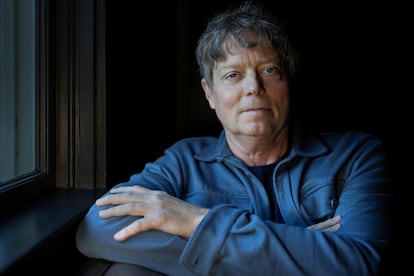
Jason Roberts, 63, considered writing a book about the adventures of these heroes of the Enlightenment, but when he began to delve deeper into their lives and those of their mentor, he saw that “they were not that very enlightened.” That was the embryo for Every Living Thing: The Great and Deadly Race to Know All Life, which this year won the Pulitzer Prize for Biography.
As Roberts recounts in a video chat, Linnaeus’ effort to classify life — which left us the Latin binomial nomenclature system for species (Homo sapiens), embodied in his Systema Naturae — was also an attempt to dominate nature and other peoples, an impulse that materialized in the colonialism of the decades following his death in 1778. As Roberts delved deeper into the Swedish researcher’s life, so grew the figure of another scientist, Georges-Louis Leclerc, Comte de Buffon, who produced his own colossal compendium of existing life in his Histoire naturelle.
Both have been portrayed by the U.S. writer in a double biography that is also a story about the ideas that transformed our way of understanding life. These two contemporary scientists, who confronted their ideas but never met in person, also represented two opposing ways of viewing existence. In contrast to the power of knowledge to dominate the world embodied by Linnaeus, Buffon represented the capacity of science to assimilate complexity.
Question. I have the feeling that you find Buffon more accurate and even more likable than Linnaeus. Yet for many years, it seemed that Linnaeus, with his rigid way of interpreting nature, was the winner. Why do you think his ideas, at least for a while, were more appealing?
Answer. That took me a while to figure out. Basically, I found that the Linnean system, particularly with the British Empire and American expansionism, just really suited the spirit of the day. People wanted certainty. They didn’t want uncertainty. And they had no interest in listening to Native cultures.
In many ways, the Linnean system kind of became this form of cultural colonialism because you were able to wipe the slate clean and award a name to a species. Not only that, but the idea that everything was fixed and that there was this specific order and that there were no surprises and that Linneus had somehow happened on to the divine vision of the way life was organized. In fact, that’s why he was called “God’s registrar.”
Whereas Buffon’s worldview was much more disturbing to them, but much more dynamic. He was the first person to actually say that we are living in the era of humans, that humans are permanently changing the global climate. And that was something that was ridiculed in his time. He was an advocate of concepts not only of evolution before that word was invented, but also of extinction. Linneus was locked into this very rigid, very organized, static view of nature. Whereas Buffon was saying it’s very dynamic. The more I researched it, the more I understood how he kind of buried his ideas in his work, because he knew quite well that the period of the time wasn’t ready for some of his ideas. This made him an even more interesting figure to me.
Q. It also seems that in a time of uncertainty like the one that followed their deaths, with the French Revolution and the Napoleonic Wars, that precise, closed model of how the world works was preferred. A bit like today.
A. Very much so. I agree with you that one of the things that we’re dealing with in our world culture right now is the appeal of simplism, the idea that there are simple and easy answers. And I wonder whether that is a response a lot of people are having to all of a sudden being flooded with so much information and being overwhelmed. So they want to be able to extract order and they don’t want to feel unintelligent. I think that’s one of the appeals that hypersimplistic worldviews offer to people: the idea that they can comprehend things and it’s really this easy.
I‘m seeing a lot of trends that are anti-intellectualism but also anti-conflict. The American political system right now is just a textbook example of simplism trying to assert dominance over what is in fact a very complex political reality. There’s this idea that when intellectuals say something is complicated, they’re just trying to act smart, and that in reality, everything would be much clearer with just a little common sense. Being able to appreciate complexity, to know that we don’t necessarily know everything about a subject, is a social value that I think we need to rediscover.
Q. In the book you also talk about the simplicity of the Linnean system, which provides security and gives the feeling, even to non-specialists, that you can control nature in a simple way.
A. The metaphor that Buffon himself proposed, and which I took to heart, is the difference between a mask and a veil. He personified nature as a kind of veiled Mother Nature. He said that we can only occasionally glimpse some of its workings behind the veil, and that only with a great deal of patience and time. For him, the Linnaean world tree was like imposing a mask on nature: slapping a false face on it and saying, “This is what there is, this is how it works.” And that, in doing so, you missed out on a lot.
Buffon had an open mind; he allowed himself to be constantly surprised by nature. Instead of explaining it away and normalizing everything, he relied on that sense of wonder. And that’s how he managed to write almost 30 volumes describing nature, with prose that has beautiful flights of language, because he was trying to capture the experience of what it felt like to be in the presence of these animals. And that’s completely different from the stark catalog where things are confined to a few words, conceptually pinning a specimen to a wall a putting a little label on it.
So what I tried to do in this book was to propose something like Buffon. Because, as I said, I did not start out in favor of one over the other. What I did was look for where the surprises lay, and try to understand where my expectations fell apart.
Q. Where did you find the biggest surprises?
A. I came across things like Buffon talking, essentially, about the concept of DNA more than two centuries before it became a science. He was saying something like if there are these principles that nature follows to create an animal from gestation, from the moment it’s an embryo, then there must be some kind of structure, some internal mold, a force that shapes it. And what happens is that, over time, there are small variations in those instructions. Those differences could be the origin of evolution.
One of the anecdotes I include in the book is that Darwin, who had never initially read Buffon, said when he finally did, “His ideas were laughably like mine.” And in On the Origin of Species he included a note crediting Buffon for being the first to address these ideas scientifically.
Q. Did being a great mathematician help Buffon develop these ideas, to better understand the inner workings of living beings? Because he wrote about biology in the 18th century with great foresight.
A. That’s one of the things I find most interesting. When you look at the personalities of these two men, you’d think their philosophies would be switched around. Buffon was the one who had a fine mathematical mind, was incredibly disciplined, incredibly organized, and lived life according to a very rigid standard. You’d think he’d be the one more drawn to categories, the one imposing structures on nature. Whereas Linnaeus, emotional and impulsive, did things you wouldn’t imagine a professor would do, like break into his students’ apartments and steal specimens he’d given them. You’d think he’d be the one with the more fluid notion. But it was the other way around.
And that tells me that if Buffon, with all his sense of order, ended up admitting that we can’t — at least at this point in the human experience — capture lightning in a bottle and say we understand what’s happening in nature, then maybe that’s precisely what we need to embrace. The idea that to understand nature, to help save it, we have to acknowledge what we don’t know, is something that is just starting to kick us in the face.
Q. How can this awareness of complexity help us, instead of taking away our self-confidence and making things more difficult for us?
A. Last year, for example, it was discovered that where we thought there was only one species of giraffe, there were actually four, which completely changes the conservation effort. It was information that was right under our noses, but we didn’t see it because we had fallen into this kind of complacency induced by labels and appearances.
Meanwhile, there’s one particular type of marine mollusk — a periwinkle — that’s been classified as a different species more than 200 times, and it turns out it’s actually just one species. This idea that we’ve been forcing categorization on nature, and that maybe our eyes are starting to clear up a little, couldn’t come a minute later. Because if we really want to understand what we’re doing to the planet, to our place in nature, and how we can maintain a safe environment, that idea of the environment as a rigid set of little labels isn’t going to work. We’re going to have to lean into complexity in order to understand nature, because we are part of that complexity.
Q. I don’t know if you think that the fact that Linnaeus classified us as Homo sapiens, attributing rationality to us as a fundamental trait, has generated a misunderstanding and has generated overly high expectations of our species.
A. What I really struggled to forgive Linnaeus for was that he assigned what we now think of as racial categories. The thing is, much of this book is set in a time before the terminology took on the meaning it has today. At that time, the term race wasn’t used in the current sense. It just meant any group that you’re talking about as a whole: you might talk about the “race of the Spaniards” or “the human race.” So Linnaeus didn’t use the word race in that sense; he might have been thinking more in terms of subspecies or something like that. He didn’t label it as such, but he was the one who divided Homo sapiens into four categories. And that, based on external appearance, skin color, could be seen as a cultural glitch or a lack of foresightedness. But what he did — and this surprised me — was ascribe emotional values to them.
He said, for example, that Homo sapiens africanus was guided by whim, whereas the European was guided by law. That kind of classification literally injected these kinds of ideas into what we call science today, from the very beginning. While I was writing the book, the Linnean Society of London issued a statement acknowledging that the roots of scientific racism can be traced back to Linnaeus, and that it’s a part of his legacy they’re trying to revisit.
Sign up for our weekly newsletter to get more English-language news coverage from EL PAÍS USA Edition









































