The mystery of orange cats is solved: A gene explains why most are male
Two independent studies have identified the same genetic mutation on the X chromosome as being responsible for the reddish coloration in domestic felines
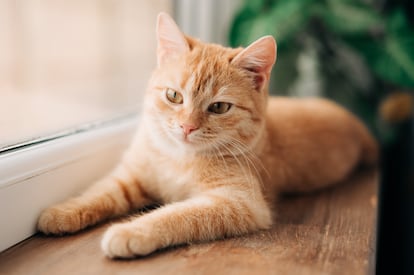

From Garfield to Nurang, a feline who recently went viral for stealing the hearts of thousands of tourists at Bangkok International Airport (Thailand), orange cats have left their mark on popular culture. Their image, which had already been immortalized in Renaissance paintings, is associated with a reputation for being mischievous, sociable, playful, and lovers of chaos. Beyond their unique behavior, these vibrant redheads have sparked scientific curiosity: behind the origin of their color lies a genetic mystery that now has an explanation. Two independent studies conducted by U.S. and Japanese scientists have analyzed the genetic origin of the color in these cats.
Working independently, both teams arrived at the same conclusion, which was published on Thursday in the journal Current Biology: the orange fur of cats results from genetic variations on the X chromosome, one of the two sex chromosomes. What makes this trait unique is that it is sex-linked — something not observed in any other mammal.
Gregory Barsh, from Stanford University in the United States and Hiroyuki Sasaki, from Kyushu University in Japan, and their respective colleagues analyzed feline genomes to identify which protein, encoded by a cat’s genes, enhances the orange hue. Although this genetic anomaly was discovered over 100 years ago, the precise molecular identity of the mutation remained unknown. Typically, mutations deactivate a gene or reduce its expression. In this case, however, the opposite occurs, making it a distinctive DNA irregularity.
ARHGAP36 is a gene on the X chromosome that encodes the protein responsible for the orange coloration in cats. “The color is due to the loss of a fragment of DNA, which causes ARHGAP36 to be expressed abnormally in pigment cells, or melanocytes,” says Barsh.
The gene is not deleted, but it is located near the deletion site, which can alter the reading of the DNA sequence. This is a harmless mutation, in an area where it is not expected to have a negative effect, like fur.

This reddish hue is found in mammals such as orangutans, golden retrievers, tigers, and humans, but only in domestic cats is the color sex-linked, appearing more frequently in males. “We believe that these types of regulatory mutations are the main drivers of species differences and constitute one of the great forces of evolution,” adds geneticist Christopher Kaelin, co-author of one of the two studies alongside Barsh.
The predominance of males among orange tabby cats had long suggested that the redhead gene was located on the X chromosome, but until now, no one had pinpointed it. After a century, that hypothesis has finally been confirmed. Males, possessing only one X chromosome (paired with a Y), will display orange coats if they inherit a copy of the ARHGAP36 gene from one parent. Females, with two X chromosomes, must inherit both copies of the gene to have a fully orange tabby coat, which is why they are much less common.
Cats that inherit only one copy of the orange gene — while the other copy is for black fur — have a patchy coat, either with a mottled tortoiseshell pattern or with the orange, black, and white markings typical of calico cats. This results from a genetic phenomenon called random X-chromosome inactivation, where one of the two X chromosomes is deactivated in each cell. The outcome is a mosaic of pigment cells: some express the orange color, while others do not.
Sasaki’s team analyzed the DNA of 18 cats — 10 with orange fur and eight others — and found that all the orange cats shared a specific deletion in the gene.
Meanwhile, the U.S. scientists conducted a functional analysis using cells and tissues from orange and tortoiseshell cats. “One of the key experiments in our study used fetal tissue from cats obtained at spay/neuter clinics, which helped us trace how the mutation operates at the cellular level,” explains Kaelin.

This is because cats are not typical experimental models — like laboratory mice—notes Priscila Ramos, a senior scientist at Spain’s National Institute of Agricultural and Food Research and Technology. “Studies rely on samples obtained from clinics or from animals that have died of natural causes, which makes it more challenging to conduct research that involves direct manipulation of their DNA,” adds the genetics expert.
A genetic puzzle
The ARHGAP36 gene was being investigated by scientists in the fields of cancer and developmental biology. It is normally expressed in neuroendocrine tissues, where it can cause tumors. Its effect on pigment cells was unknown.
“In human studies, [the gene] had been associated with developmental problems or cancer. In cats, it has not been seen to be expressed in these tissues, and when this mutation occurs, it only influences melanin production: hence the appearance of orange fur,” explains Ramos.
Scientists say that efforts to understand how domestic cats developed their diverse colors and patterns provide a gateway to exploring the origins of other physical traits — from cheetah spots to dolphin physiognomy.
The discovery was made possible in part by recent advances in genomic resources for cats, which have only become available in recent years. Christopher Kaelin points out that much of the genetic research over the past 30 years has focused on mutations in single genes. “In our case, the mutations are found across 98% of the genome,” he concludes.
Sign up for our weekly newsletter to get more English-language news coverage from EL PAÍS USA Edition