
US strategy in crisis in the Asia-Pacific
Washington’s security policy in the region is now definitively called into question following Trump’s decision to scale back military exercises with Seoul
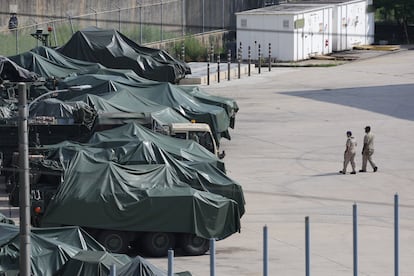

Since his return to the White House, foreign policy analysts have urged a focus on Donald Trump’s actions rather than his rhetoric. The president’s recent order to sharply curtail joint military drills with South Korea sends a signal that neither Seoul nor the wider region can ignore. It is yet another instance of a pattern that combines pressure and punitive measures toward U.S. allies with a warming of personal ties with authoritarian leaders. The episode casts doubt on U.S. national security policy in the Asia-Pacific in the face of China’s growing military power, while reminding allies of the need to take responsibility for their own defense as quickly as possible.
Trump has singled out Seoul for refusing to join the operation against Iran and for failing to implement any of the $350 billion in investment projects it pledged under the trade deal with the U.S. in order to avoid tariffs. In doing so he echoes Pyongyang’s argument that the operations are “inappropriate and hostile.”
The U.S. and South Korea have held annual military exercises for more than 70 years, a cornerstone of the framework that has sustained the Korean peninsula since 1953 and the defensive architecture of the Asia-Pacific. They serve to deter potential adversaries — in this case North Korea — but also to demonstrate allied cohesion against the Chinese threat, improve military interoperability, and reaffirm Washington’s security commitment to the region. A strategy now definitively called into question.
This month, the aircraft carrier USS George Washington sailed from the Pacific bound for the Arabian Sea, leaving the region without the presence of any U.S. carrier. In March, the Pentagon withdrew part of the THAAD missile-defense system from South Korea — a key layer of the country’s air defenses — as it again shifted resources toward the Middle East.
The military drills entail undeniable economic and munitions costs, and the impact of the war with Iran on U.S. stockpiles is evident. The situation has alarmed allies, who are seeing weapons shipments delayed, including Tomahawk missiles to Japan and the long-planned arms sale to Taiwan, amid protests from Beijing. If anyone can be pleased by this change of course, it is China’s president, Xi Jinping, who will travel to Washington in five weeks.
Sign up for our weekly newsletter to get more English-language news coverage from EL PAÍS USA Edition









































