
Our last bracero: my father’s hat
Lorenzo Salgado Araujo, who was killed by federal agents in Houston, wore the same hat as my father: one that symbolizes the hard work of millions of Mexican immigrants in the United States
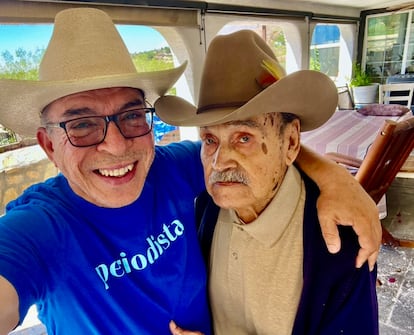
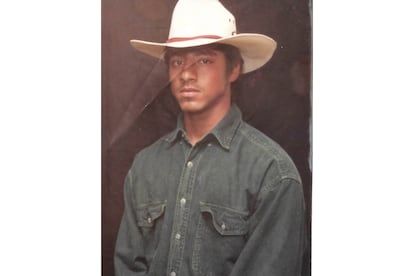
It was the white cowboy hat worn by Lorenzo Salgado Araujo, the Houston man shot and killed by federal immigration agents, that first rattled me.
As the evening’s Spanish-language newscast blared on about yet another victim of the American terror growing along with the number of raids by U.S. Immigration and Customs Enforcement (ICE) officers, I caught a glimpse of a photo of Salgado Araujo in the hat he often wore. I turned my gaze from the television and stared at my father’s own tightly woven cowboy hat that stood as our family’s timeless homage — a sombrero symbolizing the hard work of millions of Mexican immigrants, their sweat, tenacity, and grit that has helped a fickle United States in times of war or economic trouble. Tears welled up in my eyes.
Suddenly, I couldn’t face my mother, who was watching the evening news with me. I avoided her eyes, which were searching for mine. The jaded, veteran journalist who’s seen it all, speechless, saddened. I questioned how I could impartially cover this latest ICE killing when it felt so personal. Salgado Araujo’s killing at the hands of ICE agents paid with our tax dollars felt like an attack on my own family. I wasn’t alone.
In countless homes of Mexican and Mexican American families across the United States, millions of stoic men wear the same hat, to protect them during long hours toiling under a scorching sun, working farm fields in downpour during the harvest. They also proudly wear cowboy hats at family social gatherings, echoes of the braceros — the men with strong arms welcomed by the U.S. during times of war to fill a critical labor shortage. Generations of families trace their roots to the bracers.
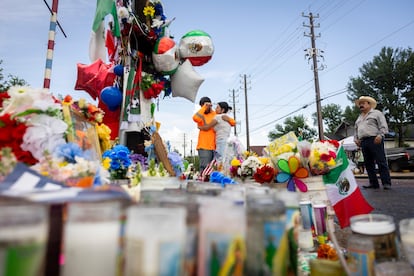
After the program ended in 1964, immigrants continued to come to the U.S., beckoned by waiting jobs to pick our crops, build our homes, and lay out a foundation for the next generation to thrive. These days, what that cowboy hat symbolizes — the hard work, the dedication to family, the determination to contribute to this country — is stained with blood.
The Trump administration’s massive deportation campaign has turned masked ICE agents, many of them Latinos, into a deadly force roaming the country on “target enforcement” operations that can turn deadly when random people are stalked and then chased by ICE agents in unmarked cars. It’s bigger and better funded than any paramilitary force I covered as a correspondent in Latin America.
It feels like we’re all suspects now. Too often newly hired, poorly trained ICE agents are quick to fire at fleeing vehicles. Under standard police protocol, which ICE does not observe, officers only shoot at fleeing suspects if they pose an immediate danger to them or the public. A deportation order shouldn’t be a death sentence.
Under intense pressure to meet a reported quota of 2,000 detentions per day and to appease the administration’s hardcore base in the run-up to this fall’s midterm elections, these agents have made well-documented mistakes, like two fatal shootings of ICE protestors, both U.S. citizens, Renee Good and Alex Pretti, in Minneapolis this winter. Now this summer, in a span of one short week, agents killed Salgado Araujo in Texas and then Johan Sebastián Durán Guerrero in Maine, a father from Colombia who had a work permit. In both the Houston and Maine killings, ICE acknowledged those men were not the intended targets. Yet they and other Black and brown immigrants feel they have a literal target on their backs because they fit a profile. Since 2025, some 52 people have died in ICE custody — 11 have been fatally shot in ICE operations, including traffic stops. What’s at zero, so far, are the legal consequences for agents involved.
Skin is my sin
When I finally was able to look at my widowed mother, she too had tears in her eyes. We were both mourning the death of my father in March.
“I’m glad your father didn’t see this,” my mother said, referring to the news about Salgado Araujo that triggered the latest rush of grief. “The cruelty, the inhumanity was already breaking his heart to pieces. He loved this country so much.”
I swallowed hard. My mind raced back to my visit to the Vatican months earlier with relatives.
Pressured by my parents, brother, and sisters, I reluctantly made my first confession. Though raised Catholic, I somehow avoided confessions. But there I was, in a confessional booth on my knees across from a priest obscured by a screen. Where to begin?
“My skin is my only sin,” I told the priest. He said he understood. He too was brown, from the Philippines.
“I don’t know that I have it in me to keep trying to be an objective journalist,” I said. “I’m not made of stone.”
I relayed memories of a lone, deranged white gunman who drove about 900 miles from North Texas to El Paso to “kill Mexicans.” He shot dozens of shoppers, killing 23 at our local Wal-Mart, late in the morning of August 3, 2019 — my father’s birthday.
The priest paused. Suddenly, his words took on a sense of urgency.
“When your house is on fire, you don’t have time to ponder questions of objectivity,” he said. “You simply run in and save what’s left of that house.”
“And,” he said firmly, “Your house is on fire. Do your job.”
Report. Write. Bear witness. Under fire.
When I returned to the U.S., I shared the priest’s words with my parents. It was six months before my father’s death.
“Está cabrón”
“Está cabrón,” my father said. His catchphrase had become a quiet immigrant’s protest who felt betrayed by the country he had adopted. He watched the American dream-turned-nightmare on the daily news, sadly witnessing the persecution of his paisanos.
My father, Juan Pablo Corchado, left his sweat in the cotton fields of West Texas. He carved rows of cotton and sugar beets from high atop his tractor in the fields of California’s San Joaquin Valley, holding his cowboy hat on his head with one hand, steering the wheel with the other. That fieldwork helped him save enough money to buy a catering truck that evolved into a family business. In the late 1970s, he and Herlinda, my mother, moved to El Paso, on the border with Mexico, where they bought a home and opened a restaurant on South El Paso Street. They named it Freddy’s Café, after me, their oldest son.
Throughout his life, Juan Pablo had played by the rules in this country. He worked hard, paid his taxes, and became a naturalized U.S. citizen. He believed so much in the promise of the United States that he even bought a cemetery plot in El Paso.
But in the last few years before his death at age 89, he had started to feel unwanted. Anti-immigrant sentiment gripped the country. In his final days from a hospital bed, monitors beeping all around him, his once firm voice turned to whispers. Fearing the end was near, I asked him where he wanted to be laid to rest.
“The United States, or next to your mother, your daughter in Mexico?” I held back the tears, trembling at the idea that soon enough, I wouldn’t hear his voice anymore, or bow my head before him for his blessing, or stare into those determined eyes.
“Squeeze my hand, papa,” I pleaded, desperately, “The United States?”
Nothing.
“Mexico?” He squeezed hard and wouldn’t let go.
We were able to bring him home from the hospital, and days later, he died, surrounded by his family, as a late winter sun set over his El Paso home.
We took his remains to our ancestral homeland, San Luis de Cordero, Durango, Mexico. A band played tunes that he once jammed to with his band — Los Pajaritos — formed by his brothers and sisters, most of them also braceros. The music wafted over the cemetery filled with many of our relatives.
I miss my father, his quiet stare, his silence, and that white hat, like the one worn by Salgado Araujo. I miss you, Cito, I often say as I wipe away tears using a term of endearment for our father.
I also hold on to his story of an America that has historically wanted it both ways. He was the last bracero in our family and one of a dying breed across this country. His story encapsulates America’s fickle nature. When it serves the powerful, the national interest, the country welcomes those it would otherwise shun, all to satisfy pressing labor needs. When mistrust, suspicion, and racial divisions arise during hard economic times, the welcome mat disappears.
We left my father’s remains in our small town, next to his mother and his daughter, who died as a child. Once I was home, back across the border on the U.S. side, I put his cowboy hat atop a bookshelf to honor my father. These days, when I see that hat, it also reminds me of an ungrateful country’s hypocrisy.









































