
Cyclones, mines and a murder: The cursed story of the floating hotel that traveled the Pacific and ended up in North Korea
The first ‘flotel’ in history, a seven-story behemoth with tennis courts, opened in 1988 in the middle of the sea. It was a success. That is, until everything went wrong...

In 1959, a group of Japanese architects signed a document entitled the Metabolist Manifesto, which was, I’m sorry to say, a nutty idea of planetary proportions: flying cities, megastructures that grew like living organisms, capsules embedded in colossal towers. It was architecture as science fiction, but for real, and it was also formidable from a purely aesthetic perspective. Big names were involved: Arata Isozaki, Kisho Kurokawa, and, above all, the undisputed boss, the modern patriarch of Japanese architecture: Kenzo Tange. The same man who, in 1960, signed one of the most ambitious (and unhinged) urban planning projects of all time: the Tokyo Bay Plan.
Tange’s plan was another one of those colossal fantasies with gigantic concrete structures floating on the Sea of Japan like technological manta rays, or ship-cities designed for a civilization more determined than our own. And yes, Kenzo, you have to have real guts to propose something like that and defend it with a straight face. However, the plan wasn’t carried out for two quite understandable reasons:
- It was a manifesto in the form of a project: a spectacular way of saying “hey, Metabolism is serious.”
- And, well… because how on earth are we going to build that, Kenzo? It’s all well and good to dream, but there are limits, man.
But here’s where we make the leap to Australia in the 1980s. Enter Doug Tarca, an Italian immigrant living in Townsville, a northeastern coastal city known more for its dockwork and cold beer than for sophisticated tourism. Doug was a professional diver, a scuba diving entrepreneur, and, apparently, a firm believer in “more is more.” It may be that one day he was looking at Tange’s blueprints, or perhaps simply recalling how well things float if you put air underneath them; in any event, he said: “Let’s build a hotel in the middle of the sea. Just because.”
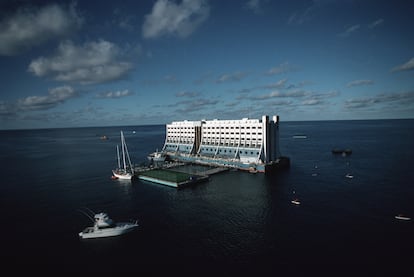
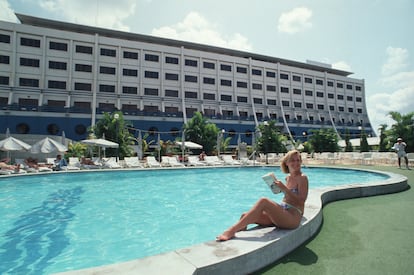
And he did it. Well, he tried. With the help of a Swedish company specializing in oil platforms, he built what he called the Four Seasons Barrier Reef Floating Resort (note the name). It wasn’t a ship or even a cruise ship. It was an actual building. A behemoth with seven floors, 200 rooms, a helipad, a tennis court, and some twenty panoramic rooms below sea level for close-up views of the Great Barrier Reef. It was anchored a few miles offshore thanks to the power of six giant anchors. They called it a “flotel.” And yes, it was as extravagant as it sounds.
It opened in 1988. It was on magazine covers, on TV, the whole country was talking about the Townsville floating hotel. Tourists came from all over the place. And yet, the following year, it closed.
What happened? Well, several things. To begin with, when they anchored the structure, they destroyed a considerable portion of the coral reef that tourists were supposedly coming to admire. Bad idea. And then, the building was hit by a cyclone that swept away the helipad and left the underwater rooms in deplorable conditions. The result: financial losses. Doug, more hopeful than financially able, sold the hotel to a Japanese company.
The new owners considered keeping it there in Australia, until a small detail came to light. Beneath the building—next to the anchors—lay over 100,000 pieces of artillery and anti-tank mines from World War II. Yes. Right underneath. Terrific.
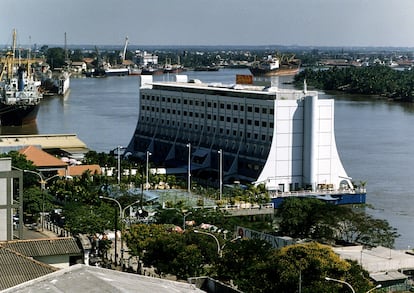
So the Japanese decided to move the floating hotel. Literally. They loaded it onto a supercharger and took it for a spin across the Pacific: 12,000 tons of concrete on a sea voyage. In 1990, the hotel anchored in Ho Chi Minh City harbor, was renamed the Saigon Floating Hotel, and reopened. The owners removed the tennis court, added a swimming pool and an artificial beach, and for a decade it was a resounding success.
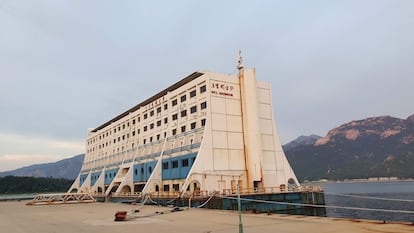
But in the late 1990s a new crisis hit, and a new sale was made. This time, the only interested party was Hyundai (yes, the car company), which wanted to tow the thing to North Korea, no less. Apparently, one of the South Korean megacorporation’s subsidiaries has significant interests in several North Korean border areas, so in 1999, the floating hotel docked on the semi-touristy shores of Mount Kumgang, near the Demilitarized Zone. It was renamed again (this time as Hotel Haegumgang), and, strangely enough, it experienced its most emotionally sweet period there.
During a brief period of détente between the two Koreas, the flotel served as a meeting point for families who had been separated for half a century. The hotel accepted only U.S. dollars and South Korean won, which generated some economic intrigue, but no one asked too many questions: the rooms were luxurious, the sea was nearby, and the family reunions were genuinely heartwarming.
But, as with any good tragic story, things took a turn for the worse. In 2008, a North Korean soldier mistakenly killed a South Korean tourist. Tensions flared again, visits were suspended, and the floating hotel was left in a diplomatic limbo from which, as far as we know, it never fully emerged.
And then, in 2023, the North Korean authorities decided that enough was enough and demolished it. End of the journey. End of a structure that had floated more than 8,700 miles (14,000 km) in 20 years, crossed three countries, two seas, a recycled Cold War, and a couple of dreams that were too big. Doug Tarca’s, for example, which didn’t turn out entirely well. But at least it worked for a while, which is more than many dreams can claim.
Sign up for our weekly newsletter to get more English-language news coverage from EL PAÍS USA Edition









































