
Has the tradwife bubble burst?
Influencers touted as standard-bearers of this movement reject the label after building lucrative brands around an idealized vision of domestic life

“Stop calling me a tradwife.” That is the title of a recent episode of the Call Her Daddy podcast in which model and influencer Nara Smith rejects the label that has followed her ever since she rose to prominence on social media with her highly elaborate recipes that she prepares everything “from scratch” while dressed in haute couture.
During the interview, Smith pulls out her phone to look up the definition of tradwife and proceeds to argue, point by point, that the traits have nothing to do with her. As she reads, a tradwife is described as a woman who embraces or promotes a model centered on marriage and family, prioritizing homemaking and childcare, supporting her husband’s role as the primary breadwinner and celebrating traditional gender roles within marriage.
Smith, who is 24 and has four children, argues that she is “a working mom” who is constantly traveling and simply loves to cook. “Sue me!” she quipped to podcast host Alex Cooper. “My husband burns everything apart from a good steak,” she added with deliberate innocence.
Smith says the couple split parenting responsibilities 50-50, that her husband always does the dishes, and that she contributes financially to the family just as much as he does.
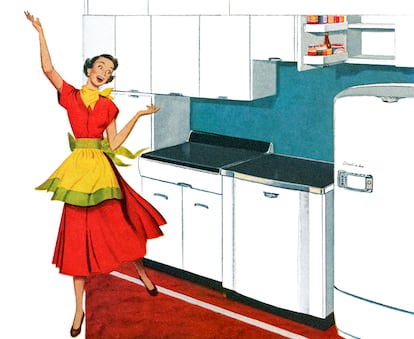
“They’re taking the image of a woman in a kitchen in a gorgeous dress and they are assuming that this is your life and we are going back in time,” says Cooper.
Smith responds that society is determined to box women into certain categories. “Why can’t we do it all?” the influencer asks, overlooking the fact that the feminist movement has spent decades challenging that very notion.
@naraazizasmith my new obsession! #easyrecipe #homecooking #fypシ #comfortfood #marriage
♬ original sound - アジアンマッサージ リラクゼーション ヴィラ 千歳店 - ガラスコーティング 洗車用品 カーフィルム コンパウンド
Nara Smith may never have identified with the label of tradwife, a term that, incidentally, was coined by men on the internet forum 4chan and forms part of the language of the incel movement. And, by her own account, she does not even fit the supposed definition of a “traditional wife.” But in the end, that hardly matters. She has capitalized on the aesthetic, preparing elaborate homemade recipes narrated in a soft, almost whispered voice, and has made a great deal of money from it. So why the gaslighting? Why try to make people doubt what they have seen with their own eyes?
With her videos, Smith has helped inflate the bubble of a movement, if it can even be called that, that does not really exist outside social media. Of course, there are homemakers who devote their days to caring for their children, if they have them, cooking, cleaning, shopping and managing the endless list of tasks that make up domestic and caregiving work. Some even argue that men should be the primary breadwinners and that women belong at home as devoted wives and mothers. But the tradwives who have found fame online are something else entirely.
The best-known figures, such as Nara Smith or the Mormon influencer Hannah Neeleman, better known as Ballerina Farm, which is also the name of the food and home goods company she co-runs with her husband, or, in Spain, the influencer Roro, who has likewise rejected the tradwife label despite recently acknowledging that she was inspired by Nara Smith when creating her recipe videos for her boyfriend Pablo, are in fact entrepreneurs running multimillion-dollar businesses built around their social media personas.
Their content, along with that of other similar influencers, glamorizes a lifestyle that appears to stem from being a stay-at-home wife with a flawless appearance and a husband who “provides.” In reality, however, it is made possible by their work as content creators. The lives of the tradwives we see online were always an illusion, a performance amplified by social media algorithms and encouraged by far-right groups for whom the image of women wholly devoted to home and family proved useful propaganda.
@roro.bueno Ganamoss!!🫶🏻🇪🇸 @Selección española #eurocopa #homemade #españa #futbol #croquetas #tortilla #recetafacil #comidaespañola #recetarapida #cocido
♬ Storytelling - Adriel
The rise of the tradwife phenomenon, a largely U.S. trend that emerged in the wake of the Covid-19 pandemic, unfolded more or less in parallel with the presidential campaign that returned Donald Trump to the White House for a second term. Now, with the U.S. president’s popularity in steep decline, being associated with these figures and the political currents they are linked to no longer seems quite so beneficial to the personal brands of such influencers. Hence the recent efforts to distance themselves from a narrative that initially helped propel their careers. Reinvention is in order.
It hardly seems a coincidence that one of this year’s breakout books is Yesteryear, by Caro Claire Burke, a work of fiction that chronicles the downfall of a tradwife who one day wakes up in another era, specifically 1855. Natalie, the novel’s protagonist, is a devoutly religious mother and homemaker who has built a social media following by promoting a traditional lifestyle through from-scratch recipes and idyllic family life on a ranch in Idaho. Suddenly, she finds herself living in the very period her content nostalgically romanticized. And, of course, there is nothing idyllic about it.
The novel, which is soon to be adapted into a film with Anne Hathaway attached as both producer and star, has become a major success not only because of its effective marketing campaign, but also because it satirizes the culture surrounding these influencers and the way audiences engage with them. At the same time, it places at the center of the story the debate that has followed tradwives ever since they first rose to prominence on social media.
In the novel, Natalie labels anyone who does not embrace the lifestyle she promotes as an “Angry Woman,” encapsulating the notion, popular among reactionary circles, that feminism prevents women from being happy because it pulls them away from a life devoted to home and family. A life that, according to them, women are naturally destined to lead.
The tradwife phenomenon has resonated not only with conservative audiences, but also with a generation of young women exhausted or disillusioned by the girlboss culture of the 2010s. The girlboss movement championed women’s leadership in the corporate world under the banner of a supposedly feminist message that ultimately proved hollow, as many of its most celebrated businesswomen were later accused of discriminatory practices or fostering toxic work environments.
That hypocrisy, combined with the uncertainties of the post-pandemic world and a broader sense of instability about the future, helped make the serene domestic life promoted by tradwives appear to some young women as the perfect escapist fantasy. Their soothing voices, spotless kitchens and leisurely approach to cooking, projecting the impression that they possess limitless time and money to devote to painstakingly elaborate recipes, provide a counterpoint to contemporary dissatisfaction. They evoke an imagined past in which life supposedly seemed simpler.
In an interview with EL PAÍS, the author of Yesteryear argued that while the rise of the tradwives was initially dismissed as harmless, “we now know it was a clear sign of a much more significant sociopolitical shift.”
Women have not, en masse, chosen to retreat into the home, vow obedience to their husbands, devote themselves to having large families and spend their days baking pies. Yet policies emerging from U.S. institutions have encouraged a return to the domestic sphere by restricting reproductive rights and making care work more expensive, creating conditions in which it becomes financially advantageous for someone to stay home and shoulder those responsibilities. More often than not, that someone is a woman. Earlier this year, Forbes reported on the findings of a 2025 survey indicating that nearly half a million women in the United States had left paid employment, many citing caregiving responsibilities as the reason.
At the same time, testimonials have begun to emerge from women who spent years living what could be described as a tradwife lifestyle and who recount harrowing experiences of abuse, isolation, control and extreme financial vulnerability stemming from their dependence on their husbands. As in Yesteryear, when the tradwife “fantasy” becomes reality, there is very little that is idyllic about it.
While Nara Smith distances herself from the tradwife label, she has also announced that next October she will publish her first book, Homemade, a cookbook whose cover features her wearing a pink gingham dress reminiscent of the Victorian era, its skirt unfolding into a table laden with a lavish breakfast.
Last year, when Roro published her own cookbook, she cited a series of images of 1950s U.S. housewives among the visual references that inspired the accompanying photography.
We’ll have to keep rubbing our eyes in disbelief, because what these influencers deny being keeps clashing with the reality of what they continue to promote. Maybe it’s just a matter of image, but image on social media — and they know this better than anyone — is everything.
Sign up for our weekly newsletter to get more English-language news coverage from EL PAÍS USA Edition









































