
The art of mastering jealousy, according to Maggie Gyllenhaal — or how to direct your husband in sex scenes
Her 2021 film ‘The Lost Daughter’ features several intimate scenes with her real‑life partner, Peter Sarsgaard — a dynamic she admits was emotionally complex to navigate
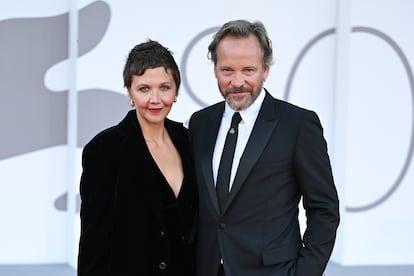

Maggie Gyllenhaal recently talked to The New York Times about how challenging it was for her to direct her husband, Peter Sarsgaard, in the sex scenes of the 2021 film The Lost Daughter. She confessed that she almost didn’t give him the role because she thought dealing with jealousy in her directorial debut would be too hard to deal with. Although she considered other actors, she was ultimately convinced that the part was right for her husband.
Gyllenhaal said she had to watch Jessie Buckley and her husband “from a very unconnected emotionally place.” “This wasn’t all about the sex. It was about the courtship, which was so hot,” she added. “I watched them do that. When I get a second to stop, it’s a little hard. But we have to keep going.”
“Jealousy is human. What you do with it is another matter,” says adult film director Erika Lust. She explains that on a set, even in sex scenes, nothing is truly spontaneous. “It’s not private intimacy, but cinematic language. And when you really understand that, something changes: you’re no longer watching your partner with someone else, you’re watching a scene that’s built shot by shot. Even so… of course it can be challenging,” she adds.
“For me, there are two keys: talking everything through and trust,” Lust continues. “And when I say talking everything through, I mean everything: what’s going to happen, what’s uncomfortable, what’s exciting, where the boundaries are. Because mystery can be sexy in fiction, but in real life, it often generates insecurity. And then there’s trust. Not only in the couple, but in the process. Understanding that there’s no betrayal in a scene, but rather representation.”
Valérie Tasso, writer and sexologist, points out that it’s a mistake to think that professionalism should immunize us against certain emotions. “Being professional doesn’t mean ceasing to feel, but rather knowing how to manage what we feel without it interfering in a dysfunctional way. Jealousy, in this context, is an understandable reaction because it activates several sensitive areas: the other person’s body, the external gaze, public exposure, and the idea — sometimes fantasized — of replacement or comparison,” she explains.
“In a professional environment like the TV and film industry, there’s also an additional element: functional dissociation,” she continues. “The performer isn’t ‘being,’ they’re ‘performing.’ And that radically changes the nature of the experience. However, the viewer’s body — and even more so the partner’s — can react as if it were real. That’s why the healthiest thing to do isn’t to deny jealousy or dramatize it, but to integrate it.”
How celebrities manage sex scenes
Separating reality from fiction isn’t always easy, and some established stars with nothing to lose may even contractually waive the right to film sex scenes or even just kissing. George Clooney, for example, explained to Richard Eden from the Daily Mail how he planned to approach his film career from now on. “I’ve been trying to follow the path Paul Newman took, and I’m not going to kiss any women anymore,” the actor said.
It’s true that actors often have certain rules with their partners about what’s allowed in sex scenes. For example, actor Boris Kodjoe explained the agreement he has with his wife, actress Nicole Ari Parker: “We have a rule. It’s called no nipple no tongue.”
After filming a scene in which he kissed Kerry Washington, Scott Foley threw a party to watch it with friends and his wife, actress Marika Domińczyk. “After the love scene, it was sort of quiet because no one knew how Marika was going to act,” he said on The Ellen DeGeneres Show. “And she broke the silence and said, ‘Why don’t you bring some of that home?’”
And when Rebecca Metz filmed a steamy sex scene in Maron, she decided to watch it with her husband, who isn’t an actor. “[H]e laughed and put his arm around me and told me it was great,” she wrote. “It wasn’t much different than watching any other role together. He knows it’s often hard for me to watch my own work, I always feel self-conscious and see things I wish I’d done differently. So whatever else he might have felt, all he told me was that I was great and he was proud of me.”
Lust explains that separating fiction from reality is the foundation of acting. “Our job is to make something seem real, but that doesn’t mean it is. A kiss on screen isn’t a kiss in real life: it’s a constructed, consensual, repeated, lit, and edited gesture. It serves the story, not the relationship,” she says.
“That said, every couple has the right to set their own boundaries. But when someone says, ‘I’m not going to kiss another person out of respect,’ it seems to me that the conversation isn’t just about fiction… but about insecurities, agreements, or relationship dynamics that go beyond work,“ she adds. ”And that’s something else entirely. It also reveals something interesting: who can afford to set those boundaries without it affecting their career? Because not everyone has that leeway. Sometimes what’s presented as a matter of principle… is also a matter of privilege.”
Tasso believes problems arise when personal perceptions interfere with professional interpretation. In other words, when the emotional brain fails to distinguish between representation and experience. “It’s not about repressing our jealousy, but about contextualizing it. Working on three levels is key,” she says. “On a cognitive level, we must understand that we are dealing with a performative fiction, not infidelity. On an emotional level, it is essential to identify which specific insecurity is triggered (fear of comparison, of abandonment, of loss of exclusivity, etc.). Finally, we must strengthen the bond, that is, reinforce communication within the couple, establishing clear boundaries, prior agreements, and spaces for emotional validation. In other words, the key is not ‘not feeling,’ but knowing what to do with what you feel.”
Ultimately, the key to managing jealousy and even integrating it positively lies in communicating with your partner and not hiding your insecurities. While most of us won’t have to direct our partners in sex scenes or watch them kiss other people on screen, we can learn from those who do and remember that the healthiest thing isn’t avoiding feeling jealous, but rather not hiding those feelings.
Sign up for our weekly newsletter to get more English-language news coverage from EL PAÍS USA Edition









































