Albertans back remaining in Canada in referendum
Some 76.5% of voters rejected holding a future vote on the province’s secession
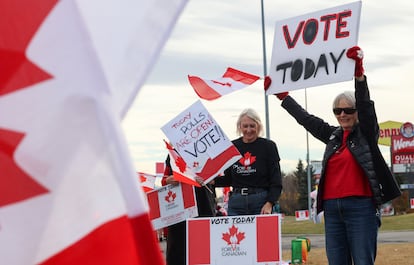

Alberta will not follow Quebec’s path. According to the early results of Monday’s referendum, 76.5% of voters in the provincial government’s consultation chose the first option on the ballot: “Alberta should remain a province of Canada.” The second proposed holding a binding referendum on secession.
“Albertans made a clear choice. They chose unity, to build together, and to take care of each other,” Canadian Prime Minister Mark Carney said after the results became known.
Alberta is the country’s wealthiest province thanks to its oil reserves and accounts for 83% of Canada’s crude production. The vote, held after several legal disputes, took place at a difficult moment for Canadians, amid a trade confrontation with the Trump administration in the United States. In response, Prime Minister Carney has repeatedly stressed the importance of national unity.
“Canada is so much greater than the sum of its parts,” the Canadian prime minister continued on Tuesday after the first results of the vote were released. “Now it is our opportunity to take all that we have been given as Canadians — and we have been given the greatest country in the world — and make our country better for all of us.”
The relationship between Alberta and Canada’s federal government has never been an easy one. In fact, tensions date back to the province’s entry into the Canadian federation in 1905. Beginning in the 1980s, voices advocating separation started to emerge, arguing that the federal government frequently intrudes on provincial jurisdictions and that political power in Ottawa is dominated by the elites of Quebec and Ontario.
The most frequently cited grievance, however, has been economic. According to separatist supporters, the province, home to the country’s largest oil reserves, contributes disproportionately to the national treasury.
The drums of separatism continued to beat quietly for years, but a combination of factors over the past decade amplified their sound. Justin Trudeau’s years as prime minister were marked by constant friction over issues such as energy policy and environmental regulation. The pandemic also played a role. The most striking example was the so-called “Freedom Convoy,” which blocked downtown Ottawa in early 2022 on the grounds that the federal government was limiting individual freedoms.
Political developments south of the border also helped fuel the movement’s rise. The emergence and growth of the MAGA movement, along with Donald Trump’s two presidential victories, served as a model for many supporters of Alberta’s separation. Suspicions of outside influence have even surfaced. According to the Financial Times, leaders of the separatist movement held at least three meetings in 2025 with members of the U.S. government.
Against this backdrop, the role of Danielle Smith, a leading figure of right-wing populism, is key to understanding how the separatist project gained so much momentum. Smith became premier of Alberta in October 2022. From her first days in office, she adopted a confrontational stance toward Ottawa on issues such as gun control and oil development.
Seeking support for initiatives that would grant the province greater powers, Smith called Monday’s referendum in February, asking Albertans to weigh in on matters including immigration, social services and judicial appointments.
Last May, following a series of changes to provincial legislation, the premier announced that the vote would also include a question on whether Alberta should remain part of Canada or proceed toward a secession referendum. Smith’s approach has been interpreted as a way of pressuring Ottawa into making concessions. Others have compared it to David Cameron’s gamble with Brexit.
Daniel Béland, director of the McGill Institute for the Study of Canada, draws the following parallel: “Like Cameron, Danielle Smith called the referendum to satisfy the demands of a significant number of members of her party, while asking voters to support the status quo.”
Frédéric Boily, a political scientist at the University of Alberta, agrees with this interpretation of the political calculations behind the vote, adding that Carney is also part of the parallel: “It is worth remembering that Carney was governor of the Bank of England during the Brexit years.”
The outcome at the ballot box was different, but it is likely to come at a political cost for Smith. Dissatisfaction runs deep within her party, both among supporters of independence and among those who favor remaining in Canada, because of what many see as ambiguity in her actions and rhetoric. Indigenous communities have also criticized her, having long opposed any process linked to a potential separation from Canada, arguing that it would violate treaties signed with the federal government.
Since taking office, against the backdrop of trade tensions with Washington, Carney has made sustained efforts to engage with Alberta. Unsurprisingly, his plan to turn Canada into an energy superpower relies heavily on the province’s hydrocarbons industry. Evidence of this was the memorandum of understanding he signed with Smith late last year. Among other provisions, the agreement includes plans for a new pipeline and certain environmental exemptions.
Relations between Mark Carney and Danielle Smith are among the closest seen in recent memory between Alberta and a federal Liberal government. Carney has repeatedly stressed his willingness to work with all provincial governments during what he describes as a challenging period for Canadians.
“Donald Trump’s policies and rhetoric have helped reinforce the feeling of unity in Canada,” says Béland. “Trudeau’s departure and Carney’s arrival, a politician more aligned with the preferences of Alberta’s government, have also had an impact. These factors have made life harder for separatists since last year.”
At a federalist rally in Calgary last Thursday, the prime minister said: “At this pivotal moment, Albertans have a choice: to build a stronger Alberta and an even greater Canada to leave for our children, or we can burden them with years of deep division and great uncertainty.”
In theory, the referendum result puts this particular challenge in western Canada to rest, at least for now. But it is not the only front. The pro-independence Parti Québécois won the election held in the French-speaking province on October 5. The incoming premier, Paul St‑Pierre Plamondon, has promised a new referendum even though polls suggest support for Quebec secession remains around 30%.
Sign up for our weekly newsletter to get more English-language news coverage from EL PAÍS USA Edition