
Argentina forces oil companies to choose between Vaca Muerta and the Falklands
Javier Milei is racing to stop an offshore drilling project in the disputed islands by threatening to bar participants from Argentina’s biggest oil prize

Vaca Muerta, the Patagonian shale formation that currently produces more than 600,000 barrels of oil a day, is not only Argentina’s crown jewel of energy production. It has also become the tool President Javier Milei is using in Argentina’s long-running sovereignty dispute with the United Kingdom over the Falkland Islands, known in Argentina as the Malvinas.
As the Sea Lion offshore oil project, approved by the islands’ British-backed government and designed to extract crude from the waters surrounding the archipelago, moves closer to production, the Argentine president has issued a warning: any company involved in the venture will be barred from operating in Argentina. In practice, that would mean giving up access to Vaca Muerta, one of the world’s largest unconventional oil and gas reserves and a basin believed to hold enough resources for decades of production.
“Those who operate on our islands behind the Argentine government’s back will have to choose between an illegal gamble in disputed territory and a profitable, secure operation in a sovereign country with clear rules and predictability. You can’t do both,” Milei said last Thursday in a speech broadcast nationwide.
In that address, he announced an expansion of sanctions already established under a 2011 law targeting companies operating in the Falkland Islands without Argentina’s authorization. The measures would apply not only to those firms but also to their shareholders, employees and suppliers. Argentina has claimed sovereignty over the islands, which have been administered by the United Kingdom since 1833 and were the subject of a brief war between the two countries in 1982.
“Choosing between Vaca Muerta and Sea Lion is like choosing between [Argentine soccer star Lionel] Messi and a youth player,” says Juan José Carbajales, a former Argentine deputy secretary for hydrocarbons and current director of the Gas and Oil Institute at the University of Buenos Aires. “Vaca Muerta is a proven resource; it works. You know there’s oil, and you just have to invest and extract it. The other is a high-risk bet and, even if everything goes right, Vaca Muerta is an entire basin, while Sea Lion is just a single field.”
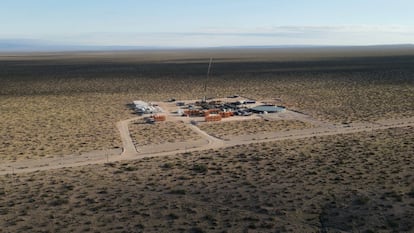
The Sea Lion field was discovered in 2010 and lies about 220 kilometers (137 miles) north of the Falkland Islands. The project is being developed by Israel’s Navitas Petroleum and Britain’s Rockhopper Exploration, which secured final investment approval for the first phase of development on Dec. 10, 2025.
Vaca Muerta is estimated to hold around 30.17 billion barrels of technically recoverable resources, while Sea Lion’s recoverable reserves are put at roughly 314 million barrels, about 1% of that amount. Vaca Muerta currently produces more than 600,000 barrels of oil a day, a figure expected to rise to around 1.5 million barrels per day by 2032. Sea Lion, by comparison, is projected to produce 55,000 barrels a day in its initial phase, with output potentially reaching 200,000 barrels a day once the project is fully developed.
There is also a significant gap in costs. Offshore drilling is far more expensive than onshore operations. While drilling a well in Vaca Muerta costs roughly $10 million, a deepwater well can cost as much as $200 million, according to Carbajales.


“Sea Lion is the size of one of the 40 projects that make up Vaca Muerta,” said Daniel Dreizzen, a former Argentine energy planning secretary and director of consultancy Aleph Energy.
Even so, Sea Lion is not a particularly small project by global standards and, above all, it represents a promise. If production goes ahead and proves profitable, investor interest in exploring neighboring blocks is likely to surge. That is why the Argentine government sees it as crucial to derail the project at this early stage.
Although the companies involved have said Milei’s statements will not alter their timetable, which calls for drilling to begin in 2027, the Argentine president’s change of stance adds political risk to an already complex venture. The Final Investment Decision (FID) was taken in December 2025, at a time when Milei had not yet signaled opposition to the project.
The president, who has repeatedly described himself as an admirer of Margaret Thatcher, Britain’s prime minister during the 1982 Falklands War, had even suggested in the past that the islands’ residents had a right to self-determination, a position he now rejects outright.
The shift in rhetoric has led both political opponents and many Argentines to view the announcements as politically opportunistic. Critics accuse Milei of embracing an issue that resonates deeply with the public at a time when his popularity is declining and he is preparing a bid for re-election.
In his speech, Milei argued that the prospect of exploiting oil reserves beneath the waters around the islands would give “an incentive for the British government to deepen its occupation” of the Falklands. While the islands were long viewed by London primarily as a strategic and military burden, the discovery and potential development of hydrocarbon resources could now turn them into a valuable economic asset.
The day after Milei’s nationally televised address, oilfield-services companies Schlumberger (SLB), Halliburton and Baker Hughes issued statements announcing that they would not participate in hydrocarbon projects in the Falklands or the surrounding maritime areas.
The position taken by those companies is significant. The global oil-services market is highly concentrated, and together the three firms account for more than 52% of the publicly traded oil-services market worldwide. While smaller competitors exist, the decision by these three industry giants to stay away from Falklands projects adds another layer of difficulty to an area that is already remote, technically challenging and costly to operate in, making it harder to secure contractors with the necessary expertise at competitive prices.
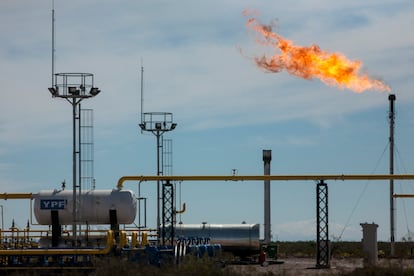
In recent days, the Argentine government has announced that it has begun proceedings to sanction 45 companies and individuals linked to hydrocarbon activities in the disputed Falkland Islands. It also plans to file a criminal complaint against the Israeli oil company Navitas Petroleum and several of its subsidiaries, as well as against Canada-based JHI Associates Inc. and its shareholder Eco (Atlantic) Oil & Gas Ltd., for holding licenses granted by the United Kingdom to carry out oil exploration and production activities in the North Falkland Basin.
Argentina has invoked the sanctions established under Law 26,659 on previous occasions. Although the legal framework for penalizing such activities has existed since 2011, it has gained weight over time as Vaca Muerta has evolved from a promising prospect into a world-class oil and gas basin.
“Today, Argentina not only has the luxury of wielding a stick in negotiations, it also has a carrot to offer. It can offer investors a place they can develop with relatively low risk, backed by a legal framework such as the Incentive Regime for Large Investments,” says Carbajales, referring to a scheme promoted by Milei that offers major investors tax, customs and foreign-exchange incentives, along with regulatory stability for 30 years. “Today, foreign investors are being offered everything.”
Sign up for our weekly newsletter to get more English-language news coverage from EL PAÍS USA Edition









































