
Milei seizes on Trump remarks to revive Argentina’s Falklands claim
The Argentine president said companies involved in oil development around the islands will face sanctions and pledged more funding for a naval base in Tierra del Fuego
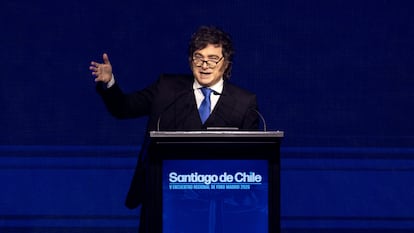

Perhaps more than ever before, Javier Milei departed from his trademark closing slogan. He left out the familiar “Long live freedom, damn it” and replaced it with “Long live the homeland.” Nor was that the only omission: the insults he routinely hurls at his critics were also nowhere to be heard. The changes reflected what the Argentine president was seeking to achieve on Thursday in a televised address broadcast simultaneously across the country.
“The Malvinas are Argentine by history and by right. There is no debate about that,” the president said, prompted by recent remarks from U.S. President Donald Trump suggesting that the United States could withdraw its support for the United Kingdom in the sovereignty dispute over the Falkland Islands, known in Argentina as the Malvinas.
Milei announced sanctions against companies involved in the imminent oil development in the Falkland Islands and reiterated that Argentina will build a naval base in Tierra del Fuego, at the southern tip of the South American nation.
“It is not enough to simply keep up our claim,” Milei said. “The Argentine state has an obligation to use all diplomatic, economic, judicial and legal tools available to defend our sovereignty and our resources.”
In the address, which was recorded hours before it aired and showed Milei at the Casa Rosada, the seat of government in Argentina, flanked by his entire cabinet, the president recalled that for the past 50 years the United Nations has urged Argentina and the United Kingdom to refrain from unilateral actions in the Falklands while the sovereignty dispute remains unresolved. He argued, however, that Britain has ignored that appeal, pointing in particular to the offshore oil project being prepared north of the islands by Israel’s Navitas and Britain’s Rockhopper.
“The Sea Lion project involves something especially serious that has never happened before: the extraction of a non-renewable resource that belongs to Argentines,” Milei said. “If we do not act, within a few months they will have the material capacity to appropriate the oil reserves that lie beneath our sea.”
Specifically, Milei announced the signing of a decree aimed at improving the coordination and speeding up the application of sanctions, already provided for under Argentine law, against companies involved in extracting resources without Argentina’s authorization. He said the measures would also apply to shareholders and suppliers linked to those companies. He further announced tougher penalties and said he would submit a national sovereignty bill to Congress that would, among other measures, create a National Security Council.
The other major announcement was an increase in funding for the Defense Ministry to move ahead with the construction of a naval base in Tierra del Fuego. The goal, Milei said, is to position Argentina as “a central logistics hub of the South Atlantic” and strengthen its geopolitical projection in the strategically important Antarctic region. The project had already been approved under the previous government, and shortly after taking office, Milei said the base would be developed jointly with the United States.
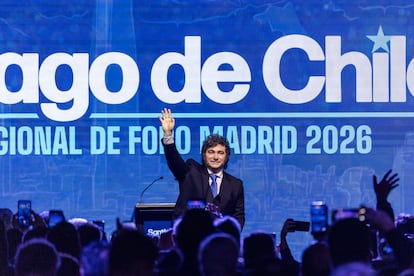
The alignment of his government with Trump was a central theme of the speech, which Milei’s administration said was prepared in coordination with the Foreign Ministry and the Intelligence Secretariat.
Milei said that while the United Kingdom is facing “multiple crises of a migratory, demographic and economic nature” and is on “a path of decline,” “winds of change favorable” to Argentina’s claim are blowing around the world.
“Trump declared that the United States is re-evaluating its historic position regarding the Falklands,” he continued. “The United States is weighing that shift because it knows it has a reliable partner in Argentina, aligned with Western values, in a strategically relevant position, one that can be a valuable ally in the decades to come.”
Without making any concrete commitment, Trump has suggested that he could reconsider the U.S. position on the dispute over the Falkland Islands, as a way of pressuring the United Kingdom over its reluctance to increase defense spending in NATO.
On Thursday, Trump returned to the issue. In an interview with the British broadcaster GB News, he criticized the U.K. government for what he described as insufficient support for the U.S. in the war with Iran and recalled the 1982 armed conflict, when Argentina’s military dictatorship attempted to retake the islands by force.
“That was a long time ago and I watched it so carefully, and you [the United Kingdom] comported yourselves very well. You took it back pretty strongly, but it’s a long way away. That’s a big trip, it’s a long way,” said Trump, a remark that could have referred either to the time that has passed since the war or to the distance separating the archipelago from London.
The issue has gained prominence for Milei in recent weeks after Argentina’s national soccer team displayed a banner reading “The Malvinas are Argentine” during celebrations at the World Cup, reviving a deeply rooted patriotic sentiment.
Previously, the subject had been politically awkward for Milei, who has openly expressed admiration for Margaret Thatcher, Britain’s prime minister during the 1982 Falklands War, and until recently had planned to travel to London this year.
In Thursday’s address, the far-right president steered clear of the insults and personal attacks he typically directs at political opponents and journalists. Instead, he sought to present himself as a unifying figure.
“We can argue about anything else, we can argue about my style [...], but this issue demands that we put our weapons aside and show a united front to the world,” he said, calling on “the entire political, economic and social leadership [...] to join this claim with a single voice.”
Earlier that day, Milei had been in Chile. There, before meeting with his counterpart José Antonio Kast, he praised Augusto Pinochet’s dictatorship and lashed out at Spain’s government and what he called the “filthy leftists.”
Sign up for our weekly newsletter to get more English-language news coverage from EL PAÍS USA Edition









































