
The Ecuadorian fishermen who disappeared during the US war on drugs: ‘I still hope they’ll return’
Eight crew members from the vessel ‘Fiorella’ remain unaccounted for months after setting sail from the Pacific coast of Ecuador
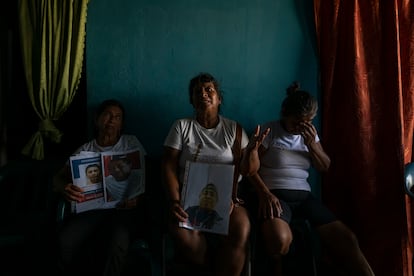
Joel Valencia’s voice was weary after a long day. He had been loading heavy fishing nets and pulling ropes against the constant rocking of the boat. His was the raspy voice of someone who is about to fall asleep when he sent one last voice message to Maoli, his fiancée, before the signal was lost. “Chao, my love. Take good care of the child, don’t make him cry. Try to give him breakfast every day so he’s chubby when I get back,” he said.
Joel, 22, is one of the eight missing fishermen from the Fiorella, a boat that set sail on the night of January 13 from the small port of Jaramijó, in Manabí, with 10 crew members on board. They planned to spend 25 days at sea to catch tuna and sea bream.
Maoli plays the audio over and over again. She plays it when the anguish of not knowing what has become of Joel gets unbearable. She also writes to him. She tells him how much she misses him, how she has been spending her time since he left and how she has been protesting in front of the Captaincy of the Port of Manta holding a photo of him. Of the 10 crew members of the Fiorella, only two have returned.
The Fiorella was a mother vessel: it was anchored while smaller boats left it to lay the long rig with hooks known as the spinel. The fishermen would later collect the catch and return to the Fiorella. On January 20, the Fiorella anchored near the Galapagos Islands, in international waters between mainland Ecuador and the Ecuadorian Exclusive Economic Zone that surrounds the archipelago. The captain then ordered two boats, with two fishermen in each, to head east and north. The plan was that around 4 p.m. they would begin to collect the spinel and return to Fiorella.
But something went wrong. The two fishermen who were traveling in one of the boats and managed to return to land told Human Rights Watch that after midday they lost touch with the captain of the Fiorella. In the distance, they saw what looked like a column of smoke, but they couldn’t make out what it was. Around 7 p.m., they finished gathering up the spinel and tried again to contact the captain and the other support boat. No one answered.
They then reached the point where the Fiorella was scheduled to pick them up. By then, they no longer saw plumes of smoke or any sign of the vessel. They waited there until about 11 p.m. Then they went to the area where the second boat should have been fishing. They did not find the boat or its crew, but they found the spinel the crew had laid.
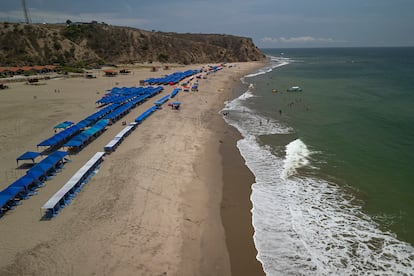
The fishermen remained in that area until 8 a.m. the next morning, January 21. As they had little fuel, they threw the fish they had caught back into the sea and made their way to the coast. On the way, they were rescued by another boat. A day earlier, on January 19, Mariana Mero, mother of Juan Carlos Valencia, captain of the ship, had received a message from her son. He told her that a U.S. patrol was following them and that drones were flying over the boat. “He said the patrol was on their case,” says Mariana, clearly beside herself over the disappearance of her youngest son.
No official response
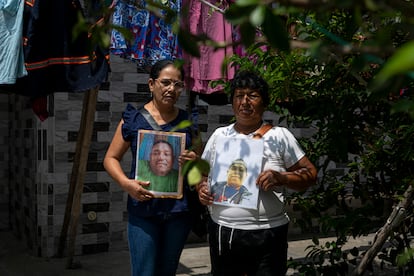
So far, the families of the disappeared have not received an official explanation indicating what happened to the Fiorella. At the Captaincy of the Port of Manta, families say they have encountered more questions than answers. Sometimes, they say, they have found the doors closed when going to ask how the search was progressing. Then there were accusations against the missing fishermen. “The captain of the Port of Manta told us that if they were involved in other things, then there were consequences! ‘You know what your husbands and sons were up to’,” one family member said she was told.
The response has triggered outrage among the families. “If they were on to something, then they should have brought them in and dealt with it, but not like this,” Mariana says. “They never offered proof that they were looking for them.” Mariana says that during one of the few meetings she had with the head of the military unit in charge of the search, she was told to ask for compensation from the owner of the ship, “without explaining what might have happened.”
The Fiorella was not the only vessel to be targeted. On March 17, 16 fishermen from the Negra Francisca Duarte II disappeared in similar circumstances. Days later, the families of the crew learned that they were being held in El Salvador and that, at some point, they would be deported to Ecuador. According to the fishermen’s account, a drone had flown over the boat. Later, a device hit the middle of the ship, landing on the kitchen and the gas cylinders, recalls Hernán Flores, the ship’s captain. A second drone came for the center of the ship, but lost control and fell on the deck. “We didn’t want to touch it for fear it would explode,” Flores says.
The ensuing fire spread quickly, and the crew jumped into the water and made it to the lifeboats. Two suffered burns, including the captain’s nephew. The crew made it to a huge blue container ship a few miles away. They called for help and say they encountered men dressed in military uniforms, who spoke English and who aimed guns at them. The crew were then hooded and handcuffed. The next day they were handed over to the Salvadoran Coast Guard, without charge. Days later, on March 26, a similar ordeal was suffered by another ship, the Don Maca, carrying a crew of 20, which was also fishing near the Galapagos.
The number of disappearances has grown while the Ecuadorian government of Daniel Noboa has avoided answering questions. The few officials that have addressed the matter have insisted that the state prioritizes the fight against organized crime — a fight which is being carried out with its main ally, the United States. Washington has denied involvement in the attacks.
But an investigation published by The Washington Post on August 13 has provided details. The Post maintains that the attacks on Ecuadorian fishing boats near the Galapagos were part of a CIA undercover operation. According to a source cited by the Post, the operation would be related to the drone attacks against the Negra Francisca Duarte II and the Don Maca, as well as the disappearance of the Fiorella and its eight crew members. The investigation also found clues linking a plane from El Salvador to the incidents. The CIA has not offered confirmation of the operation and the Pentagon and the U.S. Coast Guard have denied involvement in the attacks.
The Ecuadorian government responded in May to the United Nations Committee on Enforced Disappearances, which demanded an explanation regarding the disappearance of the eight fishermen from the Fiorella and details about which actions had been taken to find them. The response, a 15-page document, lays out the actions undertaken by the Ministry of Defense, the Ministry of the Interior, and the Prosecutor’s Office. According to the report, Defense activated the protocols of the SAR (search and rescue) system and deployed naval and air assets, as well as other specialized capabilities, to delimit the search areas. The operation began on January 24, although the owner of the Fiorella had reported the disappearance two days earlier.
The Prosecutor’s Office dedicates less than a page to the case. It indicates that it opened an investigation into the crime of involuntary disappearance and mentions several requests for information made to state institutions, from which it has not received a response. It also recognizes the difficulties in investigating a crime that occurred on the high seas. The institution explains that it does not have “the direct operational support of the police,” which limits its ability to carry out operations at sea. It points out that the search falls mainly to the Armed Forces and the Port Captaincy and admits that “so far effective and sustained coordination had not been achieved” with these institutions.
Human Rights Watch interviewed prosecutor Alexandra Bravo, who was in charge of the investigation, in May. According to the organization, Bravo explained that neither the prosecutors nor the Directorate of Violent Deaths of the Police had the competence or logistical capacity to carry out investigative proceedings at sea. The prosecutor pointed out that the National Directorate of Aquatic Spaces, which is linked to the Ecuadorian Navy, was the entity responsible for activating the search and rescue protocols. Her office had requested information from the relevant authorities, including the Captaincy of the Port of Manta, but had not received an official response. A month later, on June 14, Alexandra Bravo was murdered by hitmen. So far, the authorities have not publicly established the motive for the crime.
Fishermen’s fear of going out to sea
Jaramijó is a small coastal town in Manabí. It’s a fishermen’s enclave huddled against a mountain facing the sea, with colorful houses, some made of brick and cement, others made of wood with zinc roofs. Here, life depends on the ocean. Children grow up watching their parents leave to fish. Men learn from a young age to read the sea, cast nets and recognize the changes in the wind. For many families, fishing is not a profession but an inherited way of life.
But the trade has become increasingly dangerous. Organized crime has used fishermen to transport drugs. Some are recruited, others are extorted and forced to pay to be able to go out to fish. The poverty that still exists in Jaramijó — precarious housing, lack of basic services and few employment alternatives — is also evidence of the vulnerability in which these communities live. In a place where the sea remains the only form of subsistence for many, the line between being a fisherman and becoming a cog in drug trafficking networks can become blurred by necessity and coercion.
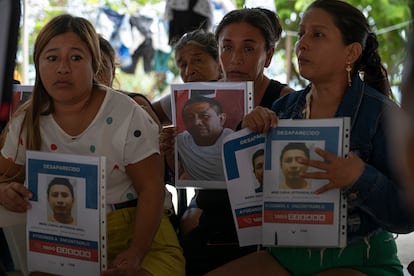
Joel wanted to be a marine biologist. He loved the sea, but he could not fulfill his dream due to a lack of money. On January 13, he hesitated before embarking. But his months-old baby had fallen ill and, faced with a public health system that does not provide care, Joel had to go into debt to buy the prescription needed for his son. “I must go,” he told Maoli, who tried to stop him. “He would always say that you know when someone goes out, but not when they come back,” she says.
Now the fishermen of Jaramijó are scared of going out to sea and not returning. Not only because of the criminals, but also because of those who claim to fight them. In Jaramijó, the families of the eight fishermen from the Fiorella are still waiting. Some have been looking at their phones for months. “I’m hopeful that he’s going to come home. In my heart I don’t feel that he’s dead. I feel that he is alive and is staying strong so he can come back and see us again,” Maoli says.
Sign up for our weekly newsletter to get more English-language news coverage from EL PAÍS USA Edition









































