
Non-transparent laws: Venezuela’s judicial reform arouses suspicion
Six months after the political shift triggered by the American military intervention, the penal reform promised by Delcy Rodríguez’s administration raises doubts about its true scope
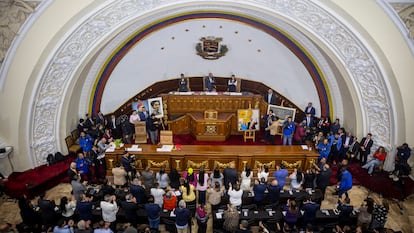

The reform of the criminal justice system in Venezuela, promoted by the government of interim President Delcy Rodríguez and Interior Minister Diosdado Cabello, is progressing amid profound doubts about its true scope and its lack of institutional transparency.
Almost six months after the U.S. military intervention on January 3 that ousted Nicolás Maduro, and with the country now reeling from highly destructive earthquakes earlier this week, the judicial restructuring process — which includes the expedited renewal of the Supreme Tribunal of Justice (TSJ), along with a controversial amnesty law — is facing resistance from the courts themselves, which are controlled by the ruling United Socialist Party of Venezuela (PSUV). The judicial branch has maintained its subservience to the executive branch, as well as its longstanding practice of persecuting political opponents, both of which have been denounced by the United Nations (UN).
“I’m about to make a run for it,” attorney Eglée González Lobato admitted a few days ago. Venezuela’s ombudswoman was speaking at a meeting of the Commission for the Judicial Revolution, chaired by Diosdado Cabello. The spontaneous yet telling phrase summarized the scale of the transformation of the criminal justice system promised by the government.
“The situation is so complex and delicate that it can only be resolved with coordination and open communication. We must serve everyone with independence and autonomy,” she added. Her words, however, reflect an uncomfortable reality: the reform is moving forward without clear rules, raising profound doubts about its true scope.
Following the U.S. military intervention, the authorities announced a drastic shift away from the repressive policies that, for years, left thousands of Venezuelans persecuted, imprisoned and exiled. Within this system, the courts have played a key role, as documented in various UN reports.
Almost six months after the removal of Maduro, the judicial reform seems to be progressing on two parallel and contradictory fronts: there are official announcements and public consultations, while the entrenched old practices continue within the courts.
The duality of amnesty
The amnesty law, considered to be the first step on the road toward a democratic transition, has quickly exposed this duality. The political scope of the law has clashed with judges, who refuse to sign release orders or who selectively apply restrictive measures.
“The amnesty law could have been a very important step, but it fell short. Not everyone has benefited; some people remain subject to legal proceedings. And here, we see the weaknesses [that arise from] the lack of autonomy: [if we had] judges who upheld due process, [even] a law that comes up short could be interpreted differently,” criminal lawyer Magaly Vásquez notes.
The passing of the amnesty law has been followed by the appointment of new leaders in the various branches of government. The new attorney general, Larry Devoe, was already operating within a system co-opted by the executive branch. For her part, Ombudsman González Lobato was nominated by the minority opposition bloc in the National Assembly, and some sectors see her appointment as a limited concession, within a process entirely controlled by the Chavista regime.
Meanwhile, the process to replace some Supreme Court justices has been riddled with irregularities. The nominations committee was established with its members not knowing how many positions they’re supposed to fill. Then, with the process already underway, the TSJ law was amended, in order to modify the composition of the chambers and increase the number of judges from 20 to 32. The appointment process has been postponed twice and remains suspended. “As a lawyer, one welcomes the possibility of reform… but only when the rules are clear and not changed on the fly. There’s no transparency. Even if you want to trust the process, there’s no reason to,” Vásquez laments.
The government has had to publicly acknowledge the flaws that the system has perpetuated for years. Minister Cabello claims to have purged 22,000 police officers involved in corruption cases. “We’ve seen the politicization of criminal justice, judges who accept bribes in exchange for releasing [prisoners]. I want to do justice for honest officials in Venezuela and I want to put an end to extortion and racketeering,” acting President Delcy Rodríguez acknowledged, during the opening of the Great National Consultation for Criminal Justice Reform, in Caracas, where she ordered the creation of a hotline for reporting extortion (“0800-Extortion”). These structural problems have systematically been denounced by human rights organizations for years.
In the daily hustle and bustle of the courthouse corridors, changes are noticeable. However, litigants attribute them to the political shift post-January 3, rather than to the judicial reform itself. For the first time in years, some lawyers have been able to be sworn in to defend political prisoners (who were previously assigned public defenders) and have managed to obtain copies of the case files. “The treatment is also different; before, the attitude was incredibly rude,” Omar Tosta recalls. He represents members of opposition leader María Corina Machado’s political team, such as Dignora Hernández, Henry Alviárez and Víctor Castillo.
However, Tosta has denounced the silent dismantling of the four anti-terrorism courts that previously operated in Caracas. In the case of the pro-Machado activists, the defense was informed that the case files had been transferred to ordinary courts in the western city of Barinas, more than 300 miles from the capital. And then, upon arriving in the Andean foothills, the defense team was told that the documents weren’t there.
“We don’t understand why they’re doing this… but this [legal] limbo is also a form of defenselessness,” Tosta maintains. The official argument is that these changes are being made to clear the dockets, but these anti-terrorism courts suffer from a fundamental flaw: they were not created by law, but by administrative resolutions. “They’re ad hoc tribunals; all their decisions are invalid. And the cases should be closed.”
This maneuver isn’t new. During the massive protests of 2014 and 2017, military courts were used to try civilians. In recent years, violations of due process have been institutionalized in the anti-terrorism courts. “Every country has laws against terrorism, but they don’t have terrorists. Here, it seems, we have too many, because any act is considered terrorism,” Joel García scoffs. He’s another criminal lawyer active in the defense of political prisoners. “It’s enough to be a dissident for [the government] to accuse you of a series of acts, without specifying individual participation (deeming someone to be an accomplice, co-perpetrator, or participant).” In these courts, early morning teleconference hearings without defense attorneys have become commonplace, as has the sight of judges wearing caps with the slogan: “To doubt is treason.” This motto was adopted by the Chavista regime after the presidential elections on July 28, 2024.
The “Afiuni Effect” and judicial subservience
Several academic circles recommended that Magaly Vásquez be appointed as attorney general, something that was ultimately not approved by the Chavista regime. For her, however, any real reform must begin with the stability of judges. Since 2003, competitive examinations to be eligible for judicial appointments have been abandoned, with most positions now being provisional. Added to this is the so-called “Afiuni effect.” Back in 2009, Judge María Lourdes Afiuni was imprisoned after she issued a ruling that contradicted former president Hugo Chávez’s orders. This set a precedent for a generation of magistrates, who have learned that their tenure depends on their submission to the executive branch.
The paradox of the current process became evident last week. While the government announced reforms, working groups and dialogue, Afiuni was summoned to court again. Despite having served her five-year sentence years ago for the nonexistent crime of “spiritual corruption,” she was notified that she must remain under house arrest, a regime that she has been subjected to since 2019. She has lost 16 years of her freedom for following the law. This is proof that, while the future of justice is debated in government offices, the old, corrupt system continues to operate in the corridors of the courts.
Sign up for our weekly newsletter to get more English-language news coverage from EL PAÍS USA Edition









































