Emaciated after 530 days in an Israeli jail without charges
The first image in over a year of the well-known Gazan doctor Hussam Abu Safiya, during a hearing at Israel’s Supreme Court, fuels concern about his condition
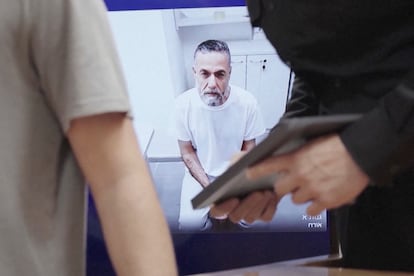

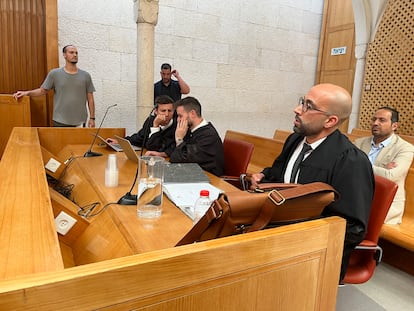
The hearing at Israel’s Supreme Court is closed to the public. It is clear to everyone that the imprisonment of Hussam Abu Safiya (held without charges and on the basis of secret accusations that even his lawyer does not know) has perhaps generated the most international mobilization, with calls for his release from the World Health Organization, the International Committee of the Red Cross, and Amnesty International. He is the pediatrician who ran Gaza’s Kamal Adwan Hospital and became a vocal critic of the Israeli invasion until troops arrested him in December 2024. He was seized inside the hospital, the only one still operating in the northern Gaza Strip.
This Wednesday in Jerusalem, the Supreme Court held a session to determine whether to extend his detention, under a law (on illegal combatants) that strips detainees of rights set out in the Geneva Conventions. Israel enacted it for Gaza two decades ago and has tightened it since Hamas’s attack in 2023. Last week, Abu Safiya, 52, was also unexpectedly placed in solitary confinement.
After an initial refusal, court staff allowed a tiny group of journalists, including one from EL PAÍS, to enter and take photographs until the judge arrived. Suddenly, Abu Safiya appears on screen: handcuffed, visibly emaciated and much thinner, like many Palestinian prisoners released from Israeli jails in recent years. Supreme Court officials quickly move to turn off the camera and try to obstruct the recording, but the video link briefly provides the first images of the doctor in an Israeli court since February 2025.
For his son, Ilias Abu Safiya, seeing him in that condition after months of waiting for any sign of his father was “extremely painful.” “I didn’t see just an image. I saw a human being whose body the occupation tried to break, but whose spirit it could not bend,” he says in voice messages from abroad, where he has settled after managing to leave Gaza.
Ilias, 28, admits to mixed feelings. On the one hand, “shock and deep sadness” at seeing “the marks of imprisonment” on his father’s face and body. On the other, “pride,” for recognizing in him the “same determination” he knows as his son and for how “he still preserves his dignity, despite all he has suffered.”
“The greatest pain is not just my father’s absence, or rather, the ignorance of his fate, which is a daily reality. Every morning we wake with the same question: How did he spend the night? Did he eat? Did he receive treatment? Will he be able to withstand the isolation? How much longer can he hold on?” he adds.
At the end of the hearing, his lawyer, Nasser Abu Odeh, said he could not disclose “many of the details” of the case because it falls under the law on illegal combatants. In fact, he had to leave the room for a few minutes during the hearing so the military prosecution could present the judge with the secret information on the basis of which it is seeking to extend his detention 530 days after his arrest, instead of bringing charges and trying him.
Abu Odeh linked the recent transfer to solitary confinement to the decision to appeal to the Supreme Court. The Prison Service said in a statement that it “determines the place of detention of prisoners and detainees according to professional, operational and security considerations.”
“We remain convinced this is a punitive measure,” the lawyer replied. “Unfortunately, the court agreed with the prosecution, based on confidential information the prosecution claims to possess and which, according to the Israeli military, is based on the argument that releasing him poses a threat to the security of the State of Israel.”
“Unjust arrest”
Abu Odeh also repeated the words Abu Safiya spoke during the hearing: “I am a pediatrician; I provide medical services and care to patients, the injured and the vulnerable. I did my work in accordance with international law and humanitarian norms. My arrest is unjust and I ask the court to release me immediately.”
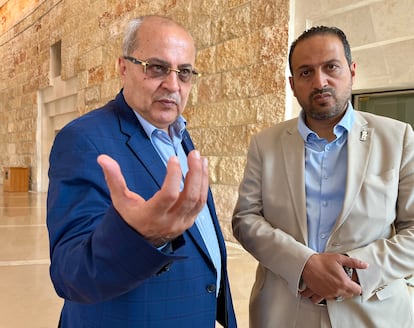
Also attending were the two members of the Israeli Parliament from the Arab nationalist Ta’al party: Ahmed Tibi and Samir bin Said, representatives of the Palestinian minority with Israeli citizenship, which makes up one-fifth of the country’s population. Both invoked their status as lawmakers to enter the closed hearing as a sign of solidarity. “The Israeli Supreme Court,” Tibi lamented, “has endorsed all the atrocities in the West Bank and Gaza,” but “sometimes there are, very few, exceptions,” and it can serve as “a platform to raise one’s voice.”
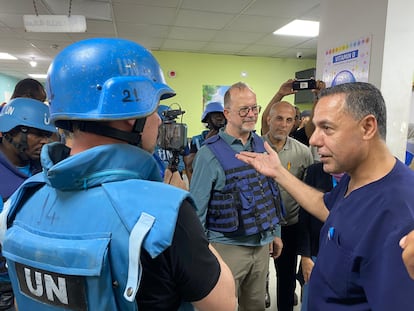
Abu Safiya became a prominent voice in Gaza in 2024 by continuing to run the hospital during an 85-day siege by the Israeli military. He spoke to the press and posted videos recorded on his phone in which he pleaded for help and documented the progressive devastation of the Strip’s health system. The video in which he tearfully said an Israeli drone had killed one of his sons went viral.
In January 2025, the Israeli military announced his arrest after having said it did not know his whereabouts. It described his hospital as a “Hamas stronghold” and labeled him a suspected “terrorist” and an “officeholder” in the Islamist movement. Subsequent accusations have portrayed him as a Hamas member, conflating that with his role in the Palestinian Military Medical Services, an organization that also operates in the West Bank and provides medical care to security forces and civilians under an agreement between the Ministries of Health and the Interior. Hamas has governed Gaza without elections since 2007.
Abuse
Israeli authorities did not allow Abu Safiya to receive legal assistance until February 2025. He had already lost 20 kilograms, according to his lawyer Gheed Kassem. When she visited him four months later at the Ofer military prison where he was then held, she estimated he had lost 40 kilograms and alleged he had been subjected to torture and beatings.
It is the result of prisons being turned into centers of systematic abuse and collective punishment, with dozens dead behind bars since 2023, according to numerous testimonies and complaints from NGOs and international bodies. It is sponsored by Itamar Ben-Gvir, the national security minister who pushed the law that effectively condemns Palestinians from Gaza and the West Bank to death if they kill Israelis in the context of the Middle East conflict.
Among the restrictions are reduced rations and limited access to adequate medical care and hygiene. Abu Safiya’s lawyer actually asked the Supreme Court to force the Prison Administration to treat his chronic illnesses and the eye condition he suffers from because he is not receiving medication. Another 13 Gaza-based doctors have been in Israeli custody since 2023, all of them held without charges.
One of the most surreal moments of Abu Safiya’s imprisonment occurred in February 2025. A team from Israel’s Channel 13 interviewed him inside the prison: standing, handcuffed, and surrounded by officers. In the hurried interview, Abu Safiya insisted he coordinated the transfer of patients and the entry of medicines during the Israeli siege, that his work is to provide medical services, and he condemned Hamas’s October 2023 attack on Israel, which left nearly 1,200 people dead and more than 250 as hostages. However, the edited version broadcast by the channel focused on implying he lied about the presence of Israeli hostages in the hospital. The basis: he asked for a question in English to be translated (“he stammers and stops understanding English,” notes the voice-over) which he then answered immediately when it was translated into Arabic.
Sign up for our weekly newsletter to get more English-language news coverage from EL PAÍS USA Edition