
Venice has had enough: Local elections will decide the city’s direction on tourism
The polls in the Italian city are framed as an existential dilemma over whether to change course in the face of overtourism and the unstoppable rise in sea levels
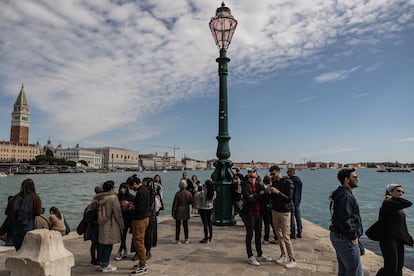

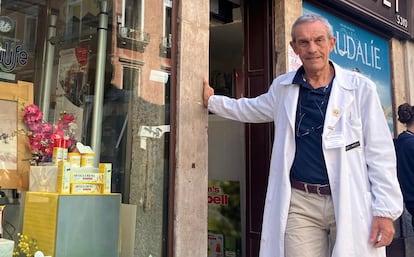
In Venice, two electronic counters track its decline. One is on the Morelli pharmacy, in Rialto, in the San Marco district, the most depopulated, and shows the number of residents: last Tuesday it read 47,461 (when it was installed in 2008, the number was 60,704, and in 1977, 100,000). The other is at the Marco Polo bookshop, on the other side of the bridge, in the Campo Santa Margherita, a more residential area. It shows the number of beds for tourists: on Tuesday, it read 52,541. There are already more tourists than people living in Venice.
Andrea Morelli, the third generation to run the pharmacy since 1906 —his daughter is the fourth — recalls that during the Covid-19 pandemic, people were only allowed to leave home to go to a pharmacy within a 300‑metre radius. “And no one came here. No one lived within 300 metres.” At night, during lockdown, every light was out.
The influx of visitors has surged out of control, especially since the pandemic: there were nine million in 2015 and 34.5 million in 2025. Barcelona, for example, which is ten times larger, received 26 million visitors last year.
Municipal elections are being held in Venice until Monday, 3:00 p.m. The vote is considered an existential dilemma, as if the moment to act had finally arrived. Signs of exhaustion are everywhere: Venetians on their way to work unable to board the vaporetto because it’s already full, or a sign in English at a bar that reads, “If you’re in a hurry, go to a fast‑food place.”
Many blame that lack of control on the man who has governed the city for 11 years, Luigi Brugnaro, the right‑wing mayor who embraced an aggressive, extractive tourism model. Polls indicate a possible victory for Andrea Martella, the centre‑left coalition candidate — a further sign of the weakening of Italian Prime Minister Giorgia Meloni’s right‑wing bloc.
Martella is proposing to limit access to the city. Not to close it, but to require reservations, as one would for a flight or a concert, and only then guarantee access to transport, museums, and services. If he wins, he plans to commission a study to set, within three months, a maximum number of visitors — some estimates already put it at 60,000. There is a widespread sense that things cannot continue as they are. Last week, Il Gazzettino, the city’s newspaper, published an article by Arrigo Cipriani, the owner of the legendary Harry’s Bar, under the headline: “Tourist rentals, the disease that is killing the soul of Venice.”
But the rethink goes much deeper: if tourists don’t sink one of the world’s most beautiful cities, the sea will. Since 2020, Venice has relied on the MOSE gate system (the initials stand for Experimental Electromechanical Module, but in Italian, it also evokes Moses, parting the waters). It now protects the city from acqua alta, but it will be insufficient in a few decades — and for now, it is not a political priority. The candidates also differ on whether they believe in climate change and think action is needed immediately, or deny it altogether.
“Venice’s survival is threatened both by the sea and by human behavior,” says the writer Antonio Scurati, author of M, who has raised the resident counter because he has just moved to live in Venice, where he grew up, with his family. He published an article in La Repubblica sounding the alarm, seeing in these elections a unique chance to change course, both short‑ and long‑term. Two worldviews are colliding.
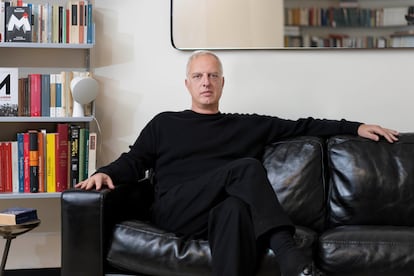
“When I was little, I walked across the city to school at nine years old. We played football in the square with the gondoliers, and the two buildings we used as goalposts are now hotels,” Scurati recalls.
School enrollment figures have just come out: there are 2,062 fewer registrations across all grades. In some preschools, there are eight children. The city’s average age is 58.
“No one is against tourism, but what is happening marks the end of this community’s way of life; those who live in Venice know it. The city should become a leader of an international movement to save Indigenous populations,” he says, half‑joking when he says the last phrase, but not entirely.
The writer’s school was the Diedo in Cannaregio, housed in a 13th-century palace that later moved to another building owned by nuns. But now they want to sell it and evict the school, even though the bishop has asked them to reconsider. Everything is for sale in Venice. The latest controversy was the sale of Palazzo Labia, the historic headquarters of Italian state broadcaster RAI, featuring frescoes by Giovanni Battista Tiepolo. And the ultimate symbol came last year, when half the city was rented out for Jeff Bezos’s wedding.
“The city has been disastrously managed in recent years, plundered by tourism and led by a mayor weighed down by a serious conflict of interest, with rampant speculation, and a vision of Venice as an object to be ransacked,” Scurati accuses.
Venice seems exhausted after the decade of Luigi Brugnaro, a right-wing mayor, businessman, and owner of the local basketball team. Investigated for illegal financing and corruption, he is a domineering figure: before leaving office, he wrote a 1,358‑page book listing his achievements, The Force of Facts.
“I leave a better city in every way, stronger and freer,” he said when presenting the volume on May 8. “They will do everything to stop Venice, but we must defeat the party of fear, rancor and inaction.” In his view, “the city is not depopulating; the balance is negative because people are dying.”
In 11 years, there has been no culture councillor in Venice— he kept the portfolio for himself. His response to overtourism was, two years ago, an entry ticket to the city (€10/$11.60, or €5/$5.80 if bought in advance), but it has deterred no one. Least of all the dreaded bachelor parties, another scourge, since the fee only applies until 4 p.m.
The past few months have been bleak: the scandal over the director imposed on La Fenice opera house and rejected by the orchestra, and the uproar over the Russian and Israeli pavilions at the Venice Biennale. But above all, a corruption case — the Palude affair — has sent one of Brugnaro’s aides to prison and still hangs over him. Prosecutors accuse him of trying to sell land he owned to a Singaporean magnate while promising to change its zoning, and of selling the local police headquarters at a discounted price.
In this end‑of‑cycle atmosphere, eight lists are competing, though the real contest is between Brugnaro’s chosen successor, his adviser Simone Venturini, 38, and Andrea Martella, 58, a veteran Democratic Party (PD) deputy and now senator. Sipping a coffee during a campaign break, Martella sums up the crucial issues at stake: depopulation, housing, tourism — all tightly linked — and security.
“We must confront tourism intelligently, manage tourist flows, and activate a reservation mechanism. We need to calculate a carrying capacity, a threshold of visits beyond which we cannot go if we want the city to remain a city,” he explains.
He wants to bring 2,500 empty public flats back into use and encourage renting to residents with tax breaks: “I am here to face head-on problems that, if we don’t solve them now, risk an unstoppable decline. Venice must recover its soul.”
Martella brings up security — something a tourist would hardly expect. But if you ask Venetians, it’s the first thing they mention. They insist the city is no longer as safe as it once was: there are more drugs, are women are more afraid to walk alone at night. Local news reports street fights with knives. Last Sunday, there was a gang brawl in Zattere involving machetes and even Japanese katanas. It’s part of the broader decline of a city that only a minority — the Venetians — still feel is theirs.
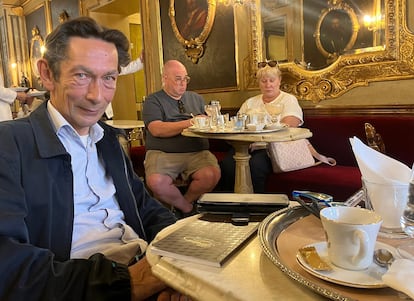
“We feel like Native Americans on reservations,” says Marco Gasparinetti, leader of Terra e Acqua, a citizens’ platform supporting Martella. The sense that this is a decisive moment is clear in the many independent candidacies running outside the party structures, driven by fed‑up residents. “One of the most unbelievable things that ever happened to me was a tourist asking: ‘What time does Venice close?’ As if it were a museum or a theme park,” he says in a crowded room of the historic Caffè Florian in San Marco, full of tourists, where he is the only Venetian.
Gasparinetti is one of those interesting Venetian characters: a jurist and musician who worked at the European Commission, then in Rome, returned to Venice in 2002, and became known for civic activism and exposing corruption. The response was a barrage of lawsuits that forced him to spend a fortune on lawyers — and that he won every time. It earned him credibility: under the city’s open‑list system, in which voters choose not only a political group but also the individual candidates who fill the seats, he was the most‑voted councillor out of 36 in the last elections. In 2020, he would have won the vote on the island of Venice, but another important factor comes into play: the municipality also includes Mestre and Marghera on the mainland, home to 180,000 people. “We’re a minority in our own home,” he laments.
It’s the rivalry between the two cities — the one on water and the one on land. A common complaint is that no one in the outgoing administration lived in Venice proper, on the water. Like them, there are 50,000 pendolari who come to the island only to work, merging into the mass of visitors. Historically, the water has voted left and the land right.
“But the housing crisis is now so severe that it’s hard to find a flat even in Mestre. I think, for the first time, the desire for change is shared on both sides of the bridge. We can’t go on like this,” says Gasparinetti.
He is pleased that many of his ideas, once seen as “visionary,” are in Martella’s program: banning any new tourist apartments, a guarantee fund to cover unpaid rent, scrapping property tax for landlords who rent to residents, higher salaries for public employees assigned to the city.
“In Venice, we invented tourism, we were the first to suffer its excess, and now we must send a signal to the world,” he says.
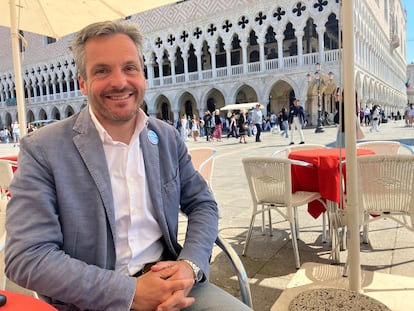
Another resident who has decided to enter politics — convinced it’s now or never — is Claudio Vernier, owner of the historic Al Todaro café facing the Doge’s Palace, run by his family since 1906.
“We can no longer trust the parties that have failed over the last 30 years. I have two daughters, five nephews, my family has always lived here; I want young people to have the same opportunities we had,” he explains. He deplores the “extractive, speculative economy,” without rules, that creates no value, has no interest in caring for the city and leaves it without workers. “A city without the people who inhabit it becomes Pompeii,” he warns. He, too, supports a system to limit entry to the city.
Vernier notes that the number of bars has jumped 130% in a decade — an economy entirely dependent on tourism — while young people leave because there is no quality work, and the transmission of Venice’s traditional crafts, “a priceless intangible heritage,” has been lost. He employs several Bangladeshi waiters, part of a large and growing community: “There’s a problem because they’ve never really been integrated — they’ve been turned into a ghetto — and Venice was the world’s first multiethnic, multicultural city.”
There are now 30,000 Bangladeshis living on the mainland, and for the first time six appear on the center‑left electoral list. Coexistence is another political issue: the community, for instance, is calling for a mosque. And one of the bus posters for Liga, Matteo Salvini’s far‑right party, reads: “No to the mosque — vote Lega.”
Yet all these debates pale beside the fundamental question: will Venice still exist in a hundred years? That is the question — ill‑suited to electoral timelines — posed by Andrea Rinaldo, a renowned engineer and hydrologist who received the 2023 Stockholm Water Prize, the so‑called Nobel of water.
“All indicators tell us that by the end of the century, the sea level in Venice will rise by one metre. The MOSE system would have to be closed around 262 times. That means disaster: the lagoon ecosystem gone, port activity gone, Venice gone,” he says.
He warns that activating MOSE more than 50 times a year will already be a problem. This year it has been used 30 times. He also believes the elections are a crucial moment: “The science is unequivocal, and of the two main candidates, only Martella understands the scale of what’s at stake. The other says we’ll worry about it in 80 years.”
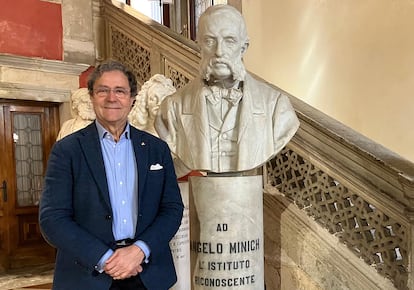
Rinaldo is president of the Venetian Institute of Sciences, Letters and Arts (IVSLA), founded by Napoleon, long dedicated to the city’s innovation. In his office, he shows a 19th‑century engraving of a train suspended from balloons. He now wants to launch a major international competition for scientific ideas on how to save Venice.
“It took 60 years to install MOSE — and that was easier than what lies ahead. When I worked on the plan, people wouldn’t greet me in the street; there was huge opposition, it was seen as imposed. Now I want to present all proposals and let people decide — and we must do it now, we can’t afford to lose more time,” he explains. Martella supports the idea.
Rinaldo notes there are obvious, severe solutions that do not interest him: one could close the lagoon, drain it, and build a giant parking lot. “That wouldn’t be a problem — the Amsterdam airport is eight metres below sea level — but that wouldn’t be saving Venice; we must use imagination,” he says. One idea under study is inverse subsidence: raising geological layers by injecting water.
In any case, sea‑level rise is only one of Venice’s problems. “Come with me,” he says, to explain another. He goes downstairs and, at the foot of the staircase, points to a white patch flaking off the red paint. “This is salt; it appeared a few months ago. This palace is 500 years old, and this is the first time. It rises from the water by capillarity,” he explains. “Venice will not sink suddenly with a bang, as people imagine, like Atlantis. It will rot slowly, falling apart bit by bit. In 20 years, it will be evident; refusing to see it is suicidal.”
On Monday, Venetians will decide their next step.
Sign up for our weekly newsletter to get more English-language news coverage from EL PAÍS USA Edition









































