
Following attacks, Japan approves the hunting of 10,000 bears this year
As the crisis arrives to the outskirts of Tokyo, official policy aims to ease strict restrictions on firearm use, and promote hunter training
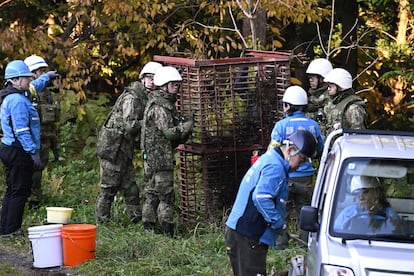

Japan is in a state of emergency due to a wave of bear attacks against humans, which in 2025 produced a record 230 incidents around the country, 13 of them fatal. The country recently presented a five-year plan that proposes hunting more than 10,000 of the animals this year. The so-called “Roadmap for Managing Damage Caused by Bears” is being spearheaded by the Ministry of the Environment, with the participation of the Ministry of Agriculture and the National Police Agency.
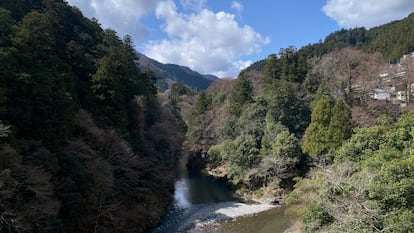
Exodus from rural areas and a reduction in the sources of their food in forests, caused by plagues and climate change, is leading bears increasingly closer to inhabited areas, including recreational zones in the country’s capital. Last summer on the outskirts of Tokyo, a man suffered minor injuries to his neck after being attacked from behind by an Asian black bear cub while fishing in Okutama, a picturesque valley through which the Tama river passes. Another 13 people who have encountered bears in other parts of the country have not been so lucky, and have died from the attacks.
Visitors arriving at the train station of Okutama, a popular destination for hiking and fishing aficionados, are received by a large sign warning of the presence of bears, which recommends they take with them “something that makes noise.” “The best recommendation would be a bell,” Hirohide Neshino, member of the Mountain Rescue Team comprised of four police officers, explains to EL PAÍS, as he rings a loud metal bell.

Neshino says that none of the members of his team, who are attired in red polar fleeces that carry the squadron’s name in yellow Japanese characters on the back, are animal experts. Their headquarters is situated between the train station and the mountain trailhead. Their job includes both preventive efforts and rescue missions, carried out in collaboration with firefighters and other local institutions.
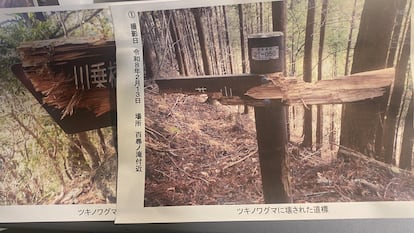
In one of the squadron’s meeting rooms, there are photographs of claw marks on trail markers that have been destroyed by Asian black bears, whose average height when standing on four feet ranges from 27.5 to 35.5 inches. Neshino emphasizes how paradoxically, due to strict regulations in Japan, his team is not authorized to use firearms to defend themselves against the animals. “I have only had the opportunity to use a repellant spray against a small bear, who immediately escaped,” he says.
The Okutama bear attack attracted attention because it took place in a mountain town of less than 5,000 inhabitants, but that is situated within Tokyo city limits. In 2025, the bulk of the attacks, and the better part of the thousands of unprecedented sightings of Asian black bears that have been reported by the media or documented by specialists, took place in the six prefectures that make up Tohoku, the northern region that has been profoundly affected by the 2011 earthquake, tsunami and nuclear accident.
Concerns related to the bear crisis motivated Kenta Suzuki, the governor of Tohoku prefecture Akita, to convene the foreign press in Tokyo last December to explain the serious damage that the 66 attacks, which have led to four deaths, were doing to the local economy and tourism. Suzuki spoke of a new generation of bears who have lost their fear of humans, and invaded inhabited areas and school zones in search of beechnuts, whose trees have also been affected by changes in the area’s climate patterns.
In Akita, the government deployed more than 900 members of Japan’s army, the Self-Defense Force — but only to provide logistical support. The killing of the animals was assigned to licensed civilian hunters.
As Suzuki underlined, though bear-caused deaths have been far fewer than those associated with car accidents, “the psychological impact on urban security has been significantly higher.”
The official plan announced this year includes legal reforms to strict firearm legislation to allow shooting in areas outside of hunting zones, and the training of hunters, whose numbers have been declining at the same rapid pace as the overall rural population’s decline. In Tohoku alone, the goal is to hunt and kill 3,800 bears this current fiscal year, which began on April 1. In Hokkaido, the northernmost Japanese island where the larger-but-less-aggressive brown bear is predominant, the provisional annual goal is to hunt 1,254 animals. Adding those figures to 600 bears in the Kanto region (where Tokyo is located), 3,500 in Chubu and 900 in Kinki, the total rises to 10,054.
Japan’s Ministry of the Environment is also carrying out a plan to control deer and wild boars. Between 2011 and 2022, hunting groups coordinated by prefectures slaughtered an average of almost one million of the animals each year.
“Japanese hunters, the majority of them over the age of 60, have a lot on their hands hunting wild boars and deers,” says Maki Yamamoto, a specialist who for nearly two decades was a wildlife management professor at the Nagaoka University of Technology in Niigata, another prefecture that has been affected by the bear crisis.
“The base problem is not the bears, but rather, the abandonment of the countryside. There are only seniors left there, and without people to manage the forest, the animals roam freely,” the researcher says on a video call.
Yamamoto, who is currently the head of Wilco, a specialist forest wildlife damage control business, underlines the deterioration of the satoyama, intermediate forest areas between towns and the mountain that have been systematically used in Japan since the Edo period (1603-1868). The term, which is a combination of the Japanese words sato (town) and yama (mountain), serves to provide firewood, charcoal and foods that can be harvested from the forest.
In Niigata, a fungal infection that impacted the Japanese oak, whose acorns serve as food for the Asian black bear, forced the animals to venture from the satoyama to find farms growing persimmons, walnuts or chestnuts. Yamamoto adds that the bears have a great ability to remember where they have eaten and, even after a year, are able to return to exact spots.
This return, in the company of newborn cubs, has given rise to the expert calls “urban bears,” young animals that are accustomed to eat in human-adjacent areas, and who do not return to their original habitat.
In Okutama, members of the rescue team bring this journalist to the mountain’s foothills, where a laminated paper sign with a drawing of a bear warns that, on the morning of November 29, a bear was sighted near a neighborhood school, headed down to the Tama river. “Be careful please,” says the poster attached to a wooden post, whose Tokyo logo serves as a reminder that we are within the capital’s city limits.
Sign up for our weekly newsletter to get more English-language news coverage from EL PAÍS USA Edition









































