
Patagonia’s puma population soars thanks to unexpected prey: Penguins
The cats’ new nutritional source in southern Argentina has led to increased concentration of the predators, who have also become more social
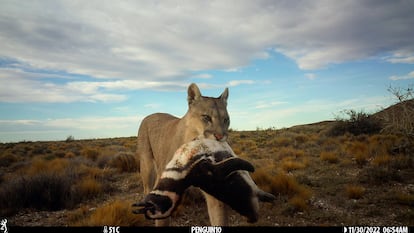

During the 20th century, pumas, like foxes and large herbivores, were rendered extinct in the Argentinian Patagonia to make way for sheep farming after the region was settled by Europeans. Their absence allowed colonies of Magellanic penguins, who had previously been confined to islands off the Atlantic coast, to spread across the continent. Today, things have changed, and pumas have returned after an attempt to restore the fauna of the past. The big cats have encountered a transformed ecosystem, whose large numbers of penguins is altering their behavior, leading to unprecedented local population density for the species.
An international team of scientists has documented this finding in Monte León National Park, in southern Argentina’s Santa Cruz province. According to ecologist Mitchell Serota from the University of California, Berkeley, who led the study, it makes the effects of conservation in transformed ecosystems clear. “The fauna is recolonizing ecosystems that have changed radically since these species disappeared,” says Serota.
Magellanic penguins form enormous colonies and spend more than half the year on land. They are abundant, easily spotted, and have no way of defending themselves against a large feline. In contrast to other prey, these birds have not adapted to predators on land. “This is the combination of two key factors for the pumas: there are so many penguins, and they are easy to catch,” sums up Serota.
The study — which was carried out using GPS collars, hidden cameras and advanced population models — shows that when penguins are present, pumas reduce their wandering and concentrate their activity around the colony. They stay longer in one place, and return over and over to the coastal region. “If you’ve ever visited a penguin colony, you’ll immediately understand. It’s a small strip of beach where they are all concentrated,” says the ecologist.
Less solitary pumas
Pumas are famous for being territorial lone hunters. Still, their level of social interaction that has been observed by the Argentinian, German and U.S. scientists has been surprisingly high. “It’s the highest density of pumas ever documented,” says Serota, more than double the maximum seen in other areas in South America.
Adult females, who normally avoid their peers, are tolerating the sharing of space. It was previously thought that interactions between pumas were typically limited to reproductive behavior. However, the study suggests that the possibility of genetic kinship between the animals cannot be ruled out, a fact that could promote greater social tolerance.
The penguins play a key role in the population density of the pumas, but their presence cannot explain the phenomenon entirely. “We think they are an important factor, but one must keep in mind that the penguins are a seasonal resource. They are present for little more than half the year,” clarifies Serota. When the birds migrate to the sea, the pumas, the region’s only large carnivore, must turn to other prey, like the guanacos, a forest animal in Patagonia that resembles a llama. “There is a large population of guanacos. That helps the pumas when the penguins are gone,” says the expert, adding that the combination of resources is what allows for the maintenance of such elevated densities of the predators.
Regular hunting of marine birds by large land carnivores is not common, but certain precedents do exist. The researcher compares the phenomenon with the relationship between bear and salmon. “Bears congregate in rivers during salmon migrations, and something very similar is taking place here with the pumas and penguins: they create a hot spot that reorganizes behavior throughout the region.” There has also been documentation of Tasmanian devils hunting penguins, as well as other recent studies on lions and jaguars that eat marine food resources.
The founding of Monte León National Park dates back to 2004, but the study was carried out from 2019 to 2023. “Many people have asked us if this represents a threat to the penguins,” says the researcher. He clarifies that data indicates that the penguin population in the region seems to be stable, and has even grown since the park’s creation.
Predators are often the focal point of restoration projects due to their capacity to regulate other species, but changes in the landscape, climate and the availability of prey affect how, when and where they get their food. “Restoring fauna does not mean bringing ecosystems back to the past. It can generate completely new interactions that modify behavior and population in unexpected ways,” says Serota.
The researcher says that now that they know how this new prey has changed the pumas’ behavior, what follows is understanding how these changes will translate into other aspects. “The next step is finding out what these changes mean for the rest of the ecosystem,” says Serota. Particularly for the guanacos, the primary large herbivore in Patagonia. “The puma-guanaco relationship is central to the region, and any change in the way in which pumas move and hunt can have chain effects,” he says.
Sign up for our weekly newsletter to get more English-language news coverage from EL PAÍS USA Edition









































